
Choosing SWOT or PESTEL for market entry misses the point. Both frameworks sort observations. Neither tests whether the entry case depends on an assumption that has not been verified. A completed grid with an untested belief underneath it is theatre, not analysis.
I sat in on a market-entry presentation where both frameworks had been completed to a standard any board would accept. The SWOT showed a strong brand and a capable supply chain. The PESTEL showed a growing economy with clear regulation. Anyone asked to judge a SWOT or PESTEL for market entry would have given this team full marks. The room voted to proceed. Nobody had tested whether the operating platform underneath could function in the new market at the speed the plan required.
That is not a rare event. I have watched the same sequence in retail, financial services, and heavy industry: a team fills the frameworks, the paper looks complete, the committee approves, and the entry fails because the few assumptions the case depended on were never examined. The grid supplies something: a paper the consultancy can bill for and the board can file before the next quarterly review.
SWOT or PESTEL for market entry is a choice between a tool that sorts an organisation's position and one that scans the external market; neither determines whether entry should proceed.
SWOT or PESTEL for market entry starts with the decision
Start with PESTEL when the uncertainty is outside the company. A new country may have a regulatory constraint or a customer habit that the existing business does not understand. PESTEL gives the analyst a prompt to look outward before the organisation begins congratulating itself on its brand or supply chain (which, in a new market, may be worth nothing).
Use SWOT after that when the question becomes more specific: can this organisation compete in the market that has just been described? Its useful contribution is to make the claim explicit. A strong distribution network is not a strength in the abstract. It is a claim that the network can reach the chosen customers at a viable cost under the local conditions found through the PESTEL work.
I would not begin by asking which template the director prefers. I would write the decision in one sentence: should we enter this market through this route by this date? Asked that way, not entering stays a possible answer. That stops a PESTEL scan becoming a general briefing on a country and stops SWOT becoming a wall of agreeable observations. The fuller SWOT analysis guide deals with the same weakness inside the four-box exercise: a category is not evidence, and an observation is not a commitment. The paper the analyst produces should name what the entry relies on and what would change the recommendation.
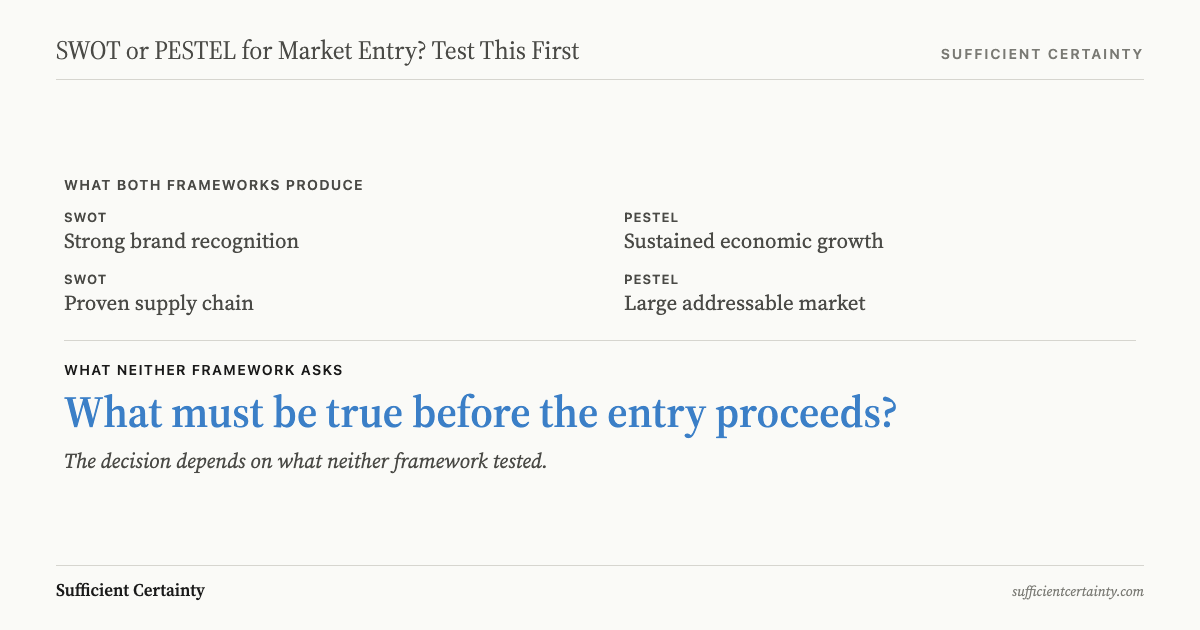
SWOT or PESTEL for market entry cannot test an operating claim
Neither framework can test the operating assumptions that sit underneath a market-entry recommendation. Target Canada is a severe example because the public signals were encouraging. Canadian consumers recognised the brand. The stores opened quickly. Yet only 30 per cent of the product data in the SAP system was accurate, against 98 per cent in Target's American operation. Product dimensions were recorded in the wrong units or order; vendor codes and weights were missing. The shelves were empty because the data that told the system what to send was wrong. CBC's account of the closure records the scale of the exit.
Neither tool asks: can we migrate the supply-chain data accurately enough to open 133 stores? That question was load-bearing. It needed an answer from someone who would carry the cost of being wrong, not a grid entry under Weakness. That is the kind of question a framework never produces.
In my experience, an item entered as a strength often receives more confidence than it has earned. Once it is in the box, it looks real. The same pattern has been reported by practitioners who use SWOT regularly: factors are often not verified with data (if they were, they would be called evidence, not factors) and are not limited once generated. King, Freyn and Morrison's 2023 study is useful precisely because it reports the ordinary failure, not an exceptional one.
The useful question is therefore not whether a claim belongs under Strength or Opportunity. It is what would have to be true for the claim to support this entry and what evidence could show that it is false. That is the work most teams skip the moment the grid is filled.
Name the one assumption your entry case depends on and find out whether the evidence supports it before the room commits. Start the Walk →
Culture is an assumption, not a PESTEL heading
Home Depot's China exit shows why a well-described market can still be misunderstood. The company bought twelve stores in 2006 for about $100 million and closed the remaining business in 2012. Its exit produced a $160 million after-tax charge. The company had capital and a supply chain built for home improvement. China had genuine economic growth. Those facts did not create a market for American-style DIY retail.
Labour was inexpensive and home improvement was commonly bought as a service. The critical assumption was that Chinese consumers would want to do the work themselves. They did not. CNBC's examination of the exit describes the gap between the offer and the local behaviour. A PESTEL heading called Social would not have made the assumption visible. It might have made the slide deck look as though culture had been considered.
Tesco's Fresh & Easy venture assumed that American shoppers would make frequent small trips rather than weekly bulk shops; that error cost about GBP2 billion. The situation analysis case covers the full story.
Anyone choosing SWOT or PESTEL for market entry in either country would have produced a credible paper. The missing discipline was a direct test of the proposition on which the offer rested. I have sat in presentations where a team described a customer as an opportunity when nobody in the room had established that the customer wanted the thing being offered. That is the gap between describing a customer and proving you have one.
Build the entry case around the assumptions that matter
A market-entry case should make the recommendation conditional before it makes it persuasive. When I work with an entry team, I make them write the decision in one sentence before anyone opens a template. PESTEL is useful after that because it produces external claims worth examining. SWOT is useful once a route exists because it puts the organisation's claimed capacity alongside those conditions. Neither contributes the decision; the decision depends on what has not yet been tested.
Next, I turn the important claims into sentences that can be wrong. "The distributor can cover the region" becomes "the distributor can reach the target accounts within the first year at the service level our offer requires." "The market accepts premium pricing" becomes a claim about the customer and the price actually proposed. This is where the Universal Decision-Making Method becomes practical rather than decorative. Its third stage is to Recognise assumptions, then judge which ones have enough influence to change the decision and too little confidence to carry it.
I do not ask for every uncertainty to be removed. I have sat through enough postponement dressed as diligence to recognise the pattern. I ask which assumption would make the proposed entry untenable if it were wrong. Target's data migration and Tesco's shopping frequency each belonged in that small group. The right response is a test with a defined result (which is to say, not another opportunity for the room to agree with itself). It may be a limited operating trial or observed buying behaviour under the intended price.
The paper that goes to the board then needs a threshold. State what result makes the company proceed and what result stops it. This is what Roger Estall and I set out in Deciding: sufficient certainty is enough confidence in the assumptions that actually support the decision, while uncertainty remains elsewhere. The work of turning a SWOT into a decision starts at that point, not when the final quadrant is filled.
Finally, record the assumptions that remain open after entry. A distributor can fail to perform or customer behaviour can fail to repeat beyond the trial. I have come back to entry decisions eighteen months later and found that nobody was watching the assumptions the original case depended on. Design monitoring around those claims and nominate the person who will bring a change back to the Deciders. The original facts will decay; the recommendation may have been sound on the day it was made and no longer be sound six months later.
The strategy analyst who has been asked to produce a SWOT or PESTEL for market entry does not need to argue with the assignment. Produce the useful parts of both. Then make the recommendation carry the claims those tools leave untested. That is the work the board is actually paying for.
You could commit to the entry before testing the assumption it depends on.
Work through your decisionNo sign-up. Just pick your decision and start.
Grant Purdy is the co-author, with Roger Estall, of Deciding (2020), and the architect of the Universal Decision-Making Method.