
SWOT strategic planning produces a whiteboard photograph and a wish list. The five steps after the grid are what turn it into a commitment the board will fund: surface what each entry assumes, test the claims that carry weight, and assign someone to watch whether they hold.
I arrived at a planning day two years ago to find the SWOT grid already on the wall. Someone had lifted it out of the previous year's board pack and blown it up to A0, which is common enough in SWOT strategic planning, and the only thing that had changed was the date in the corner. Nine of the entries in the strengths box were word for word what the organisation had claimed about itself twelve months earlier, including one about a distribution agreement that had lapsed in March.
The room spent the morning adding to it. That is the ordinary shape of the exercise: the boxes fill, the photograph goes into the pack, and the plan gets written afterwards by two people using judgement they cannot show you.
The grid itself is not the villain here. What matters is who the day and a half is for, because it is not obviously for the organisation.
The consultancies who run these sessions bill for the room, the catering and the write-up, and none of that revenue survives a client who says the position is already understood and the argument should be about what to stop doing. The planning-software vendors give away the four-box template because a template that is easy to fill gets filled, and a filled template is a screenshot in next quarter's sales deck.
Most reliably of all, an executive who settled the matter in January now has a wall of contributions from eleven colleagues, photographed and dated, which makes a decision that was already made look like something the organisation arrived at together. A completed grid is excellent political cover, and I have watched it used for nothing else.
SWOT strategic planning is the use of a strengths, weaknesses, opportunities and threats grid as an input to an organisation's strategy cycle, usually at a planning offsite.
What SWOT Strategic Planning Actually Delivers
A completed grid delivers a shared description, and that has value. Eleven people who each held a private version of the organisation's position now hold roughly the same one, written down, in a form everyone can point at.
What you have not gained is a strategy. Michael Porter drew this line in "What Is Strategy?" in 1996, separating operational effectiveness from strategic positioning. Doing your existing activities better, and cataloguing how well you do them, sits on one side of that line. Choosing a different set of activities from your competitors sits on the other. A SWOT workshop is almost entirely an exercise on the first side. It inventories capability and it inventories worry, and neither of those is a position.
The organisations that do get value from the grid have buried it inside something larger. Robert Dyson's account of strategic development at the University of Warwick is the clearest published example I know. Warwick did not run a SWOT and then write a plan. It ran SWOT as one component inside a resource-based planning cycle, iteratively, with the outputs feeding decisions about where money and staff actually went.
The grid earned its place by being subordinate to a process that forced allocation, which is why I would rather you treat how to do a SWOT analysis as a question about hypothesis collection than as a question about workshop format. Left on its own the exercise produces the photograph.
Run your current SWOT through five steps and cut the wish list down to the commitments the board can actually fund. Start the Walk →
Strategy Subtracts, and a Grid Only Adds
Every mechanism in SWOT strategic planning pushes toward addition. Someone raises a strength, it goes up. Someone raises a threat, it goes up. Nobody running the session says "that is a weak observation, take it down", because the social cost of removing another person's contribution is higher than the cost of leaving it there. Forty entries is what an addition-only process produces when you give it a day, and I have seen grids run well past that.
Strategy runs the other way. Executives retreat into planning rituals because real strategy is uncomfortable: it means choosing under uncertainty and closing off paths you would rather keep open, and a ritual asks neither of you. Roger Martin put the same point in "The Big Lie of Strategic Planning", and the gap between the ritual and the choice is the whole of strategic thinking versus strategic planning. A plan that keeps every option alive is a budget with adjectives.
Adobe is the cleanest example I can point to of the discomfort being accepted rather than avoided. Moving off perpetual licences to a subscription model meant deliberately breaking the revenue line the company had been reporting for two decades, in public, with analysts watching and nothing to show for two years but falling numbers. It came right: by fiscal 2015 subscription revenue was past three billion dollars and net income had more than doubled on the prior year, as the annual report records.
A grid at the start of that journey would have carried "subscription growth" as an opportunity in the top right box, in the same handwriting and the same size as everything else, and the entry would have told nobody whether two bad years were an acceptable price. That judgement is what strategy is, and no box contains it.
There is a question you can put to a planning room that settles in a few seconds whether you have a strategy or an inventory. Ask what the plan gives up. Ask which customer you are content to serve worse, and which capability you will let decay because it is no longer the one that matters.
A room holding a real strategy answers immediately, because the giving-up is the thing they argued about. A room holding a filled grid goes quiet, then someone says the plan is about focus, and the meeting moves on.
Notice that the grid cannot even hold the answer. There is no box for "things we are deliberately choosing to be bad at". The four categories will take a weakness you regret and a threat you fear, but they have nowhere to put a weakness you have selected on purpose, which in a good strategy is the most important entry on the page.
Every Box Is Written in the Register of Fact
The dangerous property of a SWOT grid is grammatical. "Strong brand loyalty" is written as a statement of fact. So is "customers value our pricing model". Neither carries evidence, a date, or a confidence level, and once the phrase is on the wall in the same marker as everything else it reads as settled. A marketing situation analysis using the 5C makes the same grammatical error across five categories instead of four. The plan then inherits the confidence without inheriting any of the testing that would justify it.
Wesfarmers is what happens when that inheritance goes into a real commitment. The company bought Homebase in 2016 for £340 million and set about converting it to the Bunnings format that works very well in Australia. In went the warehouse racking and the trade pricing, out went the kitchen showrooms and the soft-furnishing concessions. The commitment was genuine and it was executed at speed, which boards usually praise.
The belief underneath it, that the British customer who had been shopping at Homebase wanted what the Australian customer wanted, was never tested at anything like the scale of the bet. Two years later the business went to a restructuring firm for one pound, and the 2018 annual report carried more than A$1.3 billion in write-downs and disposal losses. Commitment stacked on an untested belief destroys value faster than any harmless workshop ever could.
The failure sits in the gap between describing a position and betting on one. Roger Estall and I set out the test that belongs in that gap in Deciding: for every claim the plan rests on, state how much influence it has on the outcome and how confident you are that it holds.
In most sessions I have sat in, three or four entries out of forty carry real weight and rest on nothing much, and that set is never the one the room wanted to discuss. The rest of the grid can be left alone, which is the part nobody believes until they try it. If you want the mechanics of that conversation, they sit in assumptions in decision-making.
There is a second problem with the register of fact, which is that facts expire. SWOT strategic planning carries no date stamp, so an entry copied forward from last year's pack arrives looking exactly as solid as one somebody checked last week. When a plan fails on a point everyone thought was settled, the post-mortem writes it up as a surprise when it was an expiry, and the same untested-entry problem runs through every use of the tool, which the guide to SWOT analysis works through in full.
Five Steps That Turn SWOT Strategic Planning Into a Plan
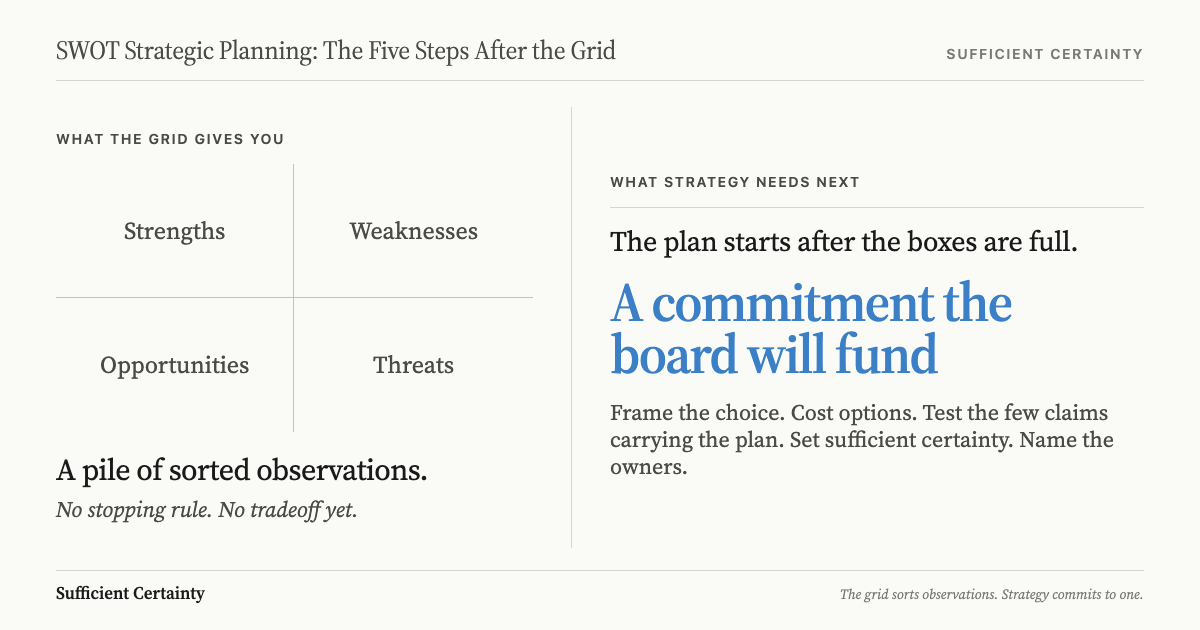
Frame the decision before anyone picks up a marker. Not "our strategy for the next three years" but the specific choice the board will be asked to fund, because a grid with an address behaves differently from a grid with none. Then develop options as real alternatives, costed, including the option of doing nothing, since an opportunity in a box is not an alternative until somebody has put a number against it.
Then recognise the assumptions each option rests on, which is where the register-of-fact problem gets dismantled: rewrite each entry as a claim and attach the evidence, or admit there is none.
Then set the point of sufficient certainty, the threshold at which you know enough to commit. That threshold is the thing the four boxes cannot supply and the thing every planning cycle silently needs, because without it a room either keeps gathering or treats a full whiteboard as permission to proceed. The Universal Decision-Making Method sets the sequence out plainly.
The fifth step is the one planning cycles drop, and it is design monitoring. Attach it at the moment of decision rather than at the next offsite.
What makes this work in a planning cycle specifically is where the assumption register lives: it goes in the board pack behind the plan, with a name against each critical claim, and it gets read at the quarterly review alongside the financials.
A register that lives in the strategy team's shared drive is not monitoring, it is filing. That is also the honest answer to the organisation with the recycled grid on the wall. Its board did not need a better grid. It needed to know which four beliefs the plan was resting on and who was watching them.
SWOT is a decent way to get eleven people to agree on what they think they know, which is worth an hour of a planning cycle. Give it the whole cycle and you will keep approving plans that were written somewhere else.
You could photograph the finished grid and still walk into budget season with nothing decided.
Work through your decisionNo sign-up. Just pick your decision and start.
Grant Purdy is the co-author, with Roger Estall, of Deciding (2020), and the architect of the Universal Decision-Making Method.