
After a credit risk assessment, compare the proposed credit limit and payment terms with the dated evidence of repayment before approving them. Around US$10 billion was invested in four Credit Suisse funds when they closed in March 2021, according to FINMA's 2023 findings. Their low-risk description did not prevent the underlying claims from changing. Record which change will stop further credit while someone reviews the evidence.
A credit risk assessment examines whether a customer or borrower can meet payment obligations under proposed credit terms.
The credit limit needs an expiry condition
A completed assessment gives the finance manager evidence for deciding how much a customer may owe, and for how long. The next operational step is to set the limit, enter the terms and release the order. Before that release, put the assessment date beside the proposed payment date. Check whether the evidence covers the period in between.
Start with the customer named in the contract. Match that legal entity to the financial statements, payment history and any guarantee. A parent company's accounts do not, by themselves, show that the purchasing subsidiary can pay. If approval depends on support from another company, identify the document that provides it and have the appropriate adviser confirm its effect.
Then calculate the exposure the proposed terms permit. Include unpaid invoices and orders that could be delivered before the next payment arrives. Ask whether several trading accounts belong to the same customer group. The credit limit should constrain the amount actually outstanding, rather than each invoice considered separately.
The International Trade Administration's trade finance guide describes open-account sales as shipments made before payment falls due. Such terms can help win business, while exposing the seller to nonpayment. A completed assessment helps choose terms that serve the sale without making the exposure larger than the repayment evidence supports.
Approve a defined amount for a defined period under stated conditions. Record the evidence date, the permitted exposure and the next review date together. This connects the assessment to the transaction being authorized. The wider risk assessment question is what decision the analysis supports. Here, that decision concerns another party's obligation to pay. Where insurance supports that exposure decision, the follow-up to an underwriting assessment checks whether the quoted coverage matches the assessed business.
Do not confuse it with the supplier's own funding decision. The article on cash-flow analysis examines whether the business can meet its payments. Customer credit approval concerns whether this customer can meet these terms, including when further deliveries might increase the unpaid balance.
What does the repayment evidence actually cover?
The assessment can bring together facts that would otherwise remain separate. Payment history shows how previous invoices were settled. Recent financial information helps assess the resources available for repayment. References and credit reports can identify matters that need explanation. None should be treated as interchangeable evidence.
Ask the assessor to identify the expected source of payment. If repayment depends on the customer collecting money from its own buyer, find out when that collection should occur. If it depends on refinancing, distinguish a signed facility from a planned application. The point is to understand which event makes the proposed due date credible.
The Basel Committee's 2025 credit risk principles separate credit granting from continuing administration and monitoring. Their banking context differs from customer trade credit. The useful distinction is that an initial approval and the evidence needed to continue exposure are separate responsibilities.
A satisfactory assessment can justify an initial limit without justifying every later increase. A customer seeking a larger order, longer terms or a different purchasing entity has changed the decision. Check what changed before treating the old approval as permission for the new exposure.
Use the distinction in the article on what follows risk analysis: connect an analytical conclusion to the commitment it supports. An acceptable rating is useful evidence. It still needs a limit, terms and a person responsible for detecting when the original basis has changed.
Which change in repayment evidence would stop the next delivery on credit? Start the Walk →
Credit Suisse lacked control over the claims
FINMA found that Credit Suisse had little knowledge or control over the claims in the Greensill-related funds. Greensill selected and reviewed the claims and arranged insurance. Over time, the funds also acquired possible future claims that had not yet arisen. Credit Suisse did not initially understand the consequences of that change.
The regulator found inadequate identification, limitation and monitoring of the relationship's risks. It required regular, holistic counterparty reviews of the bank's most important business relationships. These findings concern the Greensill relationship, rather than the separate Archegos event or the later bank collapse.
Check whether today's exposure still consists of the obligations described in the original assessment. This is a proposed application for a finance manager, not a claim that Credit Suisse used a particular assessment template. The practical question is whether the customer, obligation or repayment basis has changed since approval.
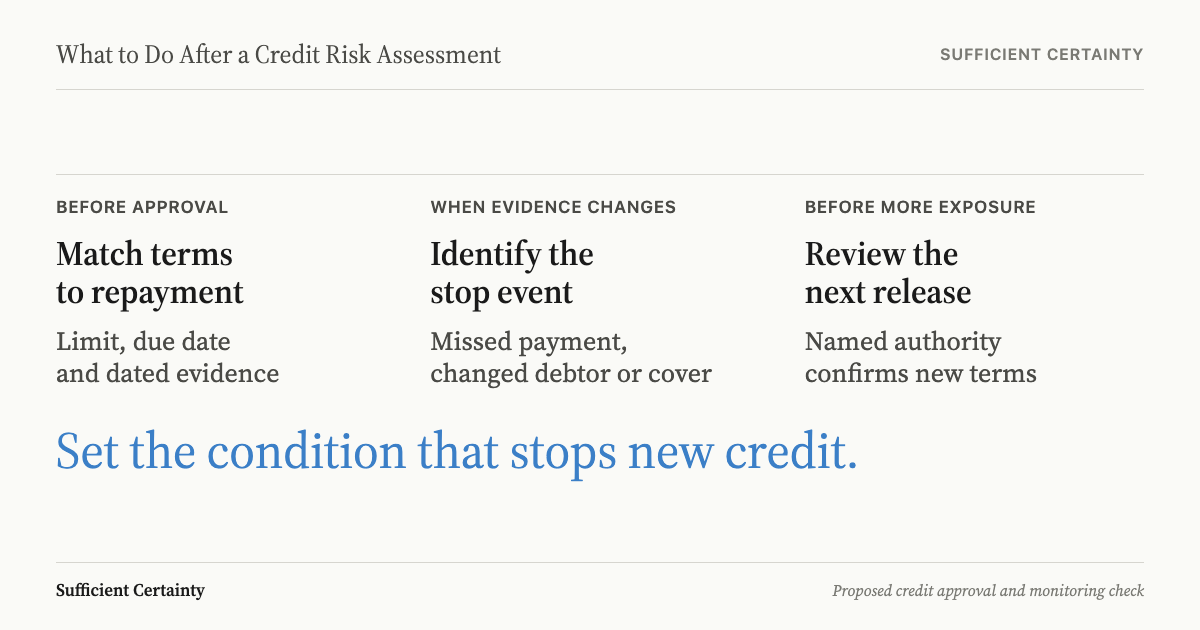
For a customer account, the equivalent check starts with the ledger and the next order. Are the invoices still supported by delivered goods and accepted terms? Has a dispute changed the amount expected? Has the customer begun asking for extensions that the original assessment did not consider? Trace the changed item to its source before increasing exposure.
The same discipline applies to insurance or a guarantee. Ask which debtor, transaction and period the document covers. A reference to cover in an assessment is insufficient if the next delivery falls outside it. Any condition needed for reliance should have an owner who can confirm it before release.
A warning needs a specified response before the next order creates more exposure. The article on when a dashboard should change the decision addresses this connection. A flagged account cannot protect the business if orders continue because nobody has authority to stop them.
A calendar review remains useful, but it cannot cover every change between reviews. Pair the next review date with observable events that require an earlier decision. Choose events linked to the evidence supporting this account, rather than copying a long list of generic warning signs.
Set the event that stops new credit
Attach a short approval note to the customer account. Name the maximum exposure, payment terms and evidence supporting repayment. Then state the event that suspends further credit. It might be a missed agreed payment, withdrawal of required cover or an unconfirmed change in the debtor. These are proposed examples, not universal thresholds.
- Approved credit limit
- Agreed payment terms
- Changed debtor or repayment source
- Outstanding and committed exposure
- Expired or withdrawn required cover
- Event that suspends further credit
Make the event precise enough for the order team to use. Replace “payment performance deteriorates” with the agreed payment and date that matter. State whether the response blocks new deliveries, requires advance payment or sends the account for review. Check existing contracts before choosing a response that affects an accepted order.
Give one named role authority to release the account after review. Sales, finance and order processing should see the same condition. A salesperson's explanation can inform that review, but should not silently cancel the stop event. Record any exception, the person authorizing it and the additional exposure it permits.
The Universal Decision-Making Method connects the decision with its purpose, evidence and monitoring. Applied here, it asks what credit terms will support the sale and what must remain true for those terms to continue. It does not turn a rating into an automatic answer.
Test the arrangement against the next order before putting it into use. Ask the person releasing goods to find the available limit and stop condition. If the system cannot apply the condition, agree a workable manual check and its owner. A condition buried in an assessment attachment may never reach the person creating the exposure.
The assessment is ready for use when the next delivery can be checked against its actual conditions. Keep the record of the credit decision with the evidence, then update both when the repayment basis changes. This leaves a clear reason for the original decision and a clear point at which another decision is needed.
Your credit limit needs a clear condition for suspending further exposure.
Work through your decisionNo sign-up. Just pick your decision and start.
Grant Purdy is the co-author, with Roger Estall, of Deciding (2020), and the architect of the Universal Decision-Making Method.