
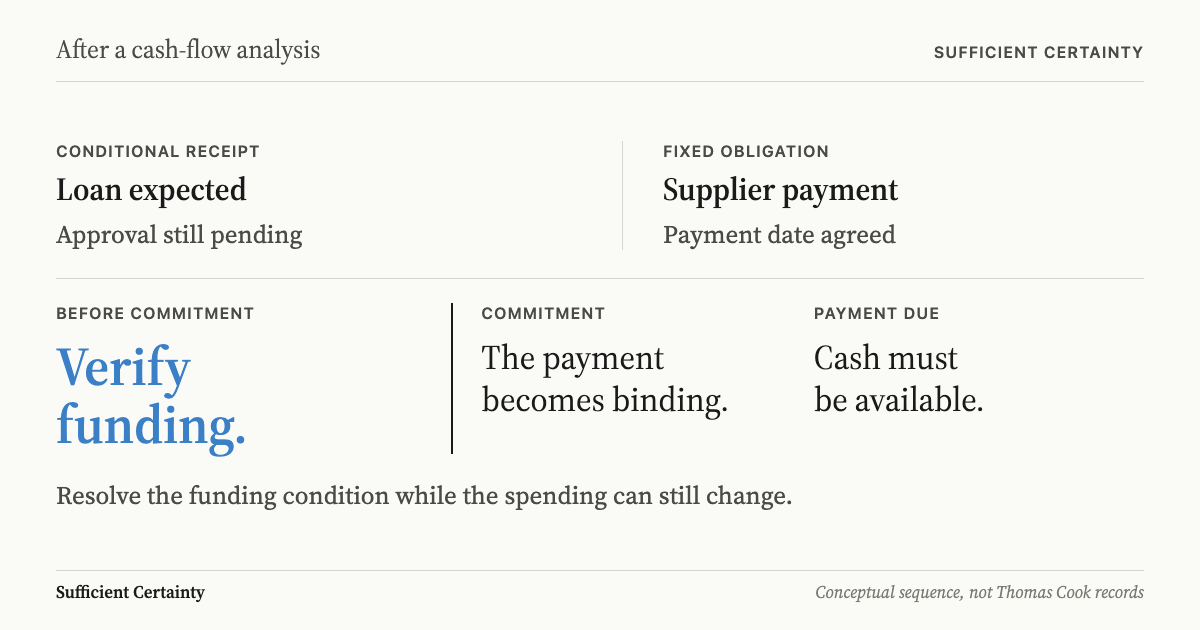
After a cash-flow analysis, mark the first payment date that depends on money not yet received. Consider a finance manager reviewing a forecast before approving a supplier order. The closing balance is positive, but part of it comes from a customer payment and a loan still awaiting approval. Those entries need different treatment before the order becomes a commitment.
Keep the analysis, then check the conditions behind that payment date. The next task is to establish whether the expected cash will be available when needed. That means checking receipt dates, funding conditions and the time available to change the spending decision.
Cash-flow analysis examines money entering and leaving a business over time, including whether cash will be available to meet payments.
Map payments against expected receipt dates
Start with the decision that prompted the analysis. It might be approving equipment, hiring staff or accepting an order with substantial upfront costs. Write down the proposed commitment and its payment dates. Then show which receipts would fund those payments.
Check whether the analysis describes past cash movements or forecasts future cash. A historical statement can identify payment patterns. A spending decision also needs a forward view. Business.gov.au's cash-flow guidance distinguishes actual figures from estimates and asks businesses to consider when money will arrive and leave.
Build the forward view from the current bank balance, expected collections and scheduled payments. Include tax, debt repayments and existing commitments alongside the proposed spending. Use dates close enough together to expose a shortage before an important payment. A monthly closing balance can conceal a shortfall earlier that month. Where expected collections depend on customer credit, the follow-up to a credit risk assessment checks the evidence supporting the limit and payment terms.
| What cash-flow analysis produced | What it assumed | Gap to test |
|---|---|---|
| Customer receipt on the due date | The customer will pay without delay | Check payment history and unresolved invoice disputes |
| Loan proceeds before the supplier payment | Approval and drawdown conditions will be met | Confirm outstanding conditions and the earliest available date |
| Positive month-end cash balance | Receipts arrive before payments fall due | Check the balance at each major payment date |
Attach evidence to the entries that matter. An invoice establishes an amount owed, while payment history helps assess the expected receipt date. A financing proposal needs its approval status and remaining conditions recorded. This continues the checks made during financial due diligence.
The useful output is a dated funding requirement for the proposed commitment. Keep that requirement beside the spending request so the approver can see what must happen first.
Cash-flow analysis shows when money is needed
The analysis can reveal a timing problem that a profit forecast does not show. A sale can contribute to profit before the customer pays. BDC explains the difference between cash flow and profit in terms of actual cash movements and revenue less costs. Non-cash expenses also affect profit.
This makes cash-flow analysis useful when choosing between payment schedules. Compare buying equipment now with staged purchases. Compare a large initial order with smaller deliveries. Record the changed dates and amounts for each option. Then check whether the operational effects still meet the purpose of the decision.
A net present value analysis addresses the value of future cash flows. This checkpoint addresses whether cash can fund a particular payment on its due date. A worthwhile investment still needs a workable payment schedule.
Keep the effect of each option visible in the same forecast. A smaller order changes both the payment and the work that can be delivered. A delayed purchase may postpone the expected receipts. Compare the revised cash dates together, so improving one payment date does not hide a new shortage elsewhere.
Use the cash-flow analysis to identify options before the spending becomes binding. This is a practical use of data-driven decision making: the figures reveal where a decision needs attention. They help compare choices, including reducing or postponing discretionary spending, without deciding which choice serves the business best.
Which payment in your cash-flow forecast depends on funding that is still conditional? Start the Walk →
Which cash entries depend on someone else's decision?
Review the entries that prevent the forecast balance falling below the amount needed for scheduled payments. Ask what has to happen for each entry to become available cash. A receipt may depend on a customer's acceptance of work. A loan may depend on lender approval, security documents or an agreed financial condition.
Business.gov.au's payment-terms guidance explains that offering credit creates exposure to late payment or non-payment. For a critical receipt, check the customer's payment process and any unresolved dispute. Do not treat the invoice due date as evidence that the cash has arrived.
For funding, ask the lender or investor to confirm what remains outstanding. Record who controls each condition and when it can be resolved. Separate cash already available, funding confirmed but subject to conditions, and funding still under discussion. Keep these distinctions visible even if the forecast includes all three.
Test the delay that would change the spending decision. Move the critical receipt to a later date, or remove the unconfirmed funding. Recalculate the balance at the payment dates. This gives sensitivity analysis a specific purpose: finding the point where a payment schedule stops being supportable.
Record the funding condition in words beside the forecast entry. Include the evidence date, the person who must act and the latest useful confirmation date. This lets the approver distinguish a checked condition from one carried forward unchanged in a spreadsheet.
Then identify an option that remains available at that point. It might be a smaller order or an agreed revised schedule. Check the contractual and operational consequences before relying on that option. Record the latest date it can be chosen.
Thomas Cook's recapitalisation failed before cash ran out
Thomas Cook's 2019 collapse shows the importance of the date cash becomes unavailable and the conditions for replacement funding. In evidence to Parliament on 23 October 2019, Insolvency Service chief executive Dean Beale described an urgent cash-flow crisis. At Q403, he said efforts to recapitalise the group had failed and creditor support for restructuring was insufficient.
Beale said the company needed over £1 billion of new capital. He understood that its money was due to run out on 4 October. Without creditor support or buyers ready to take over, the company petitioned for liquidation. The court reviewed its evidence and decided liquidation was appropriate.
At Q404, Beale identified 4 October as the date the directors believed the money would run out. He said the official receiver would examine the question of trading while insolvent. His testimony does not establish that a completed cash-flow analysis was incorrect. It establishes a dated cash crisis and failed attempts to secure the support needed for recapitalisation.
The decision lesson is to assess both the cash deadline and the conditions for funding before accepting further commitments. Knowing the expected shortage date helps establish urgency. It does not establish that another party will provide money in time.
The sequence below is a proposed payment check, not a reconstruction of Thomas Cook's internal process.
Test the funding conditions before approving payments
Use the Universal Decision-Making Method to turn the forecast into a decision about the next commitment. Keep the work focused on the payment dates and funding conditions that could change the choice.
- Frame. State the purpose of the spending and the payment being considered. Identify the person authorised to commit the business.
- Tentative Elements. Describe the proposed payment schedule, the receipts that fund it and feasible alternatives. Include delaying or reducing the commitment.
- Assumptions. Name the required receipt dates and funding conditions. Check the evidence for each condition that could change the decision.
- Sufficient Certainty. Decide whether the evidence supports this commitment. Consider the consequences of a delay and the ability to change course.
- Implement+Monitor. Assign responsibility for checking receipts and funding conditions. Specify when a missed date requires a fresh decision.
BDC recommends a weekly rolling cash forecast for businesses facing severe short-term cash issues to improve visibility over expected collections and payments. Choose a review interval that leaves time to act before the next binding payment. Add an immediate review when a critical funding condition changes.
Put the choice, evidence, unresolved conditions and review dates in a decision record. If funding remains uncertain, identify what must be confirmed before approval. A conditional approval should state who checks that condition before the commitment is made.
After cash-flow analysis, approve a payment schedule only with a clear account of how it will be funded. Keep the next receipt check and the last date for changing the commitment alongside that approval.
Before committing the next payment, check what must happen for its expected funding to arrive on time.
Work through your decisionNo sign-up. Just pick your decision and start.
Grant Purdy is the co-author, with Roger Estall, of Deciding (2020), and the architect of the Universal Decision-Making Method.