
After a performance review, match one rating to dated work evidence before approving the proposed pay or development action. A low rating can require a change in the manager's plan as well as the employee's work. Check what the person was expected and equipped to do before deciding what they must do next.
A performance review is a recorded discussion of an employee's work against agreed expectations, used to guide feedback and decisions about their development.
A rating records performance against agreed work
A completed review gives a line manager a basis for discussing an employee's contribution. It brings work from the review period into one record. It can show where an employee met the role's requirements and where further support is needed. That is useful evidence for a development plan. Where an organisation links pay to performance, it also helps explain the proposed award.
The record needs to identify the work being judged. A comment such as “needs to take more initiative” leaves too much open. It could concern a missed escalation, an unfinished task or a request the employee had no authority to approve. Find the dated example behind the comment. Then identify the expectation that applied when that work was done. Where 360-degree feedback informs the action, compare the observer groups and identify the work situations behind their different ratings.
Acas guidance on reviews and appraisals recommends a written record shared with the employee. It describes reviews against agreed objectives and development plans, with regular informal conversations between formal reviews. A review can therefore preserve more than a rating. It can preserve what the manager and employee understood the work to require.
Keep that record when deciding what follows. Do not replace it with a new explanation written after the result became clear. The distinction matters for accountability without blame: the reviewer needs evidence of what was known at the time, alongside evidence of the outcome.
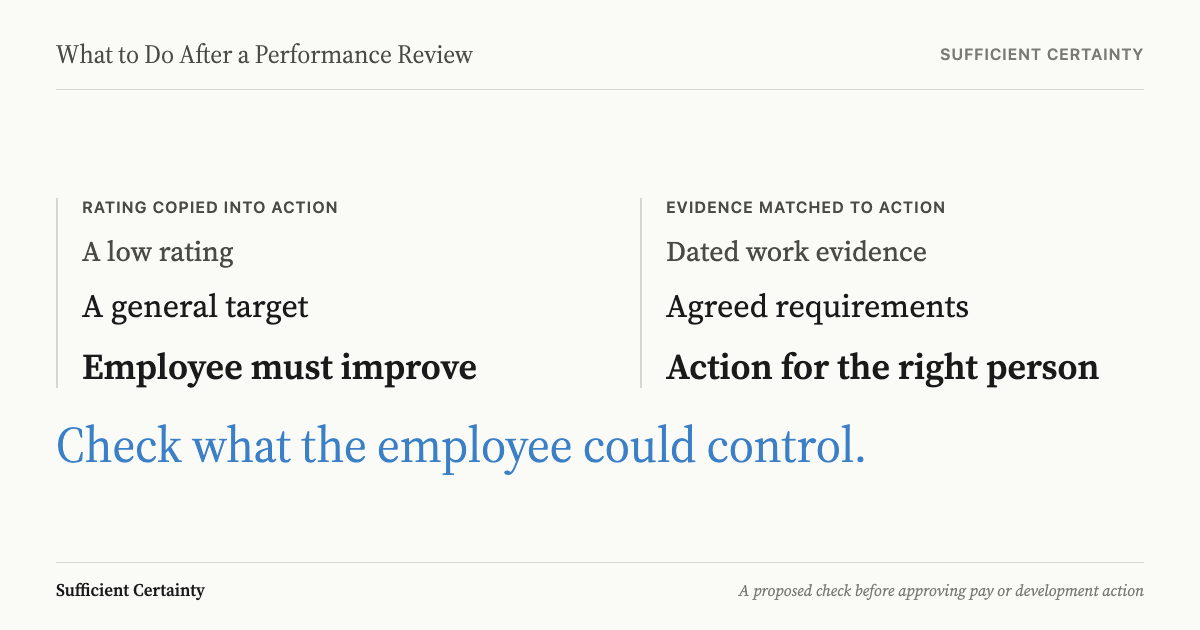
Rating copied into action
- The form records “needs initiative”.
- A general improvement target follows.
- The work conditions stay unexamined.
Evidence matched to action
- A dated example identifies the work.
- The agreed requirement defines the gap.
- The action addresses a verified cause.
The right column does not remove the manager's judgment. It makes that judgment possible to explain. The employee can identify missing evidence, and the person approving the action can see why it follows. If the decisive rating lacks a work example, record that gap before treating the rating as a settled basis for action.
Preserve the employee's response as well. Agreement that a meeting happened is different from agreement with its conclusions. If the employee disputes an example, identify the disputed fact and the evidence needed to resolve it. The next approver should be able to see the difference between an established finding and a point still under review.
Which review finding supports the action being proposed for this employee? Start the Walk →
Does the employee control the result?
A review framed as “how good is this employee?” can make every shortfall look like a personal weakness. The next decision needs a more specific question: what prevented the agreed work from being done? That question permits different responses. Training may address a skill gap. A missing approval may require action from the manager who controls it.
Check the requirement against the conditions of the work. Did the employee receive the assignment early enough to complete it? Could they obtain the information it needed? Did competing instructions change the priority? These are proposed checks for the manager. They are not reasons to assume that every poor result came from outside the employee's control.
The US Office of Personnel Management's guidance on performance standards distinguishes what employees do from how well they must do it. It also allows work to be assessed through observation when a useful number is unavailable. A vague judgment does not become reliable just because the form gives it a score.
Compare the dated evidence with the role's agreed requirements, rather than an unstated picture of an ideal employee. Those requirements should serve a clear purpose for the work. Where requirements changed during the period, identify which applied to the work being rated. Keep past performance separate from the demands of a proposed new assignment. Evidence that supports recognition for completed work may leave a development need for different work.
A useful check is to ask what the proposed response would change in the next piece of comparable work. If the answer is only that the employee will try harder, the plan needs more detail. Identify the behaviour that must change, or the condition that someone else must provide. Then check that the proposed action can produce that change.
This is the practical issue behind authority in management. A person can be answerable for how they used their authority. The manager still needs to address conditions the person could not change. The wider accountability in leadership question becomes concrete here: who can change the condition that the proposed action depends on?
Adobe changed the review conversation
Adobe offers a practice example of connecting performance discussions to current work. In 2012, it replaced annual performance reviews and ratings with Check-in. Adobe's account of the change describes an ongoing conversation between employee and manager about performance and career growth. The company says employees had found its annual process cumbersome.
Its later digital approach provides a central place to document goals and feedback. Individual goals can be updated by the employee and manager as work changes. Adobe describes quarterly Check-in conversations about progress and expectations. It says managers determine salary and equity from performance, informed by those conversations, without formal ratings or rankings.
Those are features of Adobe's reported process. They do not establish what happened in a particular employee's review. They also do not prove that removing ratings produces better decisions elsewhere. The useful comparison is narrower: a manager can keep a current account of the work behind a performance decision, whether the organisation retains annual ratings or replaces them.
The three readers need access to the same evidence, but each has a different decision to make. The manager cannot make the employee's development plan workable simply by recording a weakness. If the work requires a different assignment or access to specialist help, that commitment needs an owner with authority to provide it.
That is the application proposed here, rather than an account of an Adobe personnel decision. Keep the review finding connected to current work. Then ask whether the action changes the condition that caused concern. A more frequent conversation is useful only if the people involved can identify and act on what it reveals.
Match the proposed action to dated evidence
Before approving the plan, open the review at the finding that most influenced the proposed action. Put the dated work example beside the agreed requirement. Ask the employee to correct factual gaps. If the evidence supports a skill problem, identify work on which the employee can practise that skill and obtain useful feedback.
If the evidence instead shows missing opportunity or resources, assign the corresponding action to the manager. Acas guidance on performance problems starts with understanding why the problem exists. Its discussion of capability includes support and training. A response should follow the identified problem, rather than the wording that happens to fit the review form.
Write one work goal with an observable requirement and a date to check it. Beside it, record the support the manager will provide and when it will be available. Choose the check date around a real chance to do the work. A meeting before that opportunity arrives cannot establish whether the employee has improved.
For a pay decision, state which completed work supports the recommendation under the organisation's pay rules. Acas advises a fair and objective process for performance-related pay. Do not turn a budget limit into an unsupported claim about the employee's performance. Record the budget decision separately.
At the next check, retain evidence of the work and whether the promised support arrived. If the support was delayed, record that before judging progress against the goal. This keeps the next conversation tied to the actual assignment rather than a repeated reading of the original rating.
The Universal Decision-Making Method begins by clarifying the decision and its purpose. Here, the decision is the employee action to approve. The assumption to examine is whether that action addresses the cause shown by the evidence. Retain the review, but approve the next commitment only when that connection is clear.
Before the development plan is approved, who can change the condition behind the performance gap?
Work through your decisionNo sign-up. Just pick your decision and start.
Grant Purdy is the co-author, with Roger Estall, of Deciding (2020), and the architect of the Universal Decision-Making Method.