
After a property valuation, compare the use assumed in the report with your proposed use before setting a bid. A lower valuation need not make a property unsuitable, and a higher valuation need not justify buying it. The next step is to establish which purchase terms the evidence supports.
A property valuation estimates the value of a specified property interest for a stated purpose, at a stated date.
Use the valuation to define a bounded bid
A completed valuation gives a business owner a reasoned estimate to compare with the seller's price. For a commercial property, read that estimate alongside the tenancy schedule and the proposed purchase terms. Identify whether the report values the property with its existing tenants or assumes a different occupancy position.
The International Valuation Standards Council glossary distinguishes market value from the value to a particular owner. Market value concerns a hypothetical exchange at the valuation date. Investment value concerns the objectives of a particular owner or prospective owner. A business may have reasons to prefer a building that another buyer would not share.
Write those reasons separately. An owner who intends to occupy the property may value control over premises. An owner buying for rental income needs evidence about the income available under the leases. State the purchase purpose before treating the valuation as a bid limit.
Check whether the report assumes continued occupation, vacant possession or a future change of use. Put that description beside the use in the purchase proposal. For an empty site, the question may concern what can be built. For a leased building, it may concern when the buyer can occupy it. Ask the valuer whether the proposed use falls within the report's stated scope.
Keep the asset in view. This is a property purchase, rather than the acquisition of an operating company. A business valuation raises different questions about the interest being acquired. Here, the immediate evidence concerns the premises and the income or use that comes with them.
Prepare a short purchase note beside the valuation. Record the proposed use, the price under discussion and the report's valuation date. Add the lease documents that the valuer used. Ask whether any relevant document arrived later. This is a proposed management check, not a replacement valuation.
The bid should reflect the property the business will acquire under the proposed terms. The data-driven decision-making hub examines how evidence supports that choice.
Which lease or transaction assumption supports the figure?
Start with the rent roll, the schedule of tenants and rental income. Put it beside the signed leases and any later agreements. Ask the valuer to identify which income figures are contractual and which depend on a future letting or review. Mark a discrepancy for explanation before changing the purchase note.
RICS guidance on comparable evidence identifies lease length, break options and tenant financial strength as factors affecting investment property value. It also explains that comparable transactions generally need adjustment for differences. A nearby sale is useful evidence only after those differences receive attention.
Ask for the comparison behind the most influential transaction. Does it concern a completed sale or an asking price? Does the comparable have a longer lease? Were rent incentives included? Ask the valuer how the available evidence deals with these differences. A manager needs an explanation of their effect, rather than an unadjusted price per square metre.
A comparable price supports the bid only to the extent that the comparison fits. Record important limits to that comparison. If evidence is confidential, ask what explanation the valuer can provide without disclosing protected information.
Consider a proposed check where the report assumes uninterrupted rent, but a lease allows the tenant to leave earlier. Ask the valuer whether that term was included and what it means for the estimate. This is an illustration, not a claim about a particular property. The response might confirm the report or require a revision.
Keep valuation and funding questions connected without merging them. A property may have an acceptable estimated value while the business lacks cash for a vacancy period. The review after cash-flow analysis addresses when funds will actually be available.
If the report uses a cash-flow model, ask which lease dates enter that model. The review after a DCF analysis connects the modeled receipts to the transaction being considered. A manager does not need to rebuild the model to ask whether its occupancy premise matches the purchase proposal.
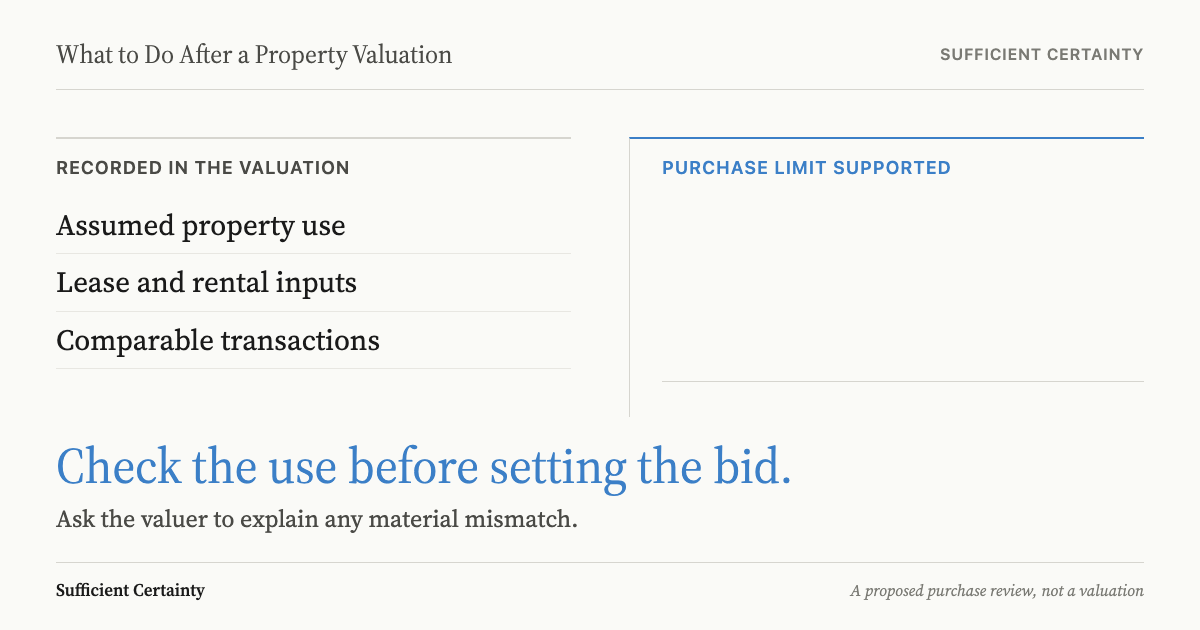
Resolve the mismatch that could change the purchase decision before requesting more general analysis. Ask what would change if the disputed lease term or comparable transaction were treated differently.
Does the use assumed in the valuation match the property purchase you are about to approve? Start the Walk →
Leppington Triangle exposed weaknesses in valuation advice
The Australian Government bought the Leppington Triangle land beside Western Sydney Airport in July 2018 for about A$29.8 million. Its financial-reporting fair value at June 2019 was about A$3.1 million. Those figures concern different purposes and dates. Their difference alone does not establish that the original decision was unsound.
The Australian National Audit Office's 2020 audit provides the relevant findings. It found the valuation approach inappropriate and said it inflated the land's value. Departmental instructions assumed speculative industrial rezoning that was highly unlikely given legal restrictions and airport requirements. They also restricted the usual valuation enquiries.
The audit found no indication that the department paused to reconsider its assumptions when contrary evidence arrived. Available valuation comparisons were omitted from briefings to decision-makers. These are explicit findings about the basis of the valuation and the advice supporting the commitment.
Put contrary valuation evidence in the approval paper, with an explanation of its relevance. A decision-maker cannot assess a disagreement that the paper leaves out. Different purposes and dates need explaining rather than being treated as reasons to ignore the comparison.
This government land acquisition is a limited analogy for a commercial-property purchase. It does not establish how a particular rent roll should be valued. Its practical relevance is the link between the question given to the valuer and the decision later made using the answer.
For the reader, the proposed application is to inspect the instructions as well as the report. If the purchase assumes a change of use, ask what evidence supports that use. If the business needs the existing rent, ask which lease conditions preserve it. A report prepared for one transaction premise needs review when the proposed purchase uses another.
Ask the valuer to resolve the material mismatch
Send the valuer the specific discrepancy, with the relevant lease extract or transaction evidence. Explain the purchase decision awaiting approval. Ask whether the report already accounts for the discrepancy and whether its conclusion remains suitable for that use.
RICS' account of valuation methods describes verifying comparable evidence and avoiding reliance on a single item. The owner can ask for that explanation while leaving the valuation judgment with the qualified valuer. Questions about lease enforceability belong with the legal adviser reviewing the transaction.
The Universal Decision-Making Method helps organize the management decision around the revised evidence:
- Frame. State what the property must enable the business to do.
- Tentative Elements. Compare the proposed bid with alternatives, including retaining the current premises or waiting.
- Assumptions. Identify the lease or comparable-sale condition the bid relies on.
- Sufficient Certainty. Decide whether the valuer's explanation supports the commitment and its consequences.
- Implement+Monitor. Record who must check for a material tenancy change before the next approval.
Use the response to retain the bid limit, lower it or postpone approval. Where the answer depends on a document that remains unavailable, record that dependency. Avoid describing an unresolved question as completed due diligence. The review after legal due diligence connects material findings to the transaction terms.
Before the approval meeting, check that the seller's latest proposed terms match the terms sent to the valuer. A changed tenancy arrangement may require another question even when the asking price stays the same. Identify who will refer that change back for advice.
Keep the explanation with the purchase note so the approver can inspect it. Approve a purchase limit supported by the actual lease and transaction evidence.
Before setting the bid limit, name the property use and lease conditions that the valuation must support.
Work through your decisionNo sign-up. Just pick your decision and start.
Grant Purdy is the co-author, with Roger Estall, of Deciding (2020), and the architect of the Universal Decision-Making Method.