
After legal due diligence, put one material finding beside the contract clause or closing condition that addresses it. A legal report can flag a consent requirement while the draft agreement still assumes the contract will transfer. Use that mismatch to ask whether the proposed transaction needs to change.
Legal due diligence examines a target's legal position and identifies findings that affect the terms, feasibility or obligations of a proposed transaction.
Legal due diligence identifies constraints on the transaction
A useful legal report ties its findings to the transaction under consideration. It identifies what the seller can transfer, which permissions may be required and what obligations may remain. The decision-maker can then see where the agreement needs different terms or where the proposed acquisition needs further work.
The American Bar Association's account of legal diligence connects contract review to transaction documents. It describes how findings can change payment arrangements or conditions before closing. It also notes that the requested information depends partly on the transaction structure. That dependence matters when the proposed deal changes.
Keep the findings list beside the current agreement. For each material issue, identify the affected asset or right. Then locate the clause, condition or proposed exclusion intended to address it. Ask counsel what remains unresolved. A summary marked addressed is not enough if the agreement still describes an earlier version of the transaction.
The proposed comparison below is a decision check. It does not prescribe a legal remedy. The suitable treatment depends on the issue and the transaction. Connect each finding to the deal actually being proposed.
There is value in this work even when it supports proceeding. A material concern can become a specific condition with a person responsible for satisfying it. A known obligation can be included in the operating plan. The buyer can distinguish a commitment that needs more work from one ready for approval.
Keep the report's scope visible, including information unavailable at the review date. The wider review after due diligence asks what the findings support. This legal spoke asks which transaction those findings leave available. The legal findings can change the options being compared.
Use the legal findings to compare which version of the transaction can deliver the reason for buying. Start the Walk →
Which deal is the legal report actually assessing?
A report prepared for one transaction can become an unreliable basis for a changed one. A revised purchase may include fewer assets or different rights. A proposed remedy can require the buyer to sell a business it already owns. A delayed permission can change when the acquired operation becomes usable.
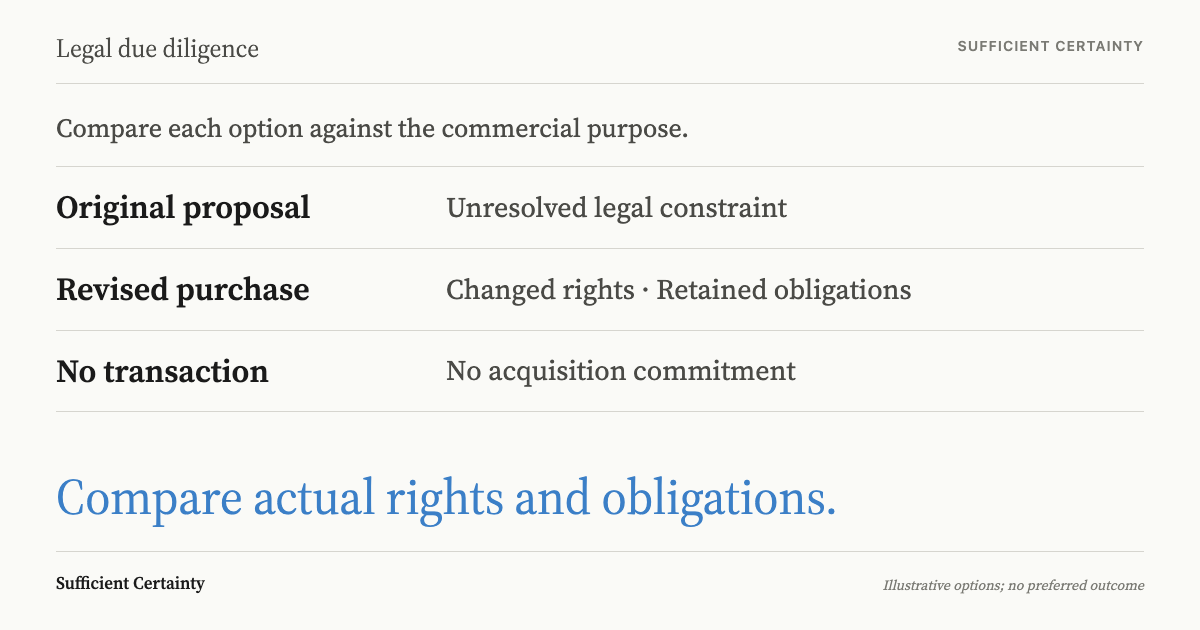
Reframe the decision when those changes affect the reason for buying. Instead of asking only whether a legal issue can be resolved, ask what each available version of the transaction delivers. State the assets retained by the buyer and the services needed to operate them. Then compare those versions against the same commercial purpose. Where the purchase depends on intellectual property, the follow-up to an IP audit traces the rights required for the proposed commercial use.
Consider a hypothetical acquisition that depends on access to a named brand. If the revised deal limits that access, a clause allocating financial loss may not restore the intended business opportunity. The buyer needs to compare the restricted purchase with alternatives. This is an invented example of the proposed check, not a reported deal.
Legal permission does not establish commercial value. Counsel can explain the rights available under the proposed terms. The decision-maker still needs to decide whether those rights support the result sought. The purpose of the acquisition provides a common basis for comparing changed options.
The Justice Department's May 2023 ASSA ABLOY settlement announcement illustrates this distinction. The proposed settlement required divestitures as a condition of finalising the acquisition. Resolving the competition objection therefore involved a transaction with changed assets and rights. The detailed court documents show what those changes entailed.
Do not give the original proposal an automatic advantage because more work has been spent on it. A narrower purchase, delayed closing or no transaction may deserve comparison. Identify which alternatives are actually available under the negotiations. Compare complete transaction options before selecting protections.
The situation analysis should follow the revised decision. If the assets change, recheck the assumptions attached to their value. Keep that question distinct from the evidence behind the purchase price. A sound price estimate for the original deal cannot settle the value of different rights.
Assa Abloy: changing the acquisition to meet objections
ASSA ABLOY agreed in September 2021 to buy Spectrum Brands' Hardware and Home Improvement division for about $4.3 billion. DOJ sued in September 2022, alleging harm to competition in premium mechanical door hardware and smart locks. The May 2023 competitive impact statement describes the proposed settlement following that litigation.
The statement explained that the settlement expanded Yale intellectual-property rights available to the divestiture buyer compared with earlier offers. It also shortened transition arrangements. The dispute concerned the scope of usable rights and continuing dependencies, not simply a payment for accepting a legal issue.
The September 2023 final judgment defined divested businesses including Emtek and Schaub, August and specified Yale businesses in the United States and Canada. It provided for a monitoring trustee to investigate and report on compliance with the judgment and divestiture agreements.
Section IV contained a bounded route to additional Yale rights. It applied after three years from the divestiture date until five years from judgment entry. It required specified findings about diminished competitive intensity and limitations on Yale rights. It did not create an unrestricted or automatic right to reopen the transaction.
This is a transaction analogy for using legal findings. The documents do not establish that a diligence review missed the competition issue. The consent judgment was not an admission or finding of liability. Nor do these documents establish the long-term competitive result. The relevant lesson is to assess the changed transaction.
The proposed application is specific. When a legal remedy changes assets, brand rights or transition arrangements, revise the acquisition option before approving it. Record the obligations that continue beyond closing. The assumptions carrying the decision must refer to that revised arrangement, rather than the original proposal.
Compare the transaction options before setting conditions
Before signing or closing, choose one finding that could change the transaction's purpose or scope. Put its proposed treatment beside the affected assets and rights. Ask counsel to confirm the legal effect. Then ask the deal sponsor what commercial result remains possible under those terms.
Use separate descriptions for each available option. Include the rights being obtained and what must happen before they can be used. Identify obligations retained after closing. The following role descriptions are a proposed review of those descriptions, not a claim about how ASSA ABLOY managed its acquisition.
A closing condition and a retained obligation need different treatment. A condition may prevent completion until an event occurs. A continuing obligation can require resources long after completion. Record who will fulfil it and what evidence will show compliance, with counsel checking the actual requirements.
The Universal Decision-Making Method starts from the result sought and the options available. Apply that discipline when the findings change the acquisition. A revised transaction deserves a revised comparison, even when the original proposal received an earlier approval.
Keep the chosen option and its unresolved conditions in the decision record. Set a review trigger for a changed remedy, withheld permission or revised transfer scope. Show what would require a new decision before signing or closing. This makes the legal findings usable by the person authorised to commit.
Keep the evidence for satisfying each condition with the current agreement version. If a revised remedy removes an asset or limits a right, return that change to the decision-maker. An approval based on the old scope should not silently become approval of the revised purchase.
Approve the transaction that survives the revised comparison. The completed legal review then supports a defined choice, with the rights being bought and the obligations being accepted made explicit.
You could resolve each legal finding and still approve a changed transaction that no longer serves the reason for buying.
Work through your decisionNo sign-up. Just pick your decision and start.
Grant Purdy is the co-author, with Roger Estall, of Deciding (2020), and the architect of the Universal Decision-Making Method.