
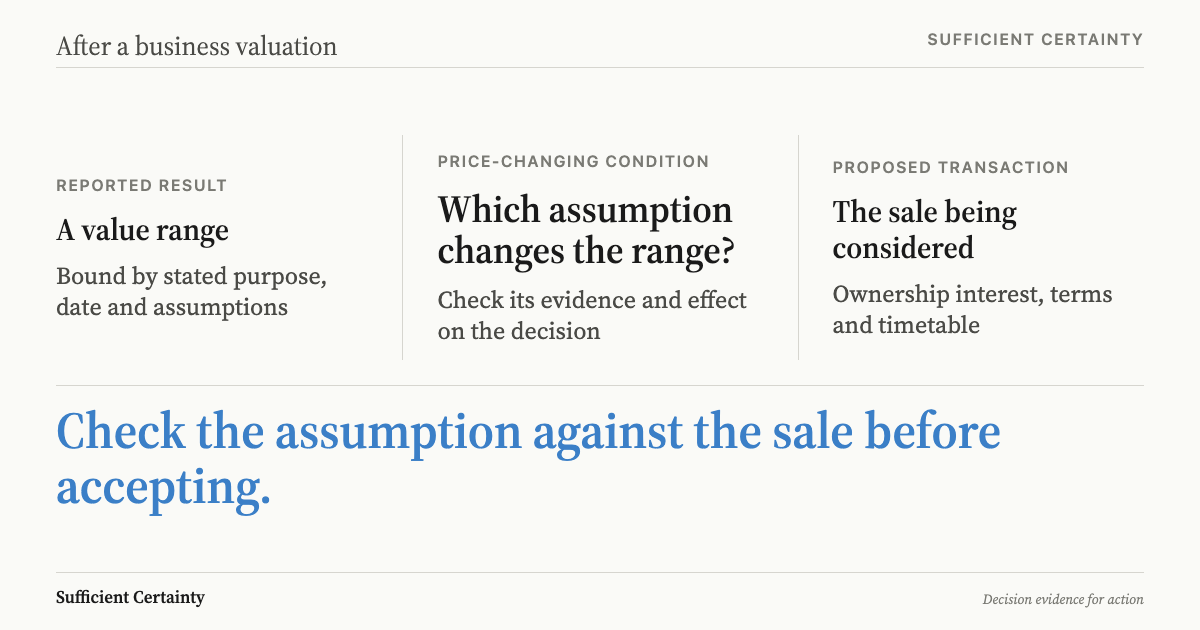
After a business valuation, the step before relying on it is to ask the valuer which assumption changes the price range most. The report arrives with a conclusion near the front and qualifications further back. Bring the relevant qualification into the transaction discussion before using the conclusion to set a price.
A business valuation estimates the value of a business or ownership interest for a stated purpose, on a stated date.
Identify what the valuation allows the owner to do
Start with the transaction under consideration. Is the owner selling the whole business, transferring a minority holding, or deciding whether to retain ownership? Write down the interest being valued. A report about one interest needs careful checking before it supports a decision about another.
Read the instructions given to the valuer alongside the final report. Check the valuation date, the stated purpose and the basis of value. The basis describes the premises behind the estimate. It helps explain whose circumstances the valuation reflects and what kind of exchange it assumes. The scope check also matters after a property valuation, where the assumed use and lease conditions must fit the proposed purchase.
The IVSC definition of market value, for example, assumes willing parties, proper marketing and no compulsion at the valuation date. An owner facing an urgent sale should ask whether those conditions describe the proposed transaction.
Ask whether the conclusion describes the value of the operating business or the shares the owner proposes to sell. Have the advisers show the connection between the reported figure and the amount the owner would receive. Record any adjustment needed before using the figure in negotiations.
Then identify the decision-maker and the next commitment. Negotiating an indicative price, granting exclusivity and accepting a binding offer require different checks. State which commitment the report is intended to support. The data-driven decision-making approach starts by connecting the information to a specific decision.
Keep this review focused on the valuation basis and proposed transaction. A financial due diligence review checks the financial evidence behind a deal. Here the question is whether the value estimate fits the ownership interest and sale conditions being considered. Where the board also receives transaction advice, the follow-up to a fairness opinion checks whether its assessed terms and shareholder groups match the final agreement.
Before discussing the price, confirm that the valuation describes the transaction the owner can actually make.
A valuation gives the transaction a reasoned starting range
A completed valuation can explain how operating performance and ownership rights affect an estimate. It can also show why different methods produce different answers. That gives the owner a way to question an offer without relying only on personal expectations.
The IVSC guidance on business valuations explains that purpose affects the choice of basis. It also stresses clear reporting of significant assumptions and limitations. These details make the report useful to someone who must decide what to do next.
Ask the valuer to separate assumptions that change the range substantially from those with little effect. Next, ask how well each important assumption is supported. The matrix below is a review aid, not a scoring system. Place an assumption using the valuer's explanation, rather than guessing from its position in the report.
| Evidence supporting the assumption | Small effect on price range | Large effect on price range |
|---|---|---|
| Limited evidence | Record the uncertainty | Test before relying on the range |
| Strong evidence | Keep the supporting source | Important and supportedCheck that sale conditions match |
The first assumption to investigate is one that could change the transaction decision and lacks adequate support. A large numerical effect alone does not make an assumption doubtful. A small effect may still matter if the offer sits close to the owner's minimum acceptable price.
Use the report to identify a focused question for negotiation or further evidence. This keeps sensitivity analysis connected to the decision rather than producing more calculations with no clear use.
Which condition must hold before this valuation range can support the proposed sale? Start the Walk →
Which assumption could change the acceptable price?
First ask whether the stated range depends on conditions the seller cannot provide. A valuation might assume continued operation, access to certain contracts or enough time to reach potential buyers. These conditions need to be checked against the proposed sale, not simply repeated in the approval paper.
An assumption can be reasonable for the valuation and unsuitable for the proposed transaction. Consider the following illustrative statements from a hypothetical report. They are not quotations from the Royal Mail documents. Together, they show why the conclusion and its qualifications need to be read as one argument.
The response is to ask the valuer to explain the mismatch. Does the conclusion require a different timetable, a revised range or a qualification? Keep that answer attached to the price recommendation. Do not leave the decision-maker to reconstruct it from separate pages.
Also distinguish estimated value from an offered price. The IVSC's paper on market value examines the different concepts of price and value. For this decision, ask what a specific buyer is offering and which conditions accompany that offer.
A higher headline offer may depend on future performance or delayed payment. Ask the transaction advisers to explain how those terms affect the owner's objectives. Use explicit assumptions to make that comparison visible.
The acceptable price depends on what must be true for this transaction to meet the owner's purpose.
Royal Mail's sale price reflected competing objectives
In October 2013, the UK government sold 60% of Royal Mail at 330 pence per share. The first day's closing price was 455 pence, a 38% rise. The National Audit Office's 2014 review concluded that the government completed its sale objective but could have achieved better value for taxpayers.
The valuation work used several methods, principally short-term dividend yield. Earnings multiples and discounted cash flow were also used. The NAO found that different assumptions made the ranges difficult to compare. Its report's valuation section explains why the methods and their premises mattered.
The published price range was 260 to 330 pence. The Department gave weight to completing the sale amid industrial-action and market uncertainty. Institutional demand reached 24 times the shares available to institutions, but book building revealed little about demand above 330 pence. Advisers opposed raising the range because of execution risks.
The first-day rise alone does not establish one objectively correct valuation that was available before the sale. It does warrant examining the assumptions and process that supported the offer price. The NAO's criticism concerns the value the transaction captured and the caution applied in completing it.
For a current owner, the useful questions are prospective. How much price flexibility remains after announcing a range? What evidence would justify changing it? Does meeting a deadline require accepting a lower price, or could the seller alter the amount sold? These are decision questions suggested by the case, not claims about a method used by the Department.
Record the cost of delay alongside the cost of accepting a lower price. Explain which objective takes priority if both cannot be achieved. A valuation review needs this transaction context before it can support an approval.
A reasoned price decision explains both the estimated value and the constraints on obtaining it.
Record the conditions before agreeing a transaction
Create a one-page valuation decision note before granting exclusivity or accepting binding terms. Attach the report and identify the pages supporting the recommendation. Use the Universal Decision-Making Method to connect the estimate to the proposed action.
- Frame: State what the owner needs from the transaction and which ownership interest is involved.
- Tentative Elements: Describe the proposed sale, including price terms and timetable. Keep retaining ownership available where feasible.
- Assumptions: Name the condition that changes the range most and the evidence supporting it.
- Sufficient Certainty: Decide whether that evidence supports the next commitment. Specify any unresolved condition that would prevent approval.
- Implement+Monitor: Assign someone to check the condition before signing and define what change will reopen the price decision.
The note should state what would change the recommendation before the owner commits. A lost contract, a changed payment structure or a missed timetable can trigger a review where it affects the recorded assumption. Choose the trigger from this transaction rather than copying a standard checklist.
Ask the valuer whether new evidence requires an updated opinion. Then revise the recommendation with the transaction advisers. Preserve the earlier reasoning in the decision record so the owner can see why the terms changed.
The immediate task is specific: identify the most important price-changing assumption, find its support and check it against the sale being proposed. Agree the next commitment only after explaining any remaining mismatch.
Before accepting an offer, record the assumption that could change the price you are willing to accept.
Work through your decisionNo sign-up. Just pick your decision and start.
Grant Purdy is the co-author, with Roger Estall, of Deciding (2020), and the architect of the Universal Decision-Making Method.