
After an A3 report, the standard next step is to implement the countermeasures and track results. Before doing that, test whether the problem statement and each proposed fix rest on assumptions nobody has named. That is the step most teams skip.
In 2004, a General Motors engineer closed out an internal problem report on an ignition switch that slipped out of the "run" position in the Chevrolet Cobalt. The torque on the switch was below specification. The documented fix: change the part. The undocumented assumption: a switch that rotated out of position was a convenience issue, not a safety defect.
Over the next decade, that assumption rode through every structured review GM conducted on the vehicle, untested, while at least 124 people died in crashes linked to the fault.
An A3 report is a structured problem-solving document, typically one page, that walks a team from problem statement through root cause analysis to countermeasures.
General Motors and the assumption nobody checked
The ignition switch in the 2005 Cobalt was designed to a minimum torque specification of 15 Ncm. Early prototypes came in below that threshold. An engineer documented the problem, flagged the shortfall, and approved a redesign. When the redesign also fell short of the original specification, the engineer signed off anyway, noting the new part was "acceptable." No formal change notice was issued. No part number changed.
The Valukas Report (2014), the independent investigation GM's board commissioned from former U.S. Attorney Anton Valukas, later described this moment as the point where the defect entered production without the traceability that GM's own quality system required.
The switch rotated too easily. When it did, the engine shut off, disabling power steering, power brakes, and, critically, the airbag system. Crash data trickled in. GM's internal systems opened investigations, generated reports, and closed them. Each review framed the problem the same way the first engineer had: the switch was a customer satisfaction concern, not a safety defect. The structured analysis was thorough on its own terms. What it never tested was whether the initial classification of the problem was correct.
Between 2005 and 2014, GM's own engineers, safety reviewers, and field investigators generated at least five separate internal inquiries into the ignition switch. Several referenced the root cause analysis that pointed squarely at the torque deficiency. But every inquiry inherited the same frame: the switch was a "non-safety" issue.
The Jenner & Block investigation found that GM's culture treated problem classification as settled once an initial determination was made, even when new evidence accumulated. The structured reviews worked perfectly within their scope. The scope itself was the error.
The National Highway Traffic Safety Administration fined GM $35 million in 2014, the maximum civil penalty at the time. GM recalled 2.6 million vehicles. Congressional hearings followed. The Valukas Report concluded that the failure was not an absence of process but a failure of classification: the problem-solving apparatus treated its own initial framing as a fixed boundary, not as an assumption to revisit.
What an A3 report gets right, and where it stops
The A3 format, developed at Toyota and codified in lean management practice, compresses problem solving into a disciplined sequence. A single page forces clarity: state the problem, map the current condition, define the target, trace root causes, propose countermeasures, build an implementation plan. The constraint is deliberate. Teams that fill 40-slide decks can hide weak thinking behind volume.
An A3 does not permit that.
The format also forces handoffs. Each section depends on the one before it. Root causes emerge from the gap between current state and target. Countermeasures follow from root causes. The implementation plan follows from countermeasures. This sequential discipline is genuinely valuable. It prevents teams from jumping to solutions before understanding conditions, a failure mode that problem framing research identifies as one of the most common sources of wasted effort.
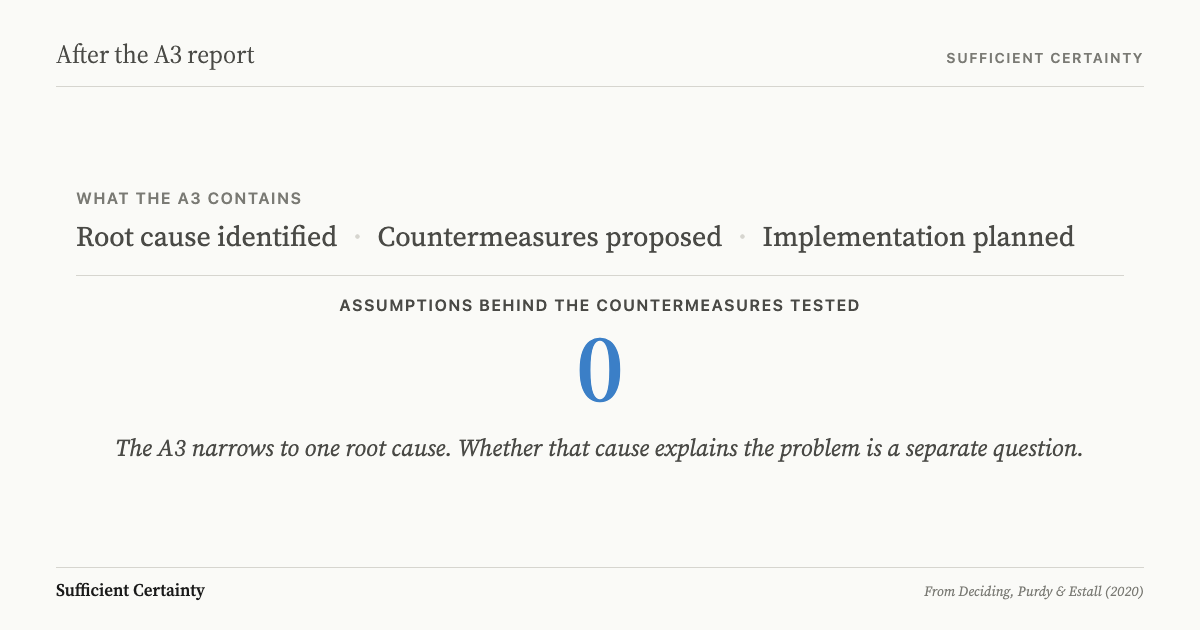
But the A3's strength is also its blind spot. Each section inherits the framing of the section above it. If the problem statement is wrong, every subsequent section is internally consistent and externally irrelevant. If the current-state analysis omits a variable, the root cause analysis cannot find it. The A3 enforces logical consistency within its frame. It does not test whether the frame itself is correct.
This is not a flaw in the tool. It is a boundary the tool was never designed to cross. The gap only becomes dangerous when teams treat the A3's output as a decision rather than as an input to one. The distinction between defining and solving a problem matters precisely here: the A3 solves within a definition it accepts as given.
A post-mortem after an incident often reveals that the A3 was completed, the countermeasures were implemented, and the problem persisted or recurred because the original framing excluded the actual cause. The issue is not that the A3 was done badly. The issue is that its outputs were treated as conclusions when they were still hypotheses.
Write down the assumption your A3's problem statement depends on and ask whether anyone verified it before the countermeasures were approved. Start the Walk →
The checkpoint between analysis and action
The A3 ends with a plan. The question it does not answer is whether the plan rests on assumptions that no one has named. The Universal Decision-Making Method treats this as a structural requirement, not an optional add-on. Before any decision is finalised, the assumptions behind it need to be surfaced, ranked, and tested for sufficiency.
For an A3 report, this means pulling out the load-bearing assumptions embedded in each section. The problem statement assumes a particular framing of what went wrong. The current-state analysis assumes the data collected represents actual conditions. The root cause analysis assumes the causal chain is complete. The countermeasures assume they address the root cause without creating new failure modes.
Each of these is testable. None of them is tested by the A3 itself.
The practical checkpoint sits between the completed A3 and the decision to implement its countermeasures. At that point, list the assumptions the report depends on. Ask which ones have been verified and which are being taken on faith. Determine what level of certainty is sufficient given the stakes.
This is the same logic that applies after a fishbone diagram or a force field analysis: the tool produces structured thinking, not a finished decision. The five-step method (Frame, Tentative Elements, Assumptions, Sufficient Certainty, Implement and Monitor) provides the scaffolding for that checkpoint.
An A3 report is an input to a decision. Treating it as the decision is where the cost accumulates. The problem-solving sequence works when teams build assumption testing into the handoff between analysis and action, not after the action has already begun.
GM's engineers completed every step the A3 asked of them. The step the A3 did not ask for was the one that mattered: questioning whether the problem had been framed correctly in the first place. That step is available to any team willing to pause between the report and the commitment. The lesson is always the same: structured analysis clarifies the problem it was given, not the problem that exists.
You could implement every countermeasure and still leave the assumption behind the problem statement untested.
Work through your decisionNo sign-up. Just pick your decision and start.
Grant Purdy is the co-author, with Roger Estall, of Deciding (2020), and the architect of the Universal Decision-Making Method.