
After an actuarial valuation, put the proposed contribution dates beside the employer’s cash forecast and flag any payment that depends on refinancing. Silentnight’s recovery plan spanned 29 years, with contributions rising substantially from 2018. The decision after a valuation includes whether the employer can support the promised payments as conditions change.
An actuarial valuation estimates benefit liabilities and compares them with assets using stated assumptions, methods and an effective date.
The valuation starts a funding negotiation
The report gives an employer or trustee a basis for discussing funding. Read the purpose of the valuation before using its result. A figure prepared for accounting, ongoing funding or securing benefits elsewhere may answer a different question. Ask the actuary to explain the basis used and which decisions the report is intended to support.
Keep the effective date visible. List the assets included, the liabilities estimated and the assumptions with a material effect on the result. A single funding percentage can hide these distinctions. Two figures from different dates or bases may not be comparable, even if they share a heading in the board paper.
Next, identify the commitment being proposed. It may involve contribution amounts, payment dates, a recovery plan or another response to the funding position. Record which body must decide and which specialist advice it needs. Avoid treating receipt of a signed actuarial report as approval of the proposed funding agreement.
The data-driven decision making task is to connect the report to that commitment. The actuary retains responsibility for the technical analysis. Trustees and employers must understand what they are relying on when they agree to act. Ask for explanations in terms of payments and obligations, alongside the specialist measures.
The check differs from the one after a DCF analysis. A DCF can inform a purchase decision about specified cash flows. Here the completed report informs funding obligations and the employer’s capacity to meet them. The question is not whether the pension promise has an attractive investment value.
Prepare one schedule that connects the report to the proposed agreement. Show each payment date, its amount, the cash expected to support it and the source of that expectation. Distinguish cash already available from future trading income, financing not yet secured and support that depends on another party’s decision. Have the relevant advisers review those distinctions.
Can the employer meet the proposed payment dates?
A valuation can make the scale of a funding issue visible. It also gives parties a consistent set of assumptions to examine with the actuary. That supports an informed discussion about how the scheme will meet its obligations. It does not remove the need to examine the business expected to supply future contributions.
The Pensions Regulator’s funding guidance links scheme funding to the employer’s ability to support it. It also expects monitoring between valuations. These are UK defined benefit scheme requirements and expectations; other benefit arrangements and jurisdictions need their own applicable advice.
Compare payment dates with the employer’s forecast using the same time periods. A profitable annual forecast can still leave a difficult contribution date. Ask what must happen before cash becomes available, and who controls that event. A proposed loan and a signed financing facility should not receive the same description in the decision paper.
The regulator’s cash flow guidance explains the importance of forecast employer cash flows when assessing affordable contributions. Use that guidance with covenant and actuarial advisers. Do not substitute a manager’s informal cash calculation for the specialist work needed to assess support for the scheme.
The practical work after cash flow analysis helps identify where forecast receipts depend on uncertain events. For pension funding, carry that evidence into the contribution discussion. Ask what the agreement relies on beyond the period for which the employer’s forecast is considered reliable.
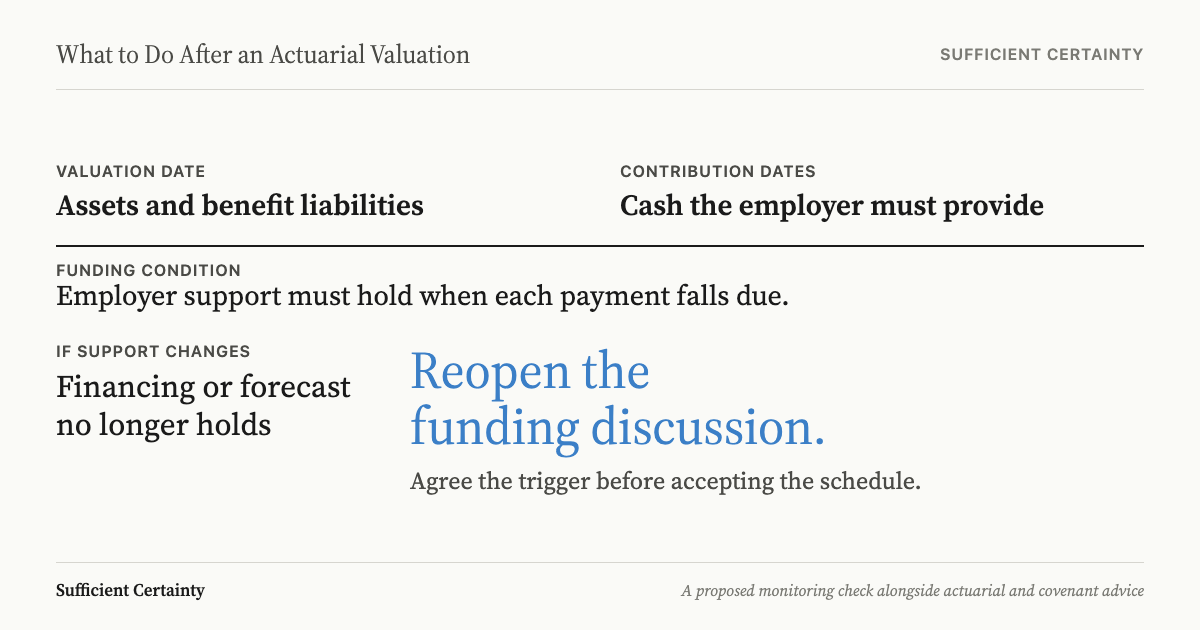
If the proposed schedule leaves little capacity for a less favourable outcome, identify that dependency before agreement. Ask advisers which alternatives deserve consideration and what evidence would distinguish them. The purpose is to make the dependence visible, rather than to select a contribution level from a generic rule.
Which future payment depends on employer support that needs a fresh check? Start the Walk →
Silentnight’s recovery plan depended on later contributions
The Silentnight regulatory intervention report describes a recovery plan based on the December 2008 valuation. The ongoing deficit was £39.5 million. The 29-year plan began with low contributions and increased them later, allowing funds to be retained for potential refinancing.
The report describes a change in the company’s lending arrangements and a later administration sale without the pension scheme. It records that the revolving credit facility was withdrawn on 6 May 2011. Administrators were appointed the following day. Those events show why the ability to make later contributions depended on more than the valuation figures.
The regulator pursued anti-avoidance allegations, which the targets disputed. The case settled in February 2021 with no admission of liability. The Determinations Panel made no findings on the events described. The report does not establish that a shorter recovery plan or a particular monitoring trigger would have prevented the outcome.
For a reader agreeing a funding schedule, the proposed lesson concerns what to monitor. Identify any financing decision that supports later payments. Record when evidence of that financing should arrive and who will examine it. An annual calendar review may occur too late if a crucial facility changes between meetings.
Keep the actuarial assumptions and the employer’s financing assumptions distinct. The actuary may revise estimated liabilities when relevant evidence changes. A lender may change the employer’s access to cash for a different reason. Either can affect the funding decision. A monitoring plan should identify the appropriate specialist and decision owner for each change.
Use the approach after financial due diligence to connect a concern to evidence that someone can inspect. For this funding agreement, that evidence might be a confirmed financing document or a revised cash forecast accepted by the relevant advisers. These are reader applications, not claims about the checks Silentnight’s trustees performed.
A change in valuation basis can change the reported funding position. Ask the actuary to separate that effect from changes in assets, obligations and employer support.
Set the conditions that reopen the funding agreement
Write a monitoring note alongside the funding agreement before it is approved. Name the dependencies, evidence sources and people who must respond. Keep it short enough to use at the next review. Its purpose is to prompt another decision while there is still time to consider alternatives with advisers.
For each material dependency, state an observable change. If later payments depend on refinancing, identify the relevant financing milestone and the evidence required. If expected cash relies on a trading assumption, ask the covenant adviser what change would require reassessment. Agree the trigger with the people who will use it.
Check how the monitoring evidence will reach trustees. Ask who supplies updated forecasts and whether the scheme can obtain relevant financing information in time. If access depends on an informal relationship, identify that weakness before agreement. A trigger cannot work if nobody responsible for acting can see that it has occurred.
Set the timing of the response as well as the trigger. Identify who receives the information, who assesses its significance and which body can reopen the funding discussion. A dashboard warning has limited value if it waits for the next scheduled meeting while the funding decision becomes harder to change.
Record the difference between reviewing an assumption and changing a binding obligation. A monitoring trigger does not itself amend contribution terms or remove legal responsibilities. It tells the responsible parties to obtain advice and decide what action is available. The funding documents and applicable law govern what they can change.
The Universal Decision-Making Method places monitoring within implementation. For an actuarial valuation, that means deciding what would make the agreed funding response need another look. A report update and an employer event should each reach the right person without waiting for a missed payment.
Use the discipline after sensitivity analysis to identify which changes matter to the commitment. Then keep the agreed contributions, current evidence and reopening conditions together. A later trustee or manager should be able to see what the decision depended on and whether those conditions still hold.
Give the funding agreement a clear reason to reopen before a contribution is missed.
Work through your decisionNo sign-up. Just pick your decision and start.
Grant Purdy is the co-author, with Roger Estall, of Deciding (2020), and the architect of the Universal Decision-Making Method.