
After an after-action review, most teams move straight to the remediation plan. The step they skip is testing the assumptions behind each finding before committing resources. The review captures what happened and what should change. It does not test whether the conditions for that change exist.
On 23 March 2005, an explosion at BP's Texas City refinery killed 15 workers and injured more than 180. BP had conducted multiple internal safety reviews in the years before the blast, and every one had identified the same process safety deficiencies. None had tested whether the organisation would actually fix what was found.
An after-action review is a structured debrief conducted after an event or project to capture what happened, why, and what should change next time.
BP Texas City and the assumption nobody checked
The Texas City refinery had been the subject of several internal audits and after-action-style safety reviews before the explosion. The Telos Group, an independent consultancy commissioned by BP in 2004, explicitly flagged deteriorating infrastructure, cost pressures on maintenance, and a widening gap between documented safety standards and actual plant conditions.
Earlier internal reviews had reached similar conclusions, citing aging equipment and inadequate process safety management. The findings were clear each time. The same problems appeared in review after review.
What changed between reviews was not the condition of the plant but the volume of documentation recording its decline. Each review produced lessons. Each set of lessons generated action items. The action items assumed that BP's management would allocate the necessary budget, that local leadership would prioritise safety investment over production targets, and that the corporate reporting structure would surface non-compliance before it became catastrophic.
None of those assumptions were tested. They were treated as background conditions, not variables.
The Baker Panel, an independent safety review commission appointed after the explosion, published its findings in 2007. The panel found that BP's corporate safety management relied on personal safety metrics, such as lost-time injury rates and slip-and-fall data, while process safety indicators went largely untracked at the corporate level.
It found that prior reviews had repeatedly identified the same process safety deficiencies, but remediation plans assumed organisational willingness and budget that never materialised. The pattern was not a failure of analysis. It was a failure to test what the analysis took for granted.
The US Chemical Safety Board's investigation reached a parallel conclusion. BP had reduced maintenance spending at Texas City by 25 percent between 1998 and 2004, even as internal reviews continued to flag infrastructure deterioration.
The reviews kept producing findings. The organisation kept not acting on them. The assumption connecting the two, that identifying a problem is the same as addressing it, was never surfaced, let alone challenged.
This is the canonical case for what the safety literature calls "lessons identified, not lessons learned." It appears wherever organisations conduct structured debriefs, from military reviews to sprint retrospectives, and then treat the resulting action items as self-executing.
The after-action review captures what happened and what should change. It does not test whether the conditions for that change exist. When those conditions are absent, the same lessons appear in the next review, and the one after that, until something breaks badly enough that the pattern becomes visible from the outside.
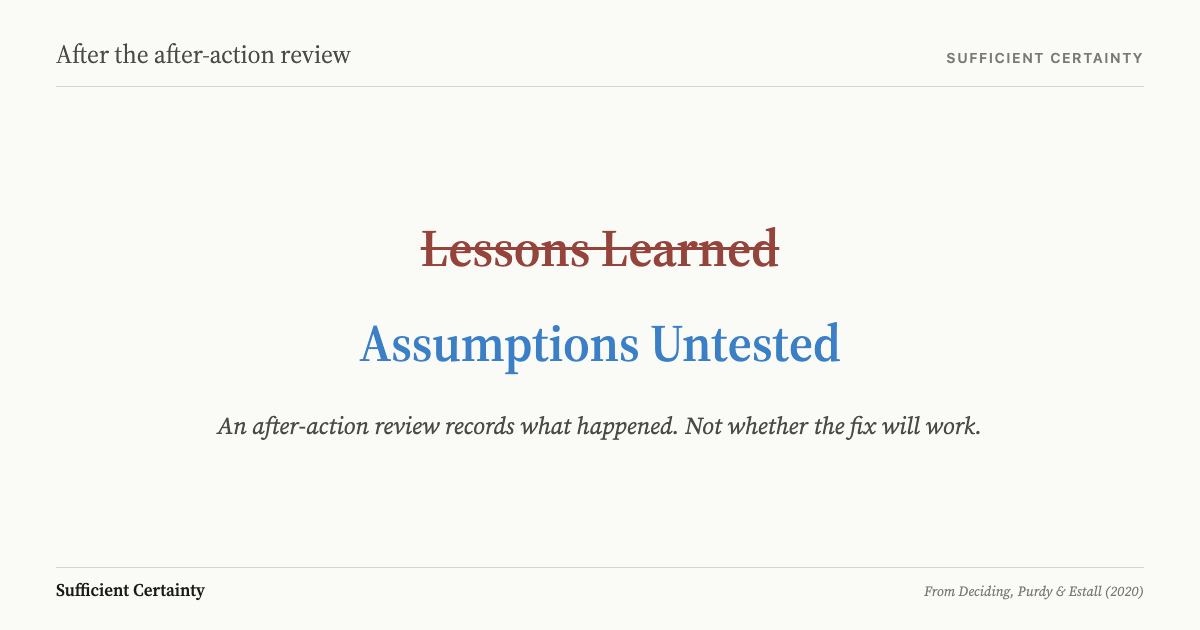
What an after-action review gets right, and where it stops
The after-action review, as a format, does something most decision tools do not: it forces a structured conversation about what actually happened rather than what the plan said should happen. Most post-event analysis drifts toward narrative coherence, a clean story about why things went wrong that fits existing beliefs.
The AAR format, particularly as developed within military training doctrine and studied in organisational psychology, counters that drift by requiring participants to compare intended outcomes against actual outcomes and identify the gap.
This contribution to decision quality is genuine. The format separates observation from interpretation. It creates a record of what the team believed going in and what they found coming out.
In organisations that conduct AARs well, the format builds a culture of honest debrief rather than blame assignment, which is a prerequisite for the kind of assumption surfacing that prevents recurrence.
But the format has a boundary, and the Texas City case illustrates it precisely. The AAR produces findings and may produce action items. What it does not produce is a test of the assumptions those action items rest on.
The AAR concludes that shift handovers were inadequate and recommends a formal protocol. Six months later, the protocol exists on paper but shift supervisors stopped enforcing it in week three because staffing levels made the extra step unworkable.
Before finalising the handover protocol, the team tests whether current staffing levels allow the extra step. The assumption fails, and the action item is redesigned around the actual constraint rather than an idealised one.
Consider the standard output of an after-action review: a list of lessons, each paired with a recommended action. "Maintenance intervals were too long; reduce them to quarterly." "Communication between shifts was inadequate; implement a formal handover protocol."
Each recommendation contains embedded assumptions. The maintenance recommendation assumes budget will be allocated. The handover protocol assumes supervisors will enforce it and that enforcement will persist beyond the first month.
When the AAR stops at "lesson identified, action recommended," it treats those assumptions as resolved. They are not resolved.
They are the next set of things that need to be checked before the organisation commits resources. Without that check, the AAR becomes a documentation exercise: thorough, well-structured, and disconnected from what the organisation will actually do.
The difference between a lesson identified and a lesson learned sits in that gap. So does the difference between a post-mortem analysis that changes behaviour and one that merely records what went wrong. The quality of the review is not the problem. The problem is the untested space between the review's output and the organisation's next commitment.
Write down the assumption your most critical action item depends on and ask whether anyone tested it before the remediation plan was finalised. Start the Walk →
The checkpoint between analysis and action
The gap is not in the review itself. It sits between the review's output and the organisation's next decision. That gap needs a checkpoint, not more analysis.
The Universal Decision-Making Method provides the structure for this checkpoint. The method's five steps, Frame the decision, identify Tentative Elements, surface Assumptions, determine Sufficient Certainty, and build Implement and Monitor conditions, apply directly to the post-AAR moment.
The review has produced findings. Those findings imply a set of remediation decisions. Each remediation decision carries assumptions about resources, authority, organisational willingness, and timeline.
The checkpoint is straightforward: name those assumptions before committing to the action plan.
This is not a second review. It is a decision step. The after-action review answers "what happened and what should change." The checkpoint answers "what is being assumed about the conditions for that change, and what will signal if those assumptions are wrong?"
In the Texas City case, the checkpoint would have surfaced a specific question: does the organisation have the budget and the management commitment to execute these remediation plans? That question was answerable. It was not answered because nobody framed it as a question. It sat inside the action plan as a background assumption, invisible and untested.
The discipline is not complicated. After the review, before the action plan is finalised, list the assumptions the plan depends on. Test the ones that matter most. Build monitoring into the ones that cannot be tested immediately.
Organisations that make good decisions despite uncertain conditions do this as a matter of course. What separates lessons identified from lessons learned is not better documentation but better decisions about what the documentation actually requires of the organisation.
You could close the review and assign every action item and still leave the assumption behind each one untested.
Work through your decisionNo sign-up. Just pick your decision and start.
Grant Purdy is the co-author, with Roger Estall, of Deciding (2020), and the architect of the Universal Decision-Making Method.