
After a break-even analysis, the step before committing fixed spending is to ask the sales or operations owner for evidence supporting the forecast sales volume. Euro Disney reported positive operating income before fixed and administrative expenses of FF1,186 million in fiscal 1994, alongside a consolidated net loss of FF1,797 million. Those figures from its 1994 annual report show why the next check must cover both achievable sales and the costs the calculation includes.
Break-even analysis estimates the sales needed to cover the costs included in a calculation, given stated prices and cost assumptions.
Match the break-even volume to a sales plan
The completed analysis gives finance a sales threshold. The next task is to connect that threshold to the proposed commitment. Name the spending decision, its approval date, and the period over which sales must cover costs. A monthly threshold needs a monthly sales plan. An annual total can conceal a shortfall before the busiest season begins.
Ask the sales owner to identify where the required orders will come from. Check confirmed orders separately from enquiries. Record the expected order dates and the prices customers would actually pay. Ask operations whether the business can deliver those orders with the staff and facilities included in the calculation. The sales threshold needs evidence from the people responsible for reaching it.
Check the units as well. An order, a visit, a room night, and a customer are different measures. Repeat purchases must not become extra customers in one worksheet and extra orders in another. The work after market sizing can establish the potential market. Here, the question concerns the sales this operation can achieve during the commitment period.
| Break-even output | Assumption behind it | Evidence to check |
|---|---|---|
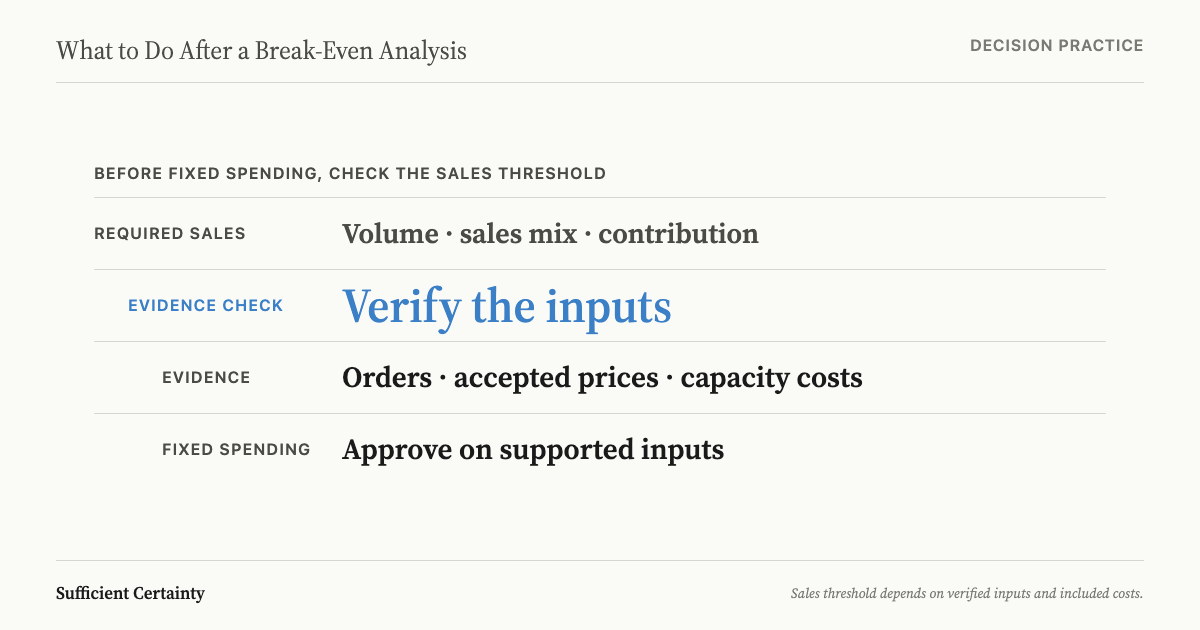
| Required sales volume | Enough orders arrive within the cost period | Order records and dated sales commitments |
| Average contribution per sale | The expected product and price mix holds | Recent sales by product, discount, and channel |
| Fixed cost total | Existing capacity covers the required volume | Staff schedules, capacity limits, and contract terms |
Put the evidence beside the original inputs rather than in a separate presentation. Keep the calculation date visible. Where there is no evidence, label the input as an assumption. That prevents a sales target copied into the model from being presented later as a verified forecast.
Check the planned start date against the sales evidence. Orders expected after a delayed opening cannot cover costs due before those orders arrive. Ask the sales owner to explain any increase from recent sales to the forecast. Record the customer commitments or operational changes that support that increase.
Before approving fixed spending, connect each important input to current evidence or a named assumption. This keeps the analysis useful within a data-driven decision, while making clear what still needs judgment.
Which sales inputs have current evidence behind them before fixed spending is approved? Start the Walk →
A break-even point shows the required sales level
Break-even analysis makes a proposal easier to examine. It translates a cost commitment into a sales requirement. OpenStax explains the calculation as fixed costs divided by contribution per unit. Contribution is the selling price less the variable cost of that sale. The result lets the decision-maker compare required sales with planned sales and available capacity.
That comparison can expose a practical problem before money is committed. If the threshold exceeds deliverable output, revisit the proposal. If it depends on a price customers have not accepted, test that price. If a cheaper facility lowers the threshold, compare it with the original option. These are useful consequences of doing the analysis carefully.
A break-even calculation gives the sales plan a clear requirement to meet. It also supports a review of discounts. A lower price can increase demand while reducing the contribution earned on each sale. The sales owner and finance owner can examine both effects before approving a promotion.
The analysis also makes cost classifications visible. The US Small Business Administration recommends separating mixed costs into fixed and variable parts where possible. Ask finance which costs remain payable when sales fall. Ask operations which additional costs appear when activity rises. The contract and the staffing schedule should support those answers. For a retain-or-exit decision, the follow-up to profitability analysis distinguishes attributed costs from spending that would actually cease.
The result serves a different purpose from the work after NPV analysis, which examines value across future cash flows. This checkpoint concerns the achievable sales mix and cost behavior behind a particular commitment. Keep the period, cost scope, and sales mix visible whenever the threshold is used for approval.
Why did Euro Disney report a loss despite a positive operating subtotal?
Euro Disney S.C.A.'s report covers the fiscal year ended 30 September 1994. Its income statement separates operating income before fixed and administrative expenses from depreciation, lease charges, administrative costs, and financing. The positive amount quoted above was therefore an intermediate result. It was not a final profit, or proof that all the business's costs had been covered.
The statement records FF889 million in lease expense, FF854 million in general and administrative expense, and FF434 million in net financial expense. Depreciation and exceptional losses also affected the result. All these amounts are French francs, not euros. A positive result before major charges cannot establish that the whole commitment breaks even.
The management report also records park attendance down 10% and spending per visitor down about 4% from fiscal 1993. Management linked weaker spending partly to lower off-peak prices and fewer visitors during peak-price periods. This matters when a calculation uses one average contribution for every visit.
The report does not establish that management used a particular break-even model. Nor does it isolate one assumption as the cause of the loss. The decision lesson is an application of the published results: examine visit volume and revenue per visit separately, then reconcile the operating result with the charges still payable.
For a current proposal, ask what would happen if extra sales came from discounted products or quieter periods. The total unit count could match the plan while contribution remained lower than expected. Check the actual mix before treating a recovered sales total as evidence that the original threshold still applies. Sensitivity analysis can show which changes matter enough to reopen the spending decision.
The same check applies to capacity. Additional sales may require another shift or a new facility. Recalculate the costs for that operating level before using the original threshold. The approval needs achievable contribution after the relevant costs, rather than a unit count considered alone.
Test the sales mix before committing fixed spending
Prepare a one-page break-even evidence sheet for the approval meeting. Identify the commitment and the last date it can be changed. Record the sales period, required volume, and expected mix. Beside each important assumption, name its owner and the evidence checked. Include the costs left outside the calculation and explain how the business will pay them.
Use ACCA's stated limitations to guide the checks. Its cost-volume-profit guidance assumes a stable sales mix and fixed costs within the relevant activity range. Ask whether the proposed operation meets those conditions. Where it does not, calculate the threshold using the expected mix and the costs of the intended operating level.
Select an evidence check that fits the uncertain input. For sales volume, compare dated orders with the required delivery period. For price, inspect accepted quotes and realized prices. For costs, check supplier terms and the extra staff needed at higher output. Test the assumption that could change the commitment before refining inputs that would not change it.
If the evidence is weak, change the commitment itself. Consider delaying a lease, reducing the initial capacity, or agreeing a shorter contract. Record what each option would change in the calculation. The Universal Decision-Making Method helps connect those assumptions to the decision and the evidence needed before acting.
Set a review trigger before approval. Require a fresh calculation if the sales mix changes enough to reduce expected contribution, or if required capacity adds fixed costs. Give a named owner authority to bring the decision back before the next spending tranche. This is more useful than a review date that allows further commitments while the original inputs are already outdated.
Keep the supporting order records and cost quotations dated. A later reviewer should be able to distinguish the evidence available at approval from information received after the commitment.
Approve the spending when the evidence supports the required sales mix and the resulting cost commitment. Keep the evidence sheet with the decision record. It should show what supported approval and what would require the decision-maker to reconsider.
Record the sales mix and cost assumptions that justify this spending commitment.
Work through your decisionNo sign-up. Just pick your decision and start.
Grant Purdy is the co-author, with Roger Estall, of Deciding (2020), and the architect of the Universal Decision-Making Method.