
After NPV analysis, the step worth taking before you act on the number is to name the three or four assumptions the model depends on most and test whether each one holds. The NPV itself cannot do this. It inherits every assumption behind its inputs and returns a single figure that feels precise regardless of whether those inputs have been verified. Testing them is the checkpoint between analysis and commitment.
In 1987, a consortium of banks and private investors committed billions to bore a rail tunnel beneath the English Channel. Every financial model confirmed the project would generate strong positive returns. Within a decade, Eurotunnel had defaulted on its debt, its original shareholders were wiped out, and the Channel Tunnel stood as the most expensive lesson in the difference between a confident projection and a tested assumption.
Net present value analysis discounts projected future cash flows to a single present-day figure, producing a go-or-wait verdict on an investment.
Eurotunnel and the assumption nobody checked
The Channel Tunnel's investment case was built on a detailed net present value analysis. Demand models projected more than 30 million passengers in the first year of operation, with steady growth from there. Construction was estimated at £4.65 billion. Revenue would begin flowing by 1993. At the chosen discount rate, the NPV came out strongly positive, and the project cleared every financial hurdle a lender could set.
The models were not crude. They drew on transport demand studies, engineering estimates, and macroeconomic forecasts from reputable consultancies. The discount rate reflected prevailing market conditions. Passenger projections referenced existing cross-Channel traffic volumes and assumed the tunnel would capture a logical share of a growing market. Every individual input looked defensible in isolation. No single number was obviously wrong.
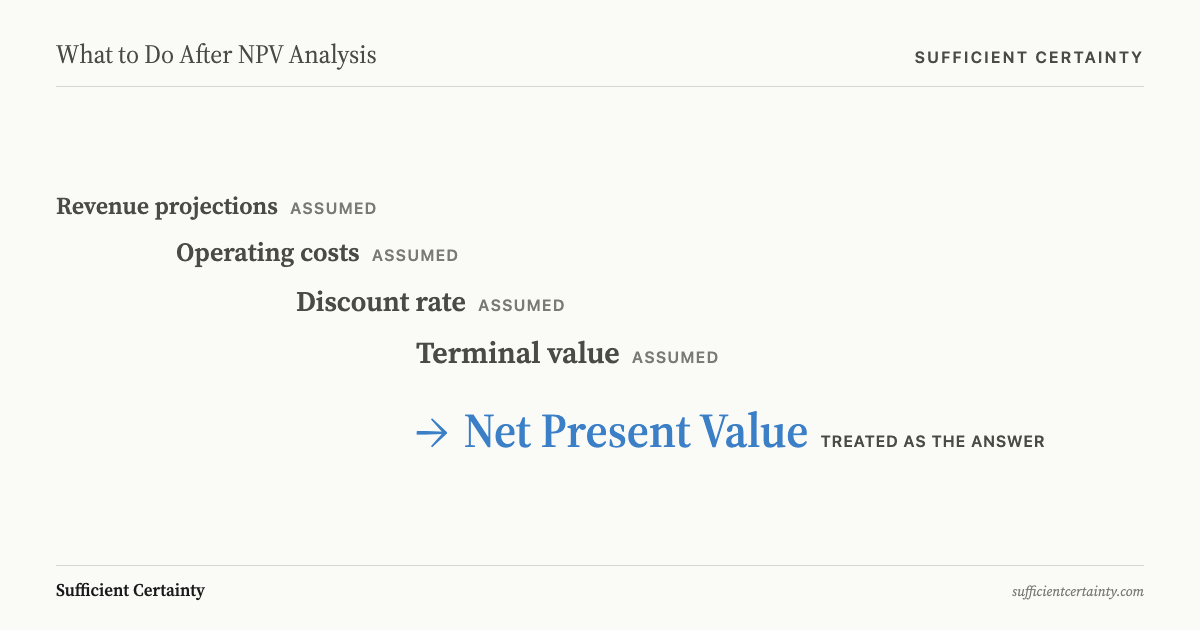
What failed was not the arithmetic. It was the assumptions feeding it. Actual first-year passengers came in below three million, roughly a tenth of the projection. Construction costs exceeded £9.5 billion, more than double the estimate. The revenue start date slipped past 1994. Each of these numbers had entered the model as a point estimate, a single figure treated as settled, when none of them was. Anguera's (2006) post-completion analysis documented just how far the actuals diverged from the forecasts that had justified the original capital commitment.
The passenger forecast assumed ferry operators would not cut prices in response to the tunnel. They did, aggressively, the moment it opened. The cost estimate assumed fixed-price construction conditions, ignoring the geological uncertainty of boring through chalk marl under the seabed. The revenue timeline assumed regulatory approvals would proceed on schedule. They did not. These were not modelling errors. They were untested beliefs about how competitors, geology, and regulators would behave, embedded in a spreadsheet and never surfaced for scrutiny.
The consequence for investors was total. Eurotunnel's share price collapsed. The company restructured its debt in 1998, converting large tranches into equity and wiping out the private shareholders who had backed the original NPV case. A project that the models said would create value destroyed it instead. The tunnel functions. The trains run. As an investment, it is a case study in what happens when confident analysis produces catastrophic outcomes.
The Channel Tunnel is not an outlier. Flyvbjerg's (2014) cross-sector analysis of megaprojects found that cost overruns of 50% or more are the norm and that rail traffic forecasts overestimate demand by an average of 106%. The pattern is consistent: detailed financial models, built on inputs nobody tested, producing numbers that feel precise but rest on nothing more than conviction.
Write down the assumption your NPV model depends on most and ask whether anyone tested it before the capital was committed. Start the Walk →
What NPV analysis gets right and where it stops
NPV analysis does something simpler methods cannot. It forces a time dimension into the evaluation. A cost today and a benefit in five years are not equivalent, and by discounting future cash flows to the present, NPV makes that difference explicit. It compels the analyst to state a discount rate, project revenues period by period, and commit to a cost structure. The discipline of building the model is itself valuable. For quantitative evaluation of competing investment alternatives on a common basis, nothing in standard finance does the job better.
This is why NPV remains the dominant capital budgeting tool. Graham and Harvey's (2001) survey of nearly 400 CFOs found that 75% always or almost always use NPV when evaluating investment decisions. The method forces structured, data-driven thinking about timing, magnitude, and the cost of capital. That structure is genuine and worth preserving.
But the structure has a boundary. NPV produces a single number, and that number inherits every assumption behind it. If the discount rate, the growth forecast, the cost estimate, and the revenue timeline are all correct, the output is reliable. If any of them is wrong, the output shifts by at least the same magnitude, with no visible warning. The precision of the output masks the fragility of its inputs.
Sensitivity analysis, the standard supplement, adjusts one input at a time while holding the rest fixed. This catches individual parameter errors but misses correlated failures, which are the ones that matter most in practice. In the Channel Tunnel case, the cost overrun, the demand shortfall, and the revenue delay arrived together. A ferry price war drove down revenue while geological complications drove up costs and regulatory delays pushed back the entire timeline. No single-variable test would have flagged that combination. The result is a model that answers a question about evidence with arithmetic instead of inquiry.
The method dictates what to do with the inputs. It does not ask whether those inputs have been tested. That is a different question, and answering it requires a step that most teams analysing investments under uncertainty skip entirely.
The checkpoint between analysis and action
An NPV model is not a decision. It is an input to a decision, in the same way that a financial due diligence report is an input to the price. The step most teams skip is the one between running the model and acting on its output: surfacing the assumptions the model depends on and testing whether those assumptions hold before capital is committed.
The five-step method outlined in Deciding provides a practical structure for this checkpoint. Frame the purpose of the decision. Identify the tentative elements that could change the outcome. Surface the assumptions explicitly, stating what must be true for the NPV case to hold. Determine whether the evidence behind each assumption provides sufficient certainty to act. Then implement the decision with monitoring designed into it from the start.
For an NPV-backed investment, this means naming the three or four assumptions the model depends on most and asking one question about each: what evidence supports this number? Not what precedent. Not what benchmark. Not what the consultant's model produced. What evidence, gathered and tested, supports treating this input as reliable enough to commit resources against.
In the Channel Tunnel case, that single question applied to the passenger forecast would have revealed that it rested on market-share assumptions with no competitive-response analysis behind them. Applied to the cost estimate, it would have surfaced the geological uncertainty that the fixed-price model concealed. The analysis was thorough. The assumptions behind it were never examined as assumptions.
The checkpoint is not a replacement for NPV analysis. It is the step that makes the analysis useful. Without it, the most rigorous financial model is a mechanism for converting untested beliefs into false precision.
You could approve the investment case and still leave every assumption behind the NPV number untested.
Work through your decisionNo sign-up. Just pick your decision and start.
Grant Purdy is the co-author, with Roger Estall, of Deciding (2020), and the architect of the Universal Decision-Making Method.