
After a business impact analysis, compare one critical process's downtime limit with the recovery evidence for its supporting systems. A recovery priority can be justified by business impact and still depend on systems that cannot recover soon enough. Check that connection before approving the priorities.
A business impact analysis identifies how disruption affects essential work over time and establishes the recovery requirements for that work.
Connect each business-impact priority to its dependencies
The completed BIA gives the next piece of work a starting point. Choose a process whose interruption would prevent an essential service. Put its impact horizon beside the systems and shared services needed to resume it. Use the actual process owner and system owners to check the connection.
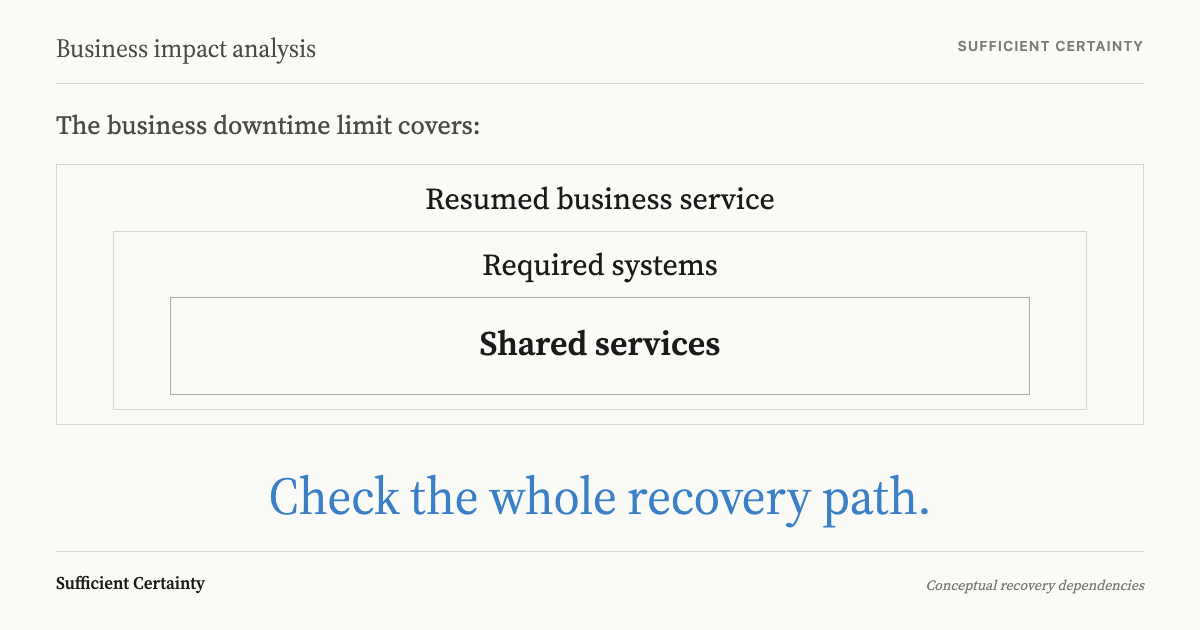
Start with the service requirement, rather than a general label such as critical. State what people must be able to do when service resumes. Then identify which supporting resources must be available first. A process can need several applications even when only one application carries its name.
NIST's contingency planning guide places the BIA within work to establish recovery requirements and priorities. It also provides a BIA template. Those outputs help shape a recovery strategy. The proposed check here connects those requirements to evidence about the resources behind them.
Keep the BIA and the operational system list open together. Compare names, service owners and required recovery times. A renamed application, replacement platform or newly shared service can make the two records describe different arrangements. Match the priority to the resources that make it possible.
| What the BIA produced | What it assumed | Gap to test |
|---|---|---|
| A maximum tolerable downtime | Supporting systems recover within that limit | Compare the limit with recovery evidence |
| A ranked list of critical processes | Shared services follow the same recovery order | Check the shared service's recorded priority |
| A required level of resumed service | Restored systems let people resume the work | Include the time needed to restart the process |
This is a check on the analysis before it becomes an approved recovery order. It does not require rewriting the whole continuity plan. The risk assessment question is whether the proposed arrangement can deliver the required service. Clarifying the purpose of the decision gives that check a definite result to examine.
An impact analysis gives recovery work an order
A BIA makes the consequences of delay explicit. It helps distinguish work that must resume promptly from work that can wait. That distinction matters when recovery resources are limited. The business requirement can then guide the technical recovery order, rather than allowing the easiest system to restore to set it.
The IRS BIA security policy describes both process-based and system-based analysis. It requires identification of supporting systems and incorporation of BIA results into recovery planning. It treats dependencies as part of the analysis. Checking the evidence behind them therefore strengthens a useful output.
Retain the reasons for each priority. A process owner may need service restored before a payment deadline or a customer commitment. Another process may have a workable manual alternative. Those differences need examination before money is committed to faster recovery. The recovery order must serve the business requirement.
The completed analysis also gives business and technical owners a common comparison. They can see where a requested recovery time exceeds current capability. The risk assessment process becomes useful when that difference changes a decision about resources or priorities.
Check whether the recovery evidence for supporting systems matches the service requirement in the business impact analysis. Start the Walk →
Can the supporting service recover in time?
A recovery target states what is required or intended. A measured recovery time provides evidence of what happened under stated conditions. Keep those entries separate. Copying a business downtime limit into a system target does not establish that the system can meet it.
The dependency can also begin before the application itself. The application may require its hosting service to be restored first. People may then need time to check data and restart business work. A measurement that begins after those preparations cannot establish the time needed to resume the complete process.
- Critical processes and impact horizons
- Recovery priorities and service requirements
- Shared services needed before applications restart
- Actual recovery times for required systems
- Time needed to resume business work
- Changes since the last recovery evidence
The items above are proposed checks, not findings about every BIA. Use them to identify what the recovery evidence actually covers. Ask when its clock started and what had already been restored. Check whether the result includes the required shared services or records only the named application.
Compare the same recovery boundary on both sides. The business limit and the measured time must refer to compatible starting points and service levels. Otherwise, a short application recovery time can appear to satisfy a requirement that also includes hours of preparation or work recovery.
Examine the conditions behind the result. A recent measurement may still depend on capacity, staff availability or a supplier service that has changed. Mark the missing evidence against the affected priority. The assumptions behind the decision become specific enough to test when each refers to a named dependency.
A discrepancy does not automatically justify buying the fastest recovery service. It may support a different process, a changed sequence or a funded improvement. A missing dependency can change the proposed recovery order. Compare the options before treating the BIA's priority list as ready for approval.
IRS recovery targets needed better impact evidence
The Treasury Inspector General for Tax Administration examined IRS recovery arrangements in audit report 2023-20-023, issued on 8 May 2023. Three mission-essential functions depended on fifty information systems. The report stated that BIA results determined recovery priorities and fed disaster recovery plans.
Yet the June 2022 planning tool contained only twenty-one of those fifty systems. It also incorrectly included seven others. Forty-five systems had recovery time objectives longer than the functions' twelve-hour maximum tolerable downtime. Cybersecurity staff said they had not been informed of the March 2020 requirement.
In FISMA years 2021 and 2022, forty systems were tested. Eight exceeded twelve hours; thirty-two met the requirement. The audit also found unclear documentation of whether application recovery times included hosting services. The business limit had to reach the supporting system records.
These were historical audit findings about arrangements and tests, not a reported failure during a live outage. Twelve hours was the IRS requirement in this report. It is not a general limit for other organisations. The report recorded improvements, including six previously untested systems meeting requirements in FISMA year 2023.
The official recommendation record for maintaining the planning tool now shows closure. The case therefore supports a practical check between business requirements and operational records. It does not establish the IRS's present recovery capability.
A useful application is to compare the same process across the BIA, system list and recovery evidence. The review after a disaster recovery test examines what a measured result supports. Here, the decision is earlier: whether the priorities produced by the impact analysis have credible supporting dependencies.
Check one recovery path before approving priorities
Select one essential process before the recovery priorities are approved. Record its maximum tolerable downtime beside each required system's recovery target and latest relevant evidence. Include supporting services and time needed to resume the work. Ask the owners to identify any missing dependency or incompatible measurement.
Where evidence is missing, record what must be checked before approval. Where capability falls short, compare a faster recovery option with a different way to maintain the service. Avoid reducing the service requirement simply to match a convenient technical target. Resolve the mismatch before relying on the priority.
The Universal Decision-Making Method connects this work to the decision being made. State the required service, compare workable arrangements and examine the assumptions carrying the preferred option. The evidence needed should reflect the consequences of accepting an unsupported recovery promise.
Keep the result in the decision record. Name the accepted recovery arrangement and the unresolved limits. Set a review trigger for a changed dependency or downtime requirement. A new hosting service, for example, should prompt a check of the affected recovery path before its old priority is reused.
Approve priorities supported by a complete recovery path. That gives the next recovery-planning decision a clear business requirement and evidence that its essential dependencies can meet it.
How confident are you that every system behind the BIA's first recovery priority can meet its downtime limit?
Work through your decisionNo sign-up. Just pick your decision and start.
Grant Purdy is the co-author, with Roger Estall, of Deciding (2020), and the architect of the Universal Decision-Making Method.