
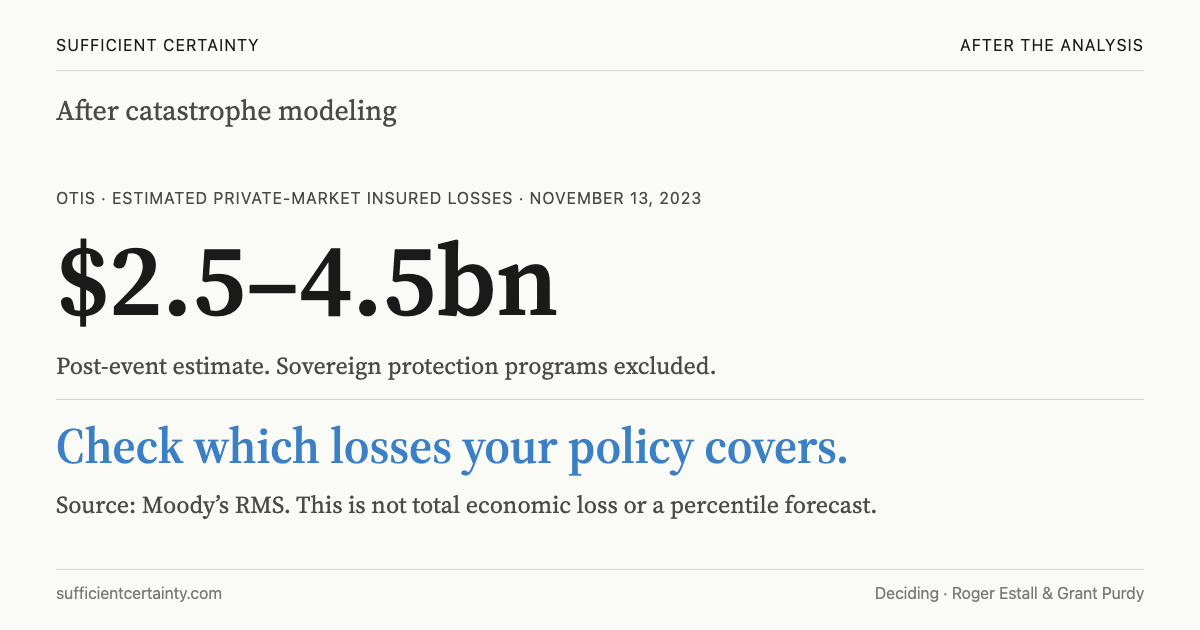
After catastrophe modeling, place the modeled asset schedule beside the proposed insurance schedule and mark every mismatch before approving a limit. Moody’s RMS estimated private-market insured Otis losses at US$2.5–4.5 billion after the event. That published range had defined coverage boundaries; it was neither total economic loss nor a portfolio percentile forecast.
Catastrophe modeling estimates losses from simulated catastrophic events using information about hazards, exposed assets, their vulnerability, and financial terms.
A catastrophe model estimates losses within stated boundaries
A completed catastrophe model provides a structured estimate of loss under stated conditions. The NAIC explanation of catastrophe models distinguishes the hazard, vulnerability, exposure, and financial components. Policy conditions enter the financial calculation. The output therefore depends on more than the event itself.
An insurance-limit decision needs the loss measure and its coverage basis beside the number.
Identify the specific output being used. A report may show expected annual loss, a loss associated with an exceedance probability, or a post-event estimate. These measures answer different questions. Do not use a number in an approval paper until the analyst has identified which question it answers and which losses it includes.
For a portfolio probability output, record whether it describes occurrence loss or annual aggregate loss. Record the probability basis and the version of the modeled portfolio. Retain the original label rather than replace it with a vague phrase such as “worst case.” The person approving the limit needs to know what the selected point means.
The model also helps compare alternatives under a common set of assumptions. A change in deductible or limit can be examined against the same exposure information. That comparison becomes less useful when the alternatives quietly use different schedules. Keep the input version visible throughout the comparison.
This belongs within data-driven decision-making for the actual insurance commitment. The following checkpoint concerns the connection between modeled property and the cover being purchased. Broader discussions after scenario analysis can help examine alternatives, but they do not resolve a mismatch between a schedule and a policy.
Keep the report’s gross and net labels intact. Ask the analyst to explain any transformation between physical damage and the loss figure used for approval. If the paper combines outputs from separate runs, identify each one. A decision-maker should not have to infer whether a quoted number already includes financial terms or whether those terms will be applied later.
Which losses would the proposed insurance actually cover?
Trace the assets in the model to the assets in the proposed insurance arrangement. Compare the named locations and their insured values. Identify additions, removals, and known uncertainties in the schedule. Ask the property owner to resolve a missing or disputed entry before treating it as part of the modeled protection.
A modeled loss cannot establish protection for an asset that the insurance arrangement does not cover.
Then compare the event and peril boundaries. Ask which hazards were modeled and which are covered by the wording under review. Check the relevant exclusions with the broker and insurer. Keep unresolved wording questions separate from uncertainty about physical damage. They may require different evidence and different decision-makers.
| Modeled output | What it assumed | Gap to test |
|---|---|---|
| Property loss estimate | The asset schedule matches the intended cover | Reconcile locations and values |
| Peril-specific loss | The proposed policy covers that peril | Check wording and exclusions |
| Insured loss after financial terms | The run uses the proposed deductible and limit | Match the financial assumptions |
The NAIC description of the financial module explains that insured-loss calculations incorporate policy conditions. Deductibles and limits therefore belong in the comparison. A model run using assumed terms cannot by itself confirm that those terms appear in the proposed contract. Obtain the relevant wording and retain the specialist interpretation.
Decide how much uncertainty is acceptable for this purchase before asking for another model run.
Some uncertainties can change the choice of limit. Others may have little effect on the available alternatives. Ask the analyst which unresolved input could move the decision, then choose a check that addresses it. Correcting an asset value may be more useful than adding precision to a model whose exposure schedule is incomplete.
Use sensitivity analysis follow-up when an uncertain input could change the preferred option. Preserve the original run and make the changed assumption explicit. Keep physical-loss uncertainty visible alongside coverage uncertainty. A narrower modeled range does not settle an exclusion in the wording.
Does the modeled asset schedule describe the protection being approved? Start the Walk →
Otis produced a post-event insured-loss range
Moody’s RMS published its Otis estimate using ensemble footprints and an industry exposure database. The specified coverage included property damage and business interruption, while excluding sovereign protection programs.
This dated post-event estimate describes private-market insured loss. It is neither final claims nor an insurer-specific result. It does not express total economic loss or an annual exceedance probability.
The Otis estimate shows why a loss number must retain its stated insurance boundary.
The proposed procedure is to apply that boundary discipline to a separate insurance purchase. This is an inference about decision practice, not evidence that a particular Otis insurer omitted a check. A manager cannot take the industry figure and infer the amount its own policy would pay. The organization needs its own assets, terms, and loss basis.
Ask the approval paper to distinguish what is modeled from what is excluded. If the selected output omits a loss type important to the organization, describe that omission beside the recommendation. Decide whether a separate analysis or different protection is needed. Do not hide the omission inside a general limitations appendix.
The output may still be useful even when it is incomplete for the decision. State which part of the purchase it supports. Keep a separate record of the exposures it cannot address. This is the same discipline of stating consequential assumptions in decision-making before relying on an analysis.
Match coverage evidence to the limit decision
Prepare one reconciliation note before approving the limit. Identify the model run, asset schedule, selected loss measure, and proposed coverage version. State each material mismatch and who will resolve it. Keep that note with the recommendation so the approving person can see whether the model describes the protection being purchased.
Approval should state what the organization will retain as well as what it expects insurance to cover.
Ask for a decision-ready comparison of the available limits under the same assumptions. Show which uncertainty would change the preferred choice and which would leave the comparison unchanged. If no available policy covers an important exposure, record that fact directly. The resulting decision may involve retaining the exposure or changing the asset plan, rather than purchasing a higher limit with the same exclusion.
Consider the consequence of being wrong about the selected limit. Determine which uncovered losses the organization could bear and which require another response. That judgment belongs to the responsible decision-maker with appropriate insurance and financial advice. The model informs it, but does not supply a universal acceptable threshold.
The Universal Decision-Making Method connects this evidence to the purpose of the commitment. State the intended protection, name the assumptions that matter, and decide whether the available support is sufficient. If a missing fact could change the purchase, obtain it or make the restriction explicit before approval.
An unresolved coverage question may require postponing the affected part of the decision. Another issue may justify approval with a clear condition. Record why the chosen response is proportionate. The discussion about enough information to decide starts with that consequence rather than a demand to eliminate uncertainty.
Reopen the decision when a material asset or coverage condition changes.
Assign the schedule owner to report relevant changes before renewal or another exposure commitment. Name who will decide whether another run is needed. A new location, changed value, or revised peril exclusion can weaken the connection between the accepted output and the policy. Keep those triggers within the existing insurance review.
The immediate deliverable is a defined basis for the limit decision. The asset reconciliation explains what the output covers. The coverage review explains which losses can reach the policy. The decision record explains why the remaining uncertainty is acceptable and who must act when that basis changes.
Keep unresolved schedule entries assigned to their owners until the decision is made. If an entry changes after the final model run, ask the analyst whether the quoted result still applies. Record that conclusion with the run reference so the approval paper does not silently combine different versions.
An insurance limit needs a checked connection between modeled losses and the losses the policy will cover.
Work through your decisionNo sign-up. Just pick your decision and start.
Grant Purdy is the co-author, with Roger Estall, of Deciding (2020), and the architect of the Universal Decision-Making Method.