
After a data governance maturity assessment, ask the data owner to resolve one disputed definition before funding improvements. Indigenous Services Canada’s 2023 audit assessed data governance at levels 1 to 2 on a five-level scale. That documented gap gives a starting point for improvement. The next task is to connect a finding to a business decision and specify what would require another look.
A data governance maturity assessment evaluates how established an organisation’s practices are for directing data use and assigning responsibility for it.
Convert the maturity findings into owned decisions
Keep the assessment, its supporting evidence and its proposed improvements together. For each finding, identify the business work affected. Start with a decision that is waiting for agreement about shared data. A new committee or catalogue may be useful, but its purpose should be clear before you commit staff to it.
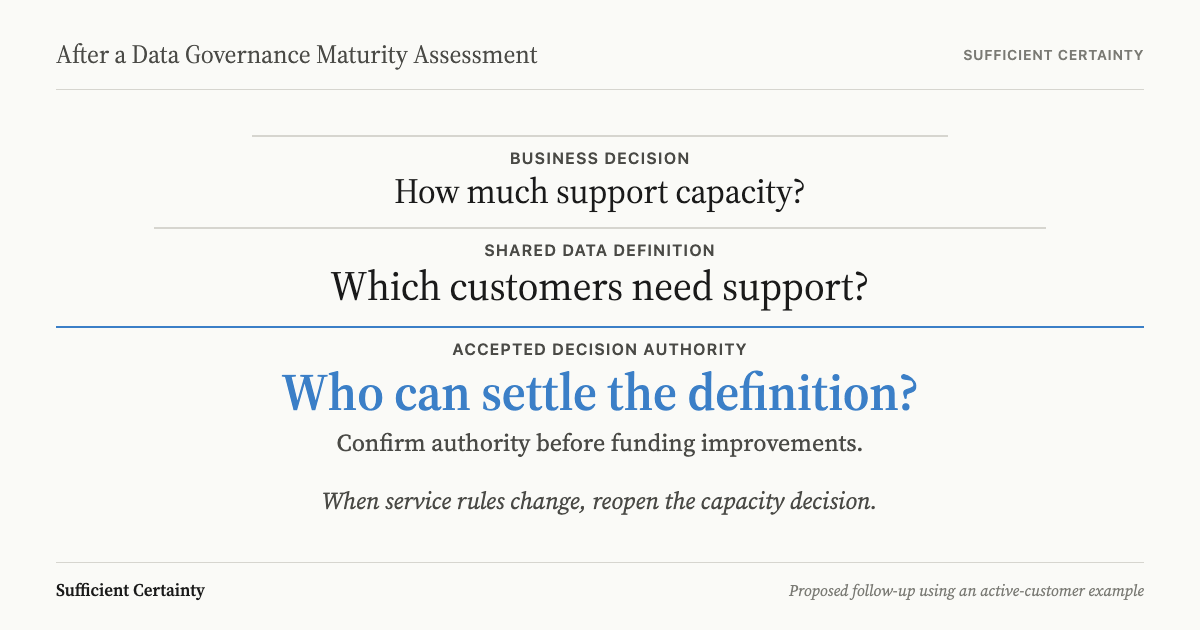
Consider a proposed example. Sales counts an account as active after an order. Operations counts it as active only while service continues. A manager must decide how much support capacity to buy. Both reports can be internally consistent while answering different questions. Asking an analyst to reconcile the totals leaves the business choice unresolved.
Before funding the response, name who can approve the shared definition for the decision it must support. Bring that person the competing definitions and examples of the records each includes. Ask which meaning fits the capacity decision. Record where that authority comes from and which affected functions accept it.
The UK government’s data ownership model distinguishes accountable data owners from stewards doing daily management. Use that distinction to check the handoff. The person who maintains a glossary may need someone else to approve a definition that changes reported performance.
Write the agreed meaning beside the report that uses it. Identify who must update that report and who will check adoption. The existing governance model may already supply the authority. The assessment follow-up should make that authority work for this shared data issue.
The handoff is incomplete until the receiving person accepts the decision and can act on it. If functions dispute that person’s authority, resolve the dispute through the existing management route. A new ownership field in a catalogue cannot resolve it by itself.
Ask the receiving owner to try the route with the actual report user present. Can the user explain the decision that depends on the definition? Can the owner approve its meaning across the affected functions? If either answer is unclear, put that unresolved issue in the proposed work plan before approving a tool purchase.
A maturity score locates gaps in governance practice
A well-supported assessment makes differences in practice visible. One department may have agreed definitions, while another relies on the analyst who last prepared the report. Comparing the evidence gives managers a basis for discussing where repeatable practices are missing. Preserve those differences when turning the assessment into a work plan.
The score is useful for organising improvement. It can direct attention to unclear stewardship or a weak process for resolving disputes. It also gives a later assessment something to compare. Keep the criteria and evidence used for each rating so that a changed score can be explained.
A maturity rating needs a separate check that the data supports the intended business decision. Better documentation can make a process more established while its definition remains wrong for a particular use. The distinction between data analysis and the decision it supports matters here. The manager must still decide what evidence justifies buying the proposed capacity. The broader check after a capability maturity assessment also asks which operating result the proposed improvement must achieve.
The proposed example has these separate questions:
Keep separate records of changes to practice and changes to the data itself. Appointing an owner is evidence about governance. Showing that the report now includes the customers needing support is evidence about its use. Both help the manager, but they answer different questions. Review them together before claiming that the assessed gap has been addressed.
The UK Government Data Quality Framework links quality to the intended purpose and users’ needs. Use that principle when choosing the first improvement. A disputed definition affecting a pending purchase deserves examination even if another assessment category has a lower rating.
Indigenous Services Canada audited data governance
The September 2023 audit used the Stanford Data Governance Maturity Model. It found an Initial to Limited maturity level. The department used data for contribution funding decisions and measuring program results. The assessment therefore concerned governance supporting real uses of data.
The audit identified gaps in communicating responsibilities and monitoring corrective actions. Its management action plan committed the Chief Data Officer and Chief Information Officer to work on objective alignment, prioritisation and clear accountabilities. It also committed them to strengthen feedback and decision processes. These were planned actions. The report does not establish their completion or a later improvement in maturity.
After the assessment, check whether the proposed ownership arrangements work on an actual data dispute. That is a reader application of the findings, not a claim that the department performed the check. The report supports examining accountabilities and feedback. It does not show that a particular operational decision was made incorrectly.
For a manager facing similar findings, choose a disputed term that crosses functions. Follow it from the source record into the report used for a pending decision. Ask the owner to explain which meaning applies. Then ask the report user to confirm the same meaning. Any difference tells you where the proposed handoff still needs work.
Retain evidence of the resolution, including any restriction on use. The result might be an approved common definition. It might also be a documented reason that two uses need different definitions. Do not force agreement by deleting a distinction that one business process needs. Make the permitted use clear to the person deciding.
Record a signal that sends the dispute back to someone with authority before the next commitment. This adds a practical question to the wider organisational governance discussion. When a new use falls outside the agreed definition, who receives the issue and decides what changes?
Which change in a shared data definition would require you to reconsider the business decision? Start the Walk →
Set a trigger for reopening the data decision
Return to the proposed active-customer example. Suppose the owner approves a definition for buying support capacity. Record the definition’s version beside the purchase decision. Ask the steward to report when a new service creates customers whose support needs the definition excludes. That change is a reason to reopen the capacity decision.
A useful trigger names a change in the data’s meaning or use that could alter the business decision. “Review governance progress” does not tell a steward what to report. “Tell the capacity manager when service eligibility changes” gives that person something observable. Choose a signal the steward can see during normal work.
Define the response with the person who owns the business decision. A changed eligibility rule could require a fresh demand estimate before another purchase. A glossary correction with no effect on the included customers may require only a report update. The response should match the effect on the decision. Escalating every edit makes the trigger difficult to use.
A proposed sequence for the same example:
Try the reporting route before relying on it. Give the steward an example of a changed service rule and ask where the notice goes. Ask the business owner what action follows. If the notice stops at a data committee, identify who forwards it to the capacity manager. Keep the route as short as the existing authority permits.
The beliefs requiring a check belong with the decision, as described in surfacing assumptions. Keep the signal beside them. The guidance on monitoring decisions explains why the check must follow the conditions that justified acting.
Check that the trigger reached the business decision owner before reporting the governance issue as resolved. The Universal Decision-Making Method connects the chosen action to monitoring. Here, the immediate result is a working route from a changed data definition to a fresh decision about capacity.
Your maturity report can name a data owner while leaving the route from a changed definition to a fresh business decision untested.
Work through your decisionNo sign-up. Just pick your decision and start.
Grant Purdy is the co-author, with Roger Estall, of Deciding (2020), and the architect of the Universal Decision-Making Method.