
After a decision tree analysis, circle the probability estimate that could change which option you choose. In a review meeting, the preferred branch and its expected value can take up the discussion. The source of that probability can remain in a spreadsheet note. Before approving the choice, check whether the evidence behind that estimate is strong enough for the commitment.
Decision tree analysis compares choices through branching outcomes, using probabilities and consequences to calculate the expected value of each option.
Trace the recommended choice back to its evidence
Start with the completed model, its input notes, and the recommendation. Follow the preferred choice through the outcomes that contribute to its expected value. Identify which estimates come from recorded results, which come from another setting, and which are judgments. Keep that distinction visible in the approval paper.
A completed decision tree gives the reviewer a clear place to start. The next task is to decide whether to accept its recommendation, change the commitment, or obtain specific evidence. Rebuilding every branch would consume time without necessarily changing the choice.
Check any sensitivity results already supplied with the tree. These show what happens when inputs change. If those results are missing, ask the analyst to vary the uncertain probabilities and consequences over defensible ranges. Record where the preferred choice changes. Start with the inputs that can change the choice.
The approval paper should show the recommended option, the credible alternative, and the relevant limits on each. Include costs that cannot be recovered and any consequence the organisation could not accept. An average outcome alone can conceal an outcome that would make the commitment unacceptable.
This illustrative supplier tree shows two choices and their possible delivery outcomes. Here q and p are on-time probabilities under the current and new suppliers, respectively, for the same order deadline. On time and late are mutually exclusive and cover all outcomes in this simplified model. The symbols are model inputs, not measured estimates. Each V denotes that order's net outcome value over the same period, including supplier price and any switching cost.
choice
supplier
timing
timing
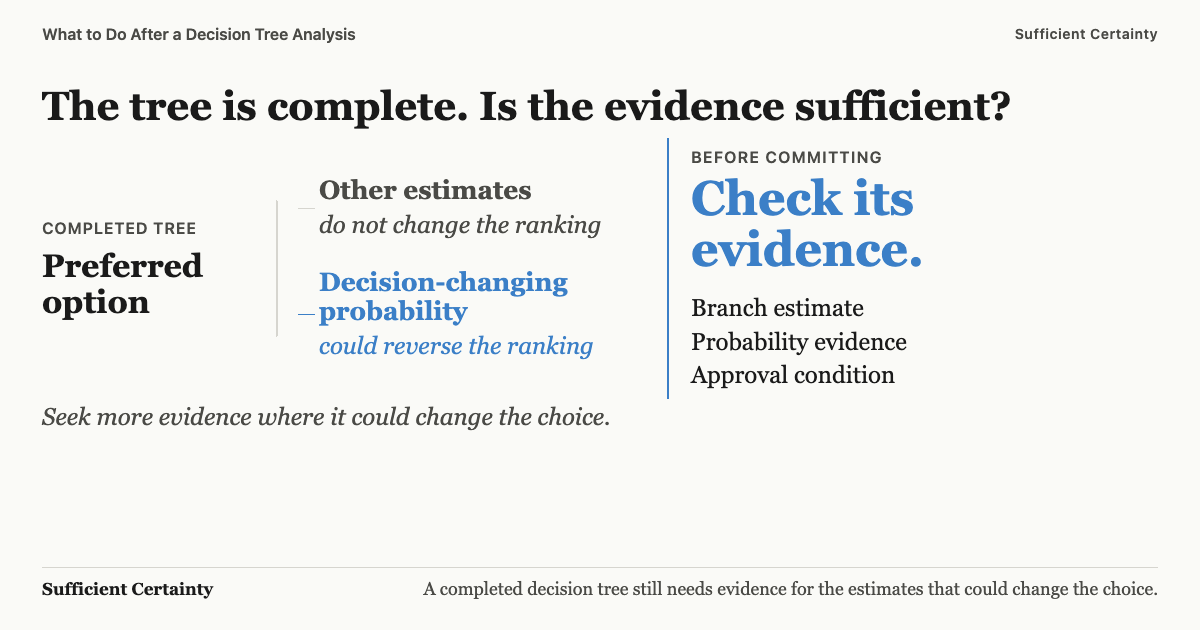
The marked p is the new supplier's on-time probability. If changing it could reverse the choice, check its evidence before committing.
The model is an input to that decision. Someone must still accept responsibility for committing resources under the stated conditions. If the paper records only the winning expected value, return it for the evidence and limits behind the recommendation.
Which branch estimate needs better evidence before you can accept the tree’s recommendation? Start the Walk →
A completed tree makes trade-offs inspectable
Decision trees are useful because they connect a choice to possible consequences. A reviewer can follow where an expected value came from. A disagreement about one probability can be separated from a disagreement about the value of an outcome.
That separation helps avoid a vague argument about whether a proposal is good. Two people may agree on the possible outcomes but disagree on their likelihood. Another pair may accept the probabilities but disagree about an irreversible loss. Each disagreement needs a different response.
The UK Treasury Green Book recommends sensitivity analysis and switching values for the preferred option. A switching value identifies an input value at which the option loses its advantage or ceases to offer value for money. Applied to a completed tree, this gives evidence gathering a specific target.
The same discipline matters after a cost-benefit analysis. A useful result states the conditions under which the recommendation holds. A change in ranking makes uncertainty decision-relevant. A large numerical change that leaves the choice intact may need less attention.
Which uncertain branches could change the choice?
A branch probability and confidence in that probability are different things. A model might assign a likelihood to delayed delivery. That likelihood could come from a long delivery record or an unsupported estimate. The same number can therefore call for very different evidence before approval.
Adding probability distributions does not remove this problem. NICE guidance on economic evaluation says the distributions used in probabilistic sensitivity analysis should represent the available evidence and be justified. A distribution chosen without that support adds calculations while leaving the evidence gap open.
Ask what would happen if the important estimate were wrong. Could the organisation recover, change course, or stop? Would a bad outcome breach a legal duty or prevent the stated purpose? The commitment determines how much evidence is needed. The number of branches does not set that requirement.
The matrix below is a proposed way to sort evidence work after the model is complete. It compares the effect on the choice with confidence in the evidence. It is not a numerical rule for approving a decision.
| Strong evidence | Weak evidence | |
|---|---|---|
| Can reverse choice | Keep source and review conditions | Obtain evidence before committing |
| Choice unchanged | Record accepted uncertainty | Recheck the rangeNew evidence may reveal a change in ranking |
If a weakly supported input can reverse the choice, name the observation that could resolve it. If a well-supported input can reverse the choice, preserve its source and watch for changes. Seek evidence where it could alter the commitment.
A sensitivity analysis identifies vulnerable inputs. The decision still needs a judgment about whether resolving them is worth the time and cost. That judgment should include what happens while the organisation waits.
NICE examined the evidence behind its influenza model
The 2009 NICE appraisal TA168 provides a documented example of reviewing completed decision trees. It concerned the economic assessment of influenza treatments. The case shows how reviewers handled model uncertainty; it provides no treatment advice for a current patient.
The Assessment Group report described pathways for people presenting with influenza-like illness. The model connected probabilities of events with costs and health outcomes. It included probabilistic sensitivity analysis, rather than relying only on one set of fixed estimates.
In its evidence review, NICE described both the manufacturer model and an independent Assessment Group decision tree. The manufacturer model was sensitive to the probability that an influenza-like illness was true influenza. It was also sensitive to the probability of presentation to a GP within 48 hours.
The committee examined the evidence behind those estimates. It considered an Assessment Group probability for children too high and sought closer alignment with the adult estimate. The committee challenged an input behind the result. Completing the calculations had not ended the review.
It also considered omitted effects, including transmission and resistance. More complex dynamic models could have addressed such effects. However, the committee judged that the evidence could not support that approach. It accepted the submitted models as an appropriate decision basis and judged that an alternative approach would not change its overall conclusions.
Greater model complexity was not automatically required. This was a specific judgment about that appraisal's evidence and conclusions. It does not establish a universal threshold. The practical lesson is to examine whether a disputed estimate or omission could change the decision before commissioning more modelling.
Set a stopping rule before approving the choice
Return to the estimate circled at the start. Beside it, record the range supported by the evidence and the value at which the preferred option changes. Name the person who accepts the remaining uncertainty. This turns the recommendation into an approval that can be questioned.
Use a concrete evidence test. For a proposed supplier change, the decision maker might require verified delivery records from work comparable to the intended order. The records must support a delay probability on the acceptable side of the model's switching value. This is an illustrative test, not a reported company case or a fixed statistical standard.
If the evidence spans both sides of the switching value, choose what to do about it. A limited order might provide useful evidence before a larger commitment. Alternatively, the cost of waiting may justify acting now with a stated limit. Define what would make further evidence worth obtaining.
The Universal Decision-Making Method places that judgment within sufficient certainty. The question is whether the decision maker can justify this commitment with the available evidence. The test for enough information concerns the decision, rather than a target volume of data.
Before signing, record what new observation would reopen the choice and who will respond. Link that observation to the branch estimate it affects. The tree then remains useful after approval, as part of the organisation's decision-making frameworks, rather than ending with a calculation.
Approve the choice with its evidence and review condition. Keep the model version, source notes, accepted uncertainty, and response together. A later reviewer can then see why action was justified and what would require a different choice.
A preferred branch becomes actionable when its evidence supports the commitment you are about to make.
Work through your decisionNo sign-up. Just pick your decision and start.
Grant Purdy is the co-author, with Roger Estall, of Deciding (2020), and the architect of the Universal Decision-Making Method.