
After a fairness opinion, compare its assessed transaction terms and shareholder groups with the final agreement before the board vote. In 2015, the Delaware Supreme Court affirmed liability against RBC Capital Markets for aiding breaches of duty in the Rural Metro sale. The board had received fairness advice, but did not know about significant adviser conduct affecting it. Check the basis for reliance before treating the opinion as a reason to approve.
A fairness opinion assesses whether transaction consideration is fair, from a financial point of view, to the party or security holders it specifies.
Rural Metro relied on advice affected by conflicts
Rural Metro's sale to a Warburg Pincus affiliate closed in 2011. The later Delaware Supreme Court opinion in RBC Capital Markets v. Jervis examined the advice and sale process. It upheld a judgment assigning RBC approximately $75.8 million of liability, plus interest.
The court described RBC's efforts to obtain a financing role with the buyer and changes to its valuation analysis. Rural's directors did not know about these matters when approving the merger. They received valuation information only three hours before the approval meeting. The court linked the misleading information and undisclosed conflicts to the board's deficient process.
The case concerns a specific transaction and specific findings. It does not establish that every success fee invalidates an opinion, or that an additional adviser always resolves a conflict. The useful next question is narrower: what does the board know about the interests and information shaping the opinion before relying on it?
A favorable conclusion needs a clear explanation of the work and interests behind it. For a board preparing to vote, the proposed check starts with the engagement letter, opinion and final agreement. Read them together. Identify who commissioned the work, which transaction it addresses and whose consideration it assesses.
Then ask the adviser to identify relevant roles and payments connected to completion. Compare the reply with the engagement and disclosures. If an unresolved interest could affect the advice, ask independent counsel what further review is needed. Record the question and response before the vote rather than relying on an informal assurance. Ask whether the person responding is addressing the specific interest raised. A statement that the firm has internal procedures does not explain how this transaction was handled or which information reached the directors.
Time for directors to examine the answer is part of the evidence needed to rely on it. A late explanation may be accurate, but directors still need to understand its effect on their decision. Specify the missing explanation and whether the scheduled vote leaves enough time for a considered response.
This application follows the problem exposed by the case. It is not a new legal test or a claim that a checklist would have prevented the outcome. The broader organizational governance task is to ensure that the person approving a commitment understands the advice used to support it.
Keep the questions about reliance separate from the numerical work addressed by what follows a business valuation. A fresh calculation cannot resolve an undisclosed interest by itself. Nor does a conflict disclosure establish that an opinion covers terms or shareholder groups outside its stated scope.
Mark each unresolved remit question beside the relevant agreement clause, so directors can see precisely which proposed commitment needs another answer.
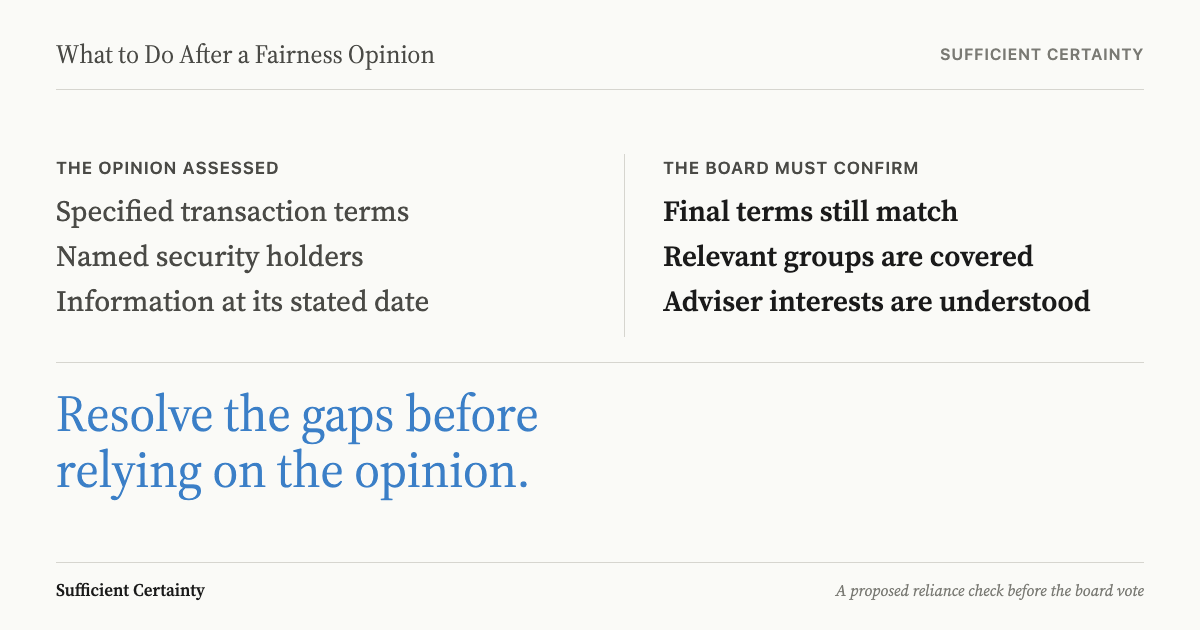
What does the opinion cover before the vote?
An opinion can give directors a structured financial assessment of the consideration in a proposed transaction. The analysis may help them compare that consideration with ranges produced by different valuation approaches. Ask the adviser to explain why the selected approaches fit the actual transaction and how important assumptions affect the conclusion.
FINRA's explanation of fairness opinions distinguishes fairness from the best price obtainable. The opinion generally addresses a range of financially fair consideration. It does not necessarily address solvency or every other matter relevant to the transaction. Read the actual exclusions before using the conclusion for a broader purpose.
The opinion answers the question within its remit, not every question before the board. Find the specified recipient and the parties whose consideration is assessed. Then compare those descriptions with the groups affected by the final terms. If different groups receive different treatment, ask which treatment was examined and which remains outside the opinion.
Next compare the documents by version and date. Identify changes to cash or share consideration, payment timing and relevant conditions after the adviser completed its work. Ask whether those changes affect the conclusion and what updated work is required. A different draft agreement should not be treated as covered without an explicit explanation.
FINRA Rule 5150 requires specified disclosures when a member knows its opinion will be provided or described to public shareholders. These concern matters including contingent compensation, material relationships and whether information supplied by the company was independently verified. Its stated scope matters; it is not a universal rule governing every opinion worldwide.
Disclosed reliance on management information is a question for the board to examine. Ask which information materially supports the conclusion and what gives directors confidence in it. The related work after financial due diligence may supply evidence, but confirm that its findings concern the same period and assumptions.
For each material limitation, write its effect on this vote. Some limitations may be acceptable because other evidence addresses the issue. Others may leave the board unable to rely on the opinion for its intended purpose. State the distinction openly instead of treating the existence of an opinion as sufficient on its own.
What evidence makes this opinion sufficient for the final transaction terms and groups being assessed? Start the Walk →
Set the evidence threshold for relying on the opinion
Before the meeting, write a short reliance note. State the final terms, the groups assessed, the opinion date and the key information supporting it. Add any change since the opinion and the adviser's response. This is a proposed board working document, rather than a substitute for applicable legal advice or required records.
Set the evidence required for the vote before deciding that the current evidence is enough. A board might require confirmation that changed consideration is covered, an explanation of a material input or independent advice on an unresolved conflict. Name the particular gap and the consequence for relying on the conclusion.
The Universal Decision-Making Method provides a sequence for examining that reliance:
- Frame: state the transaction decision and the people whose interests the board must consider.
- Tentative Elements: identify the final terms and the alternatives still available.
- Assumptions: identify what the opinion takes as given and what has changed.
- Sufficient Certainty: agree which evidence justifies relying on the opinion for this vote.
- Implement+Monitor: assign confirmation of changes before the next transaction commitment.
Keep requests proportionate to their effect on the decision. If an input cannot change the reliance conclusion, more precision may add little. If one unresolved matter could make the opinion inapplicable, resolve that matter first. The article on acting after sensitivity analysis explains the value of locating such decision-changing inputs.
Record how each issue was resolved and who supplied the answer. If further work is required, state who obtains it and whether the vote must wait. Where approval proceeds under conditions, identify the authority that confirms those conditions before the next binding step. Keep a list of the agreement provisions compared with the opinion. A general statement that nothing material changed leaves later reviewers unable to see what was actually checked. Use the transaction documents already available, with precise page or clause references.
The board's reason for relying on the opinion should be readable without reconstructing the entire meeting. Preserve it in the decision record with the document versions reviewed. This gives the opinion a defined role in the decision and makes later changes easier to identify before another commitment is made.
Before the board relies on the opinion, can its remit be matched to the agreement being approved?
Work through your decisionNo sign-up. Just pick your decision and start.
Grant Purdy is the co-author, with Roger Estall, of Deciding (2020), and the architect of the Universal Decision-Making Method.