
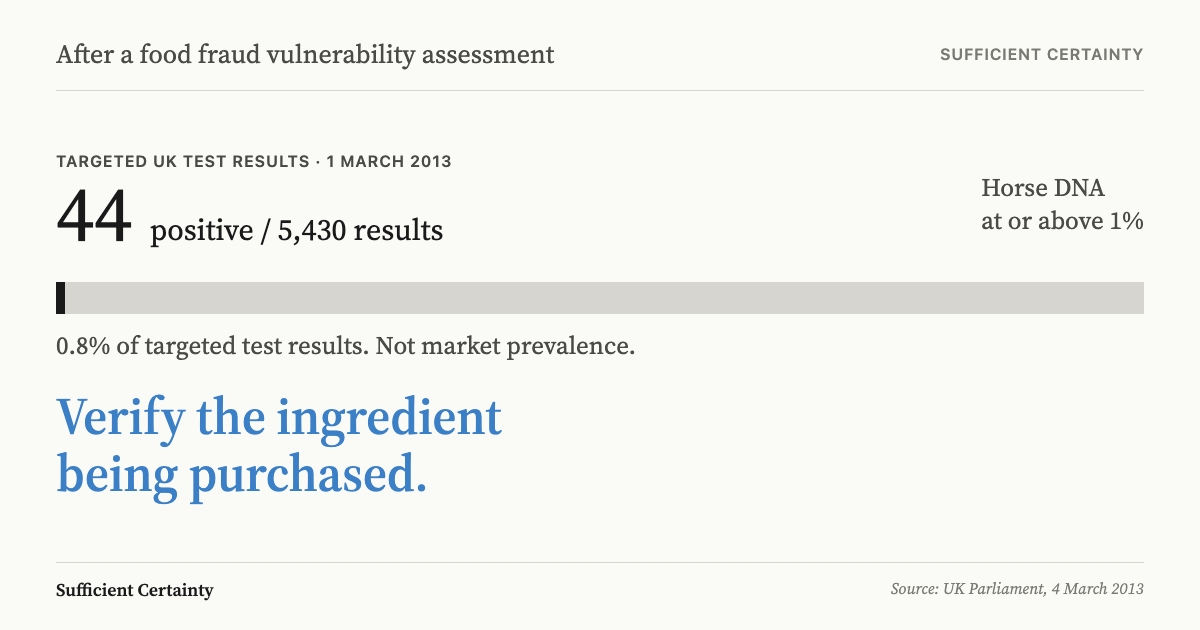
After a food fraud vulnerability assessment, select one exposed ingredient and match its supplier claim to batch evidence before accepting supply. By 1 March 2013, targeted UK industry testing had recorded 44 positives at or above 1% horse DNA among 5,430 processed-beef test results. The next procurement decision concerns the identity of the ingredient being purchased.
A food fraud vulnerability assessment evaluates how susceptible an ingredient, product or food business is to deliberate deception for economic gain.
Check the identity claim before accepting supply
Start with the ingredient awaiting a sourcing decision. Put its specification beside the vulnerability assessment. Identify the claim on which acceptance depends. It might concern species, origin or the identity of the processor. Select the claim whose failure would change the purchase decision. A broad request for more supplier documents is harder to answer than a precise question about one delivery.
Trace that claim through the proposed supply chain. The company sending the invoice may differ from the processor handling the ingredient. Record those roles separately. Ask which record connects the processor's output to the batch offered for sale. A certificate for a company cannot establish every claim about every batch that passes through it.
Acceptance needs evidence for the identity claim attached to the supply being purchased. Keep that requirement separate from the supplier's general approval status. The checkpoint after a supplier audit concerns evidence that a particular finding has been remedied. Here the question is whether the ingredient and its declared chain can be accepted.
Write the unresolved claim in the purchasing record before asking for evidence. Name the person who can judge the reply. Procurement can establish the commercial requirement, while an appropriate technical specialist determines whether the proposed identity check can answer it. Do not select a laboratory method merely because a result can be obtained quickly.
| What the assessment produced | What it assumed | Gap to test |
|---|---|---|
| Ingredient rated vulnerable | The delivered ingredient matches its declared identity | A suitable identity check on the relevant supply |
| Supplier listed as approved | The seller can identify the actual processor | A chain connecting seller, processor and delivery |
| Origin declared in the specification | The origin claim follows this batch | Records that connect origin to batch identity |
The vulnerability rating should direct a specific check before the next sourcing commitment.
A vulnerability score directs attention
A food fraud vulnerability assessment helps direct effort toward places where deliberate deception could occur. SSAFE describes its tool as supporting vulnerability identification and mitigation planning. It also states that the tool does not provide specific mitigation techniques. A finished assessment therefore still needs a decision about what evidence would address the identified vulnerability.
That distinction preserves the assessment's value. A purchasing team can compare ingredients and ask why some need closer attention. It can explain why a long trading relationship is insufficient when the proposed source or processing route has changed. The output gives technical and procurement staff a shared starting point for discussing authenticity.
A completed assessment identifies where assurance is needed; it does not supply the assurance itself. Keep both outputs in the same file, but give them separate status. One records the vulnerability. The other records why the particular source is acceptable. Closing the first task must not silently close the second.
The wider risk assessment discussion asks how analysis supports a commitment. For food procurement, the commitment is concrete: accepting an ingredient under an agreed description. Evidence that cannot be connected to that description or to the proposed supply needs a clear explanation before it supports acceptance.
Identify the supplier claim that still lacks batch evidence. Start the Walk →
Which supplier claim still needs evidence?
The important assumption is that the identity claim remains true across each change of custody. An authentic sample at one point does not establish every later delivery. Equally, a record naming an origin does not demonstrate that the material delivered came from that origin. Ask how the evidence stays connected to the ingredient as it moves between businesses.
FDA explains that economically motivated adulteration involves intentional changes that increase apparent value or reduce cost. The deception is intended to escape detection. A procurement check must therefore consider whether the evidence is independent of the claim being tested. Repeated copies of a supplier's declaration remain the same declaration.
The evidence must test the supplier claim rather than repeat it. Ask what a proposed test can detect and what it cannot establish. Species testing and documentary origin checking answer different questions. An appropriate specialist should explain the limits, including whether the result applies to the material offered and whether the sampling arrangement supports that use.
This is where making assumptions explicit changes the work. Replace a vague assurance request with the missing connection. If the processor is unknown, identify it. If batch identity is lost at repacking, resolve that break. If the analytical method cannot test the stated claim, obtain advice on a suitable check.
An unanswered authenticity question remains open even when the paperwork is complete. Record the limit instead of treating the volume of documents as a reason to accept supply.
UK testing found species evidence beyond the label
The 4 March 2013 ministerial statement reports testing of vulnerable processed-beef products. Its corrected table records 44 positive results at or above 1% horse DNA, covering 17 products. The 5,430 denominator counts test results. It does not count distinct products or independent supply chains.
The table also records a correction. One positive test had been reported twice for the same batch of the same product and was removed from the positive total. That detail matters when evidence is being summarized for a purchasing decision. Several records can describe the same material. Counting them as separate assurance can overstate what has been checked.
Evidence about an ingredient must retain its batch identity and its sampling limits. The targeted results do not estimate fraud prevalence across all food. Nor does a species result alone identify who introduced the undeclared material. Those are different questions requiring different evidence.
The case is an illustration of an authenticity gap. It is not evidence that the businesses used this assessment tool. Its procurement lesson concerns the difference between a declared ingredient and evidence of its identity. Before accepting a new source, establish which part of that difference the proposed check actually addresses.
The food-safety assessment checkpoint deals with whether a production control works. That is a separate acceptance question. Keeping the questions distinct helps the buyer commission the right technical work instead of treating a general food-safety document as proof of authenticity.
Set an acceptance condition for each exposed ingredient
Create an acceptance note for the exposed ingredient. State the identity claim, the evidence obtained and the remaining limit. Identify who reviewed the evidence and who can accept the source. If the result does not support the intended purchase, revise the sourcing proposal or obtain the missing evidence before approval.
The acceptance condition should follow the ingredient through the actual supplier chain. Attach the condition to the purchase specification rather than leaving it in an assessment meeting. A buyer replacing the original reviewer should be able to see which processor and route were accepted, and what would require another check.
- A vulnerability rating
- A proposed mitigation plan
- Ingredient identity evidence
- The actual processor
- Custody between processing and delivery
- Changes that require renewed acceptance
Set the reopening condition at the same time. A new processor, a changed intermediary or an unexplained batch mismatch can invalidate the earlier basis for acceptance. Specify where that information will arrive and who can suspend reliance on the previous approval. The decision-monitoring guidance explains why a trigger must change what someone does.
The Universal Decision-Making Method connects the check to the sourcing decision and the certainty needed to make it. Preserve that reasoning in the decision record. The useful result is an accepted source with explicit limits, or a clear reason why acceptance must wait. Another completed assessment is unnecessary when the unresolved task is already known.
Keep the evidence current for the commitment being made. An earlier result may remain relevant, but explain why it represents the present supply. A changed purchase volume can also alter the consequences of relying on a narrow check. The acceptance note should make the connection visible, so the decision does not depend on the memory of the person who collected the documents.
A vulnerability rating leaves the ingredient identity to be checked.
Work through your decisionNo sign-up. Just pick your decision and start.
Grant Purdy is the co-author, with Roger Estall, of Deciding (2020), and the architect of the Universal Decision-Making Method.