
After a food-safety risk assessment, watch an operator carry out one control listed in the assessment. A signed assessment can leave the most important production question unanswered: whether the named control works on the equipment actually in use.
The next step is to obtain evidence for that control before accepting it as effective. Start with a condition that could defeat it. A cleaning instruction is useful, but its existence does not show that the required surfaces can be reached or cleaned adequately. For allergen controls, the follow-up to an allergen risk assessment connects that evidence to the batch formulation and the label used for release.
A food-safety risk assessment examines food hazards and the conditions affecting harm to decide where control or further investigation is needed.
Jensen Farms revealed gaps in contamination control
In September 2011, FDA investigated possible contamination routes during a Listeria outbreak linked to whole cantaloupes from Jensen Farms. Its environmental assessment memorandum records equipment conditions that help explain why a food-safety document needs evidence from the process.
Ryan Jensen reported that a third-party auditor had audited the packing house one week before harvest. He said written results were provided. FDA did not review those results during that discussion. This is an audit and investigation analogy. The memorandum does not establish that Jensen Farms completed the formal risk assessment described in this article.
FDA observed deep crevices and washing or drying equipment surfaces that did not appear cleanable. Photographs recorded residue after cleaning, including equipment that had been cleaned and sanitized. The equipment seller said no manuals for proper maintenance or cleaning were supplied.
The control needed evidence from the equipment. A proposed follow-up would have asked whether the cleaning method could reach the relevant surfaces. That question differs from asking whether someone signed a cleaning record. It examines the condition that the control depends on, rather than confirming that a task appears in the procedure.
The investigation considered possible contamination routes. These observations do not establish that one cleaning defect alone caused the outbreak. Nor does the reported audit timing show what its written results covered. The useful lesson is narrower: equipment conditions can remain unresolved despite a reported audit.
For a reader who has just completed an assessment, the practical question is what would justify accepting the proposed control. Suppose the assessment relies on cleaning a packing line. The responsible person needs evidence that the method suits that equipment. The check should include the difficult parts of the equipment, rather than only the surfaces easiest to see.
Cleaning records cannot resolve inaccessible surfaces. A record may show who performed the task and when. It cannot by itself show that the method reached a crevice. If the person performing the task cannot explain access or demonstrate the specified process safely, record that limitation. Ask the food-safety specialist to resolve it before treating the control as established.
This proposed application does not require copying an outbreak investigation. It starts with the assessment's own claim. Find where that claim depends on a physical condition. Then ask what evidence would support it under the intended production conditions. A claim that surfaces can be cleaned needs different evidence from a claim that employees received instructions.
A visit to the line is a starting point, not a microbiological clearance. An observation can expose an access problem. It cannot establish that pathogens are absent. A competent specialist should decide what further checks are appropriate for the hazard. The same distinction applies when identifying assumptions behind a decision: the check must answer the assumption actually being relied on.
The graphic below shows the evidence needed for a proposed cleaning control. Each support concerns a different question. Missing support means that acceptance still needs work. The graphic does not assign a safety score to Jensen Farms or claim to reproduce its audit.
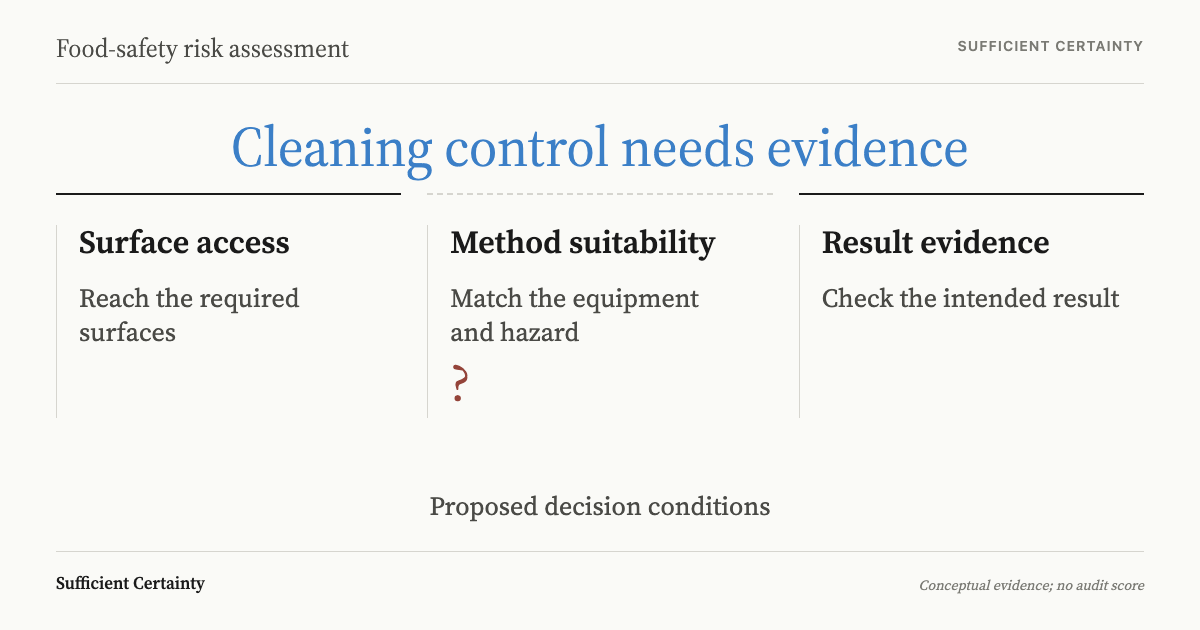
Keep the response proportionate to the unresolved condition. If instructions are unclear, obtain appropriate instructions. If the equipment cannot be cleaned as required, more signatures will not fix that problem. The evidence needed for acceptance must resolve the condition being relied on. State which evidence is missing and who can obtain it.
Which food-safety control still lacks evidence from the process that production will actually use? Start the Walk →
What evidence supports the food-safety conclusion?
An assessment helps identify hazards and the controls intended to address them. It can direct attention toward the process conditions that need further work. The risk assessment hub examines how that analysis supports an actual decision. Here, the decision is whether there is enough evidence to rely on a food-safety control under the planned production conditions.
Define what the control must achieve. A statement such as “clean the equipment” leaves too much open. The responsible specialist should specify the process and the evidence needed to support it. The FAO maintenance and cleaning guidance connects effective equipment maintenance with equipment that can be cleaned and disinfected.
The checklist below gives example questions for a packing-line control. Every item remains untested here. It describes a proposed review, rather than verified findings about a particular operation.
Different controls need different kinds of evidence. A visual inspection may answer whether access is obstructed. It may not answer whether a cleaning process controls the relevant hazard. Do not use the easiest available check simply because it produces a quick result. Ask which check could change the conclusion about the control.
Evidence must apply to the intended process. FAO guidance on validation and verification distinguishes evidence that a plan can control hazards from checks that it works in operation. It also cautions that externally developed limits need to apply to the particular operation. That principle helps avoid accepting evidence from different equipment without examining the difference.
A food-safety assessment and a HACCP plan have related purposes, but they are not interchangeable documents. This article concerns whether the evidence supports the control identified by an assessment. The next step after a HACCP plan addresses the separate decision about that plan. Keep the control's operating evidence visible whichever document records it.
Verify a process condition before approving production
Choose the control whose failure could change the production decision. Ask the person responsible for it to state the condition that must hold. For the cleaning example, the condition may be access to the surfaces that the method must treat. Write the condition in the same terms used by the person performing the work.
Agree on the check before accepting its result. The food-safety specialist should define what would count as adequate evidence. That includes any sampling or technical review needed. A demonstration of access alone should not become a claim that the entire product is safe. Keep the result within the limits of the check performed.
Use the Universal Decision-Making Method to state the production decision and the assumptions that could change it. It asks the Decider to seek sufficient certainty before committing. In this setting, that means enough relevant evidence to support relying on the particular control. It does not mean assigning a percentage to food safety.
When evidence is insufficient, name the unresolved condition. Ask the responsible specialist whether the equipment needs modification or the process needs revision. Record who can authorise the next step. Operational urgency cannot establish that a control works. A production deadline should not determine the technical result required for acceptance.
Keep the acceptance reason with the finding. Record what was checked and the limits of the result. State who reviewed it. If additional work remains, leave the finding open and record the next action. This gives the next reviewer a basis for judging the control, rather than a completed status with no supporting explanation.
Set a trigger for reconsidering the decision. Replacement equipment or a change in the cleaning method can alter the basis for acceptance. The responsible person should identify such changes before relying on earlier evidence. Monitoring decisions is useful when it names the condition that would reopen the decision.
Accept the control only within the evidence obtained. The first demonstration may reveal a clear gap or support further technical checking. Use that result to direct the next step. The assessment has done useful work when its findings lead to verified process conditions before production relies on them.
How much evidence supports the food-safety control your production decision depends on?
Work through your decisionNo sign-up. Just pick your decision and start.
Grant Purdy is the co-author, with Roger Estall, of Deciding (2020), and the architect of the Universal Decision-Making Method.