
After a food recall, compare one affected retailer’s removal confirmation with its delivery record before recommending closure. A completed notification list can still leave recalled food available for sale. The next decision concerns the product that customers could still buy, including stock held beyond the first recipient.
A food recall removes or corrects distributed food because it presents a safety concern or fails relevant requirements.
A recall notice starts the recovery work
The immediate work follows the agreed recall strategy. Identify the affected food precisely, contact the relevant customers, and arrange removal or correction. Keep the product identifiers consistent across messages and records. A retailer needs enough information to distinguish affected stock from similar products that remain available for sale.
Once those urgent actions have started, prepare a record for the next decision. The food business manager must decide whether protection needs to continue, whether the recall scope needs attention, and whether the evidence supports a closure request. A list of completed calls cannot answer all three questions without the stock records.
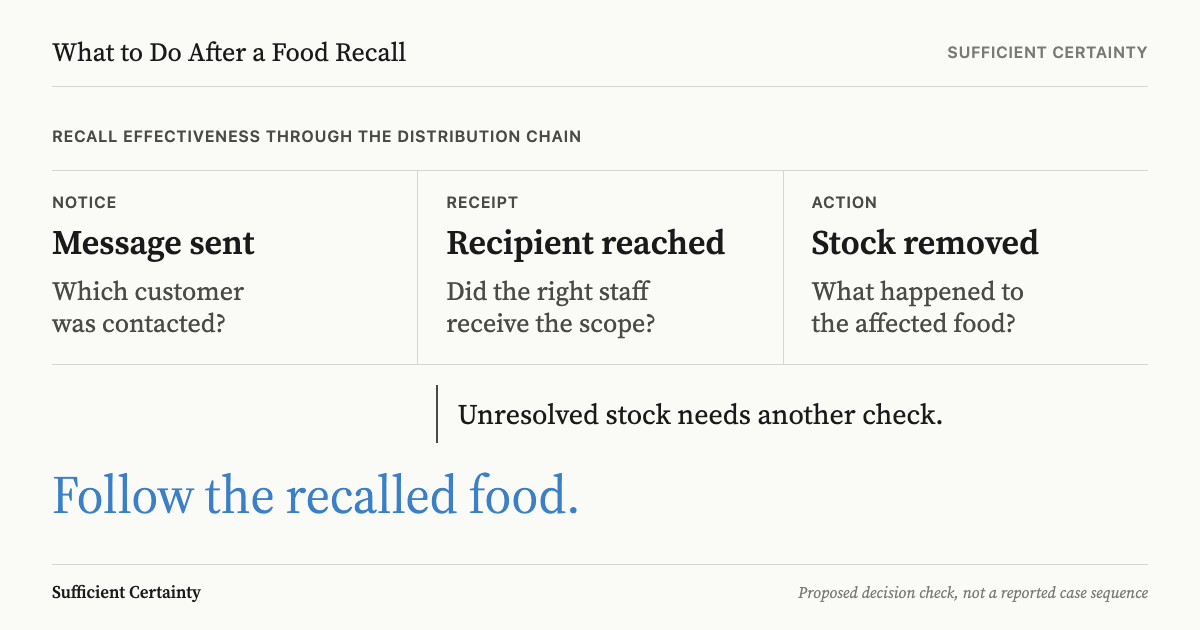
Build the record around each consignee, meaning each customer or organisation that received affected food. Record what was delivered, what notification reached that recipient, and what happened to the food. Where that recipient supplied others, ask how the message and removal instructions reached the next stage. Preserve unresolved quantities as unresolved.
Use the existing recall team and regulatory contact. This article concerns the management decision after a recall has begun. It does not replace urgent notification duties or the competent authority’s role. FDA guidance on product recalls sets out information used to evaluate and monitor recalls, including customer notification and product information.
- Customer notices sent
- Returns received
- Product removed from retail shelves
- Stock held by onward customers
- Unanswered consignee notices
- Safe disposition of returned food
A prevention review serves a different decision. The check after a HACCP plan concerns whether production controls support the intended operation. Closing an actual recall requires evidence about distributed food. Keep that distinction clear when assigning work, so an improved factory procedure does not stand in for recovery evidence.
What recall evidence supports closure?
Good records let the team direct effort where customers remain exposed. A delivery list defines the population that needs attention. A notice log shows attempted contact. A response can establish receipt and describe action taken. Stock accounting connects those statements to quantities. Each record supports a different part of the closure decision.
Ask what a confirmation actually confirms. An email saying “received” may acknowledge the message without confirming that staff removed the product. A chain office may have forwarded instructions without checking individual stores. A returned quantity may cover warehouse stock while food already delivered to a shop remains outside that return.
Keep evidence proportionate to the agreed strategy and hazard. The required check might involve direct contact, a documented store response, or a visit. Do not invent a universal recovery percentage. The FDA recall evaluation guidance discusses effectiveness checks and status reports, and links consideration of termination to the final status report and product disposition.
Before deciding that a missing quantity has been consumed, check whether that explanation has a basis. Sales information may help, but an assumption about normal turnover cannot establish the whereabouts of every affected unit. Record the uncertainty and its effect on protection. The broader risk assessment discussion applies here: evidence must serve the specific decision.
Keep production restart separate from recall closure. A business may have corrected the manufacturing problem while distributed stock remains unresolved. Conversely, recovery work may finish while prevention work continues. The food safety assessment checkpoint helps address the conditions for future operation without obscuring the current recovery task.
A recall response needs a clear decision about the stock still outside confirmed control. Start the Walk →
Castleberry products remained on retail shelves
In 2007, Castleberry recalled canned products because of possible botulinum toxin contamination. The FDA enforcement account for fiscal 2007 describes expanded warnings and retail checks. FDA investigators found potentially contaminated products still being sold in 1,303 of 12,989 stores visited. State inspectors found them in another 1,192 of 10,073 stores checked.
The source also says retailers were asked to remove the food and prevent its return to sale, service or donation. The historical finding is specific: products remained on shelves after the recall. It does not establish that every affected store had read a notice. Nor do these inspection results measure the response rate of all retailers.
That distinction matters for a manager considering closure. A communication record and a shelf check answer different questions. The proposed application is to connect both to the same recipient and product. If food is found for sale, investigate the failed removal route instead of treating an earlier notification as sufficient evidence.
Use any failed effectiveness check to reconsider the remaining checks. Ask whether the failure concerns a product identifier, an onward distributor, or a local execution problem. Other recipients using the same route may need renewed contact. The supplier audit follow-through makes a related point about verifying the result of assigned corrective work.
The notice log is complete, so the manager closes the internal recall task while some retailers have not confirmed removal.
The manager separates unconfirmed retailers from verified removals and keeps follow-up active until the outstanding stock is resolved.
The case does not imply that closure requires proof about every individual can in every circumstance. It shows why the agreed recall strategy needs evidence of actual action. The hazard and distribution route determine what further work is necessary, with the responsible authority involved. Avoid substituting a deadline chosen for administrative convenience.
Use the same unit when reconciling quantities. A delivery record may count cases, while a shop response counts cans. Convert those quantities using a documented pack size before comparing them. Mark substitutions or uncertain conversions explicitly. An apparently balanced total can otherwise conceal a mismatch between the affected delivery and the food removed.
Keep the date of each check visible. A shop response from before a recall expansion may no longer cover the affected products. Ask whether the expanded scope reached the same local staff and whether their removal confirmation includes it. Preserve earlier responses as history, but do not silently extend what those responses establish.
Prepare the handover around exceptions rather than a percentage alone. Show the recipient awaiting contact, the quantity awaiting explanation, and the person responsible for the next check. That lets the incoming recall lead continue protective work immediately. A high overall completion figure is useful context, but it cannot explain a particular unresolved distribution route.
Set the stock check that can reopen the recall
Write a short effectiveness decision record before recommending closure. Identify the recall scope and the decision owner. State which notification and stock records were reconciled, which exceptions remain, and why those exceptions do or do not prevent the proposed next step. Reference the evidence so another team member can examine it.
Give each unresolved recipient an owner and a next action. A non-response needs follow-up; a confirmed shelf finding needs removal and a wider check of its cause. Escalate scope questions to the recall lead and authority. An internal decision to close a task must not be represented as regulatory termination.
Name the evidence that will reopen the internal decision. Examples include a new retail shelf finding, a newly identified onward customer, or returned food being placed back into saleable stock. These are proposed triggers, not claims about Castleberry. Specify who receives the signal and who can extend protective action when it appears.
Current FDA advice to the food distribution chain stresses removal from distribution and sale after notification. Apply that principle to the remaining uncertainty, rather than treating another broadcast as the automatic response. A targeted stock check may resolve a specific gap; a missing distribution route may require broader investigation.
The Universal Decision-Making Method connects implementation to monitoring. For recall closure, that means preserving the connection between the closure reason and the event that would invalidate it. The quality audit checkpoint can help distinguish a completed action from evidence that its intended result occurred.
End the record with the decision actually made. State whether follow-up continues, whether further protective action is required, or whether a closure request is supported. Attach the outstanding items rather than hiding them in meeting notes. The next person taking over the recall should be able to see what remains uncertain and what must happen next.
Which stock finding would make the recall closure decision change?
Work through your decisionNo sign-up. Just pick your decision and start.
Grant Purdy is the co-author, with Roger Estall, of Deciding (2020), and the architect of the Universal Decision-Making Method.