
After a franchise assessment, recalculate the store margin with every mandatory fee and lawful staffing cost included. In the 2016 Australian 7-Eleven inquiry, wages and related expenses were around 85% of expenses borne by sampled franchisees. Check the changes available to the operator before signing.
A franchise assessment examines a franchise opportunity and its operating terms to judge whether the proposed investment meets the buyer’s needs.
The forecast depends on costs the franchisee cannot freely change
The assessment should already describe the franchise opportunity and its expected economics. Keep that work. The next task is to check whether the forecast can survive the obligations the buyer is about to accept. A margin estimate needs to include the required operating model. Otherwise, the buyer may be approving a business that the agreement does not allow them to run.
A franchise can provide a recognised brand and an established format. It also limits choices that an independent owner might make. The FTC consumer guide to buying a franchise describes controls that may affect products and methods of operation. Its guidance concerns US franchise purchases. For any location, check the actual agreement rather than assuming the controls are identical.
Put the forecast beside the relevant contract terms. Locate the basis for royalties and mandatory purchases. Check whether the forecast includes the expense when it is due, including during weak trading. Record who controls the selling price and permitted product range. These details determine how much of a projected margin the operator can retain.
Forecast viewed alone
- Read the projected store margin.
- Assume the owner can reduce costs.
- Leave restricted recovery actions unexamined.
Forecast under the terms
- Reconcile costs with the agreement.
- Check which changes require consent.
- Identify a lawful response before signing.
The decision concerns a store operated under binding terms. A forecast for an unrestricted business answers a different question. Mark any proposed improvement that requires franchisor approval. Ask for the basis of that approval before counting its financial effect. A helpful sales conversation should not become a permission the written agreement never gives.
Use the strategic thinking question to keep the purpose clear: what does the buyer need this investment to provide? An acceptable income for an owner who will work in the store differs from a return for a largely absent investor. State the expected role before judging whether the margin is enough.
Can the store earn enough under the franchise terms?
Start with the unit economics in the completed assessment. Replace any network average with evidence relevant to the proposed location where possible. Check what period the figures cover and which stores they include. Ask whether the reported result includes owner labour. A store that appears profitable before paying for the owner’s work may not meet the purpose of the purchase.
The revenue check should address local demand and competition. It differs from the acquisition benefits examined in commercial due diligence. Here, the buyer needs enough store revenue under a restricted operating format. Identify the evidence supporting transactions at this location. A recognised name does not establish how many customers will buy here.
Recalculate the result using the cost of lawful operation. Include the staffing needed to deliver required hours and service. Treat employment obligations as conditions the business must meet. The question is whether the opportunity works while meeting them. An assessment that requires underpayment or inaccurate records is not a viable basis for approval.
Check any recovery action included in the downside forecast. Can the operator reduce opening hours? Can they change suppliers or remove an unprofitable product? Could they sell the business on acceptable terms? Find the provision governing each action. Some responses may need consent. Others may carry a cost that the forecast omitted.
Ask for written clarification of material uncertainties before signing. The relevant contract review should identify who must act on each obligation. It should also show whether the assumed recovery option is available. A clause allowing a transfer subject to consent is different from an unconditional right to sell whenever cash runs short.
The FTC warns that franchise ownership is no financial sure thing. That does not settle the decision for an individual buyer. It explains why the assessment needs a store-specific test. Record what would make the projected return unacceptable and what the buyer could do at that point.
Your store forecast needs a lawful operating margin and a response the franchise agreement actually permits. Start the Walk →
The 7-Eleven inquiry exposed limits on operating choices
The Fair Work Ombudsman inquiry into 7-Eleven in Australia reported in 2016 on workplace non-compliance in the network. Its sample of franchisee financial statements showed wages and related expenses at around 85% of expenses borne by franchisees. The report also described controls over stock levels and promotions that limited operating choices.
The report concluded that controlling labour costs was possibly the only significant expense lever available to franchisees within that model. It described the role of location and nearby competition. These findings do not establish that every store was unviable. They show why the division of costs and control matters when judging a particular franchise opportunity.
The regulator’s statement accompanying the report said that a number of franchisees deliberately falsified records to disguise underpayment. It also found that the network’s approach did not adequately detect or address non-compliance. Cost pressure provides no justification for those practices. A buyer needs to assess the business on the basis of meeting its obligations.
Check whether the operator can act on the variables the forecast assumes they control. Check each proposed response against the obligations in the agreement. A cost that looks flexible in the spreadsheet can be fixed by required hours or purchasing terms. The buyer needs to know which changes are available, whose consent they require and how long that consent could take.
For the buyer, the completed assessment should show a credible response to weaker trading. If every material response needs approval, seek clarity about the process and timing. If no available response restores an acceptable result, that changes the purchase decision. It cannot be fixed by adding an optimistic note to the margin forecast.
This is also why assumptions in decision making need owners. Someone must verify the permission behind a planned response. Someone must check the financial effect. Keep those responsibilities explicit. A general statement that the franchisor will provide support does not establish a specific action available at the required time.
Set review triggers before accepting the obligations
Turn the completed assessment into a decision record using the Universal Decision-Making Method. The five steps can be applied directly to this commitment:
- Frame: state the income or investment result the purchase must provide.
- Tentative Elements: compare signing with a changed offer or declining the opportunity.
- Assumptions: identify the local demand and permitted operating changes behind the forecast.
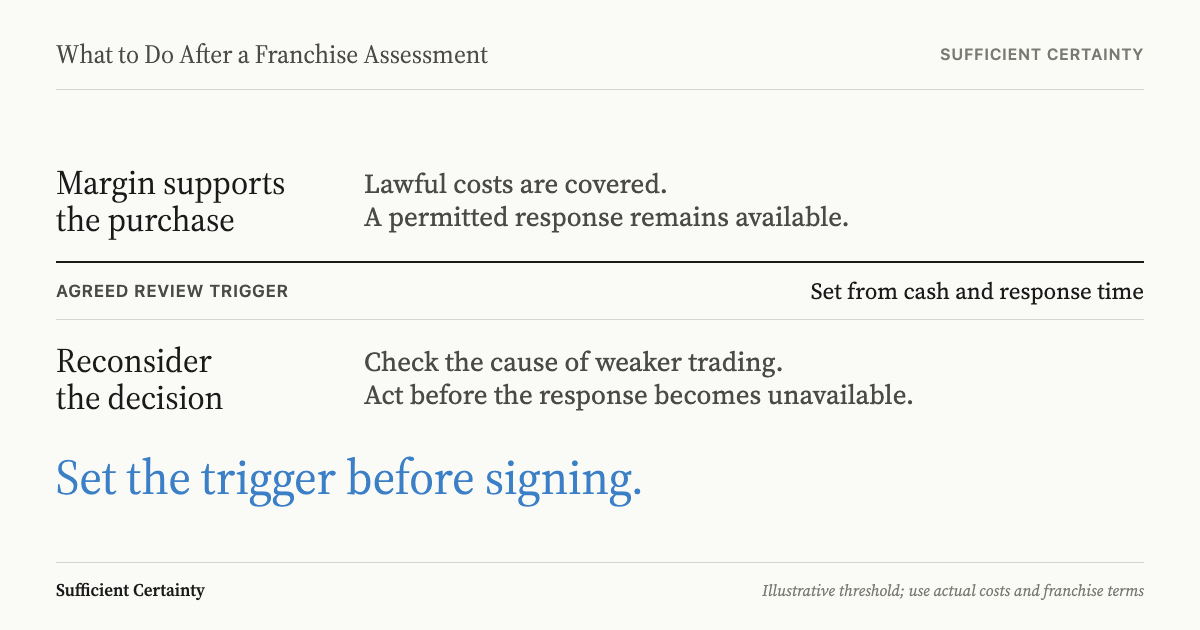
- Sufficient Certainty: decide which evidence is needed before accepting the obligations.
- Implement+Monitor: assign signals that require the owner to reconsider the decision.
The monitoring signal must arrive before the buyer loses the ability to respond. Set it from the cash needed to keep operating lawfully and the time needed for a permitted change. Use the forecast to select the actual threshold. Avoid a generic monthly review that reports falling profit after available cash is already committed.
A trigger needs an action and a person with authority to take it. Identify who will check the figures and who can ask the franchisor for consent. Record when the buyer will reduce exposure or seek an exit. The discussion of decision monitoring explains why watching results needs to lead to reconsideration when conditions change.
Check how long the buyer can fund a shortfall without missing an obligation. Compare that period with the time needed to obtain consent or sell the store. If the response would arrive too late, the review threshold needs to be earlier or the initial commitment needs to change.
Finally, compare the expected return with the consequences of being unable to change course. Include the obligations that survive a closure or transfer where the agreement provides them. If the evidence is insufficient, obtain the missing information or change the commitment. Sign only when the operating terms support the result sought and the review triggers leave a credible response.
When would weaker store trading require action, and would the franchise terms let you take it in time?
Work through your decisionNo sign-up. Just pick your decision and start.
Grant Purdy is the co-author, with Roger Estall, of Deciding (2020), and the architect of the Universal Decision-Making Method.