
After a freedom-to-operate analysis, compare the product version named in counsel's opinion with the version scheduled for launch. In 2017, Life Technologies v Promega turned on a specific US rule about components supplied for assembly abroad. Before release, ask counsel about any difference between the reviewed scope and the planned activity.
A freedom-to-operate analysis assesses whether a proposed activity may infringe enforceable intellectual property rights within a defined scope.
The FTO opinion must match the planned release
Locate the opinion and the technical description supplied to counsel. Then open the release specification. Compare their version identifiers before reading the conclusion as approval to launch. If the opinion describes an earlier design, the immediate task is to identify what changed. The product manager can establish that difference without attempting to interpret patent claims.
Give counsel the product that will actually be released. Include the proposed uses and the intended markets. Identify where manufacturing and assembly will occur where those facts matter to the opinion. A product label may stay constant while its technical functions change. The release record needs a more precise reference than the name used in the sales plan.
The next step is to connect unresolved findings with release choices. Ask which finding could prevent the planned activity or require further work. Record whether the proposed response is a design change, a licence or another option counsel has assessed. A finding marked for later attention needs an owner and a reason why the launch can proceed before it is resolved.
The diagram describes a proposed release check. It does not suggest that the analysis leaves out its own scope. A careful opinion may already state every relevant condition. The problem arises when the release team relies on the conclusion without comparing those conditions with its present plan. Attach the scope to the launch recommendation so that comparison can happen.
Keep the patent decision distinct from general launch readiness. A favourable opinion about specified patent rights does not settle every legal or operating question. The work after legal due diligence addresses a different commitment when an acquisition is involved. Here the product manager is deciding whether a particular own-product release falls within reviewed advice.
What does an FTO opinion establish?
An analysis can identify relevant patent rights and examine how their claims relate to the proposed activity. It gives the business a reasoned basis for choosing among options. Its value depends on keeping the technical and legal scope attached. A conclusion about one design in one market cannot automatically answer a question about a modified design somewhere else.
WIPO's freedom-to-operate toolkit distinguishes its preliminary technical comparison from a legal analysis. It recommends qualified professional work before committing development to a specific path. This distinction matters after a completed review too. Confirm whether the deliverable is a search result, a preliminary screen or counsel's legal opinion before relying on it.
Ask what question the conclusion actually answers. The answer may concern an identified patent and a stated product configuration. It may include qualifications about information unavailable at the review date. Keep those limits in the approval note. Removing them can make a careful specialist conclusion appear broader than its author intended.
Ownership of a patent and freedom to operate are also different questions. WIPO's patent guidance explains the territorial nature of patent rights. A company's own patent does not establish that its planned activity avoids another owner's rights. Counsel should assess the relevant rights for the intended activity rather than treating possession of a patent as launch permission.
This is a useful contribution to organisational governance. The specialist explains what the evidence supports. The person authorising the launch decides what commitment to make within that advice. The opinion should remain accessible to that person, with any conditions stated clearly enough to become release requirements.
Check whether the release you will approve is the product and activity counsel actually assessed. Start the Walk →
A reviewed design and a changed product
The assumption most easily lost between review and release is that the product remains the one examined. Engineering may remove a feature or substitute a component. A customer may request an additional use. Each change can be commercially sensible. The question is whether it affects the facts on which counsel assessed the relevant patent rights.
Record material differences before asking for an updated conclusion. Create a short change note referencing the reviewed specification. Describe the new function or activity in technical terms. Ask the engineer responsible to confirm that description. Counsel can then assess the significance of a defined change rather than search through an unstructured release history.
Apply the same comparison to geography. A launch plan can expand during distribution negotiations while the opinion still covers the original markets. A new supplier can alter where a component is made. Ask counsel whether those facts require additional analysis. Do not turn the commercial phrase global launch into a claim that worldwide patent clearance has been established.
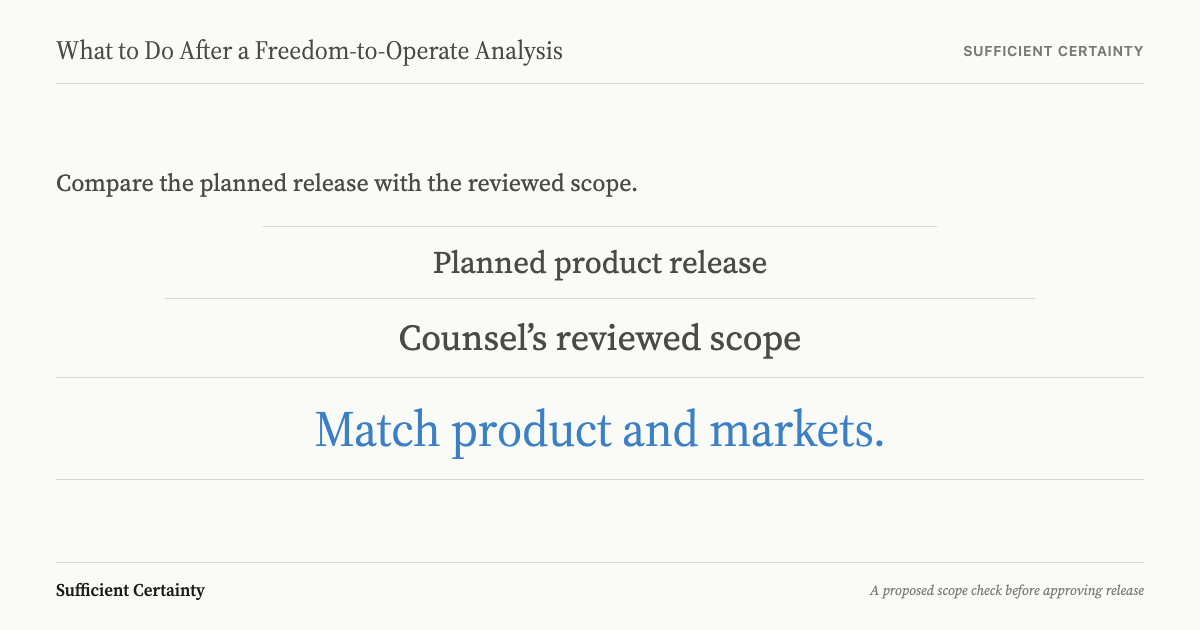
Unresolved findings need the same care. An opinion might depend on an assumed permission or a proposed technical change. Check whether that condition has been met in the release package. If it has not, ask counsel what the difference means. A project deadline is evidence of urgency, rather than evidence that the missing condition no longer matters.
Does the launch still match the product and markets counsel reviewed?
A related contract review can help confirm the scope of an agreed licence. The product manager still needs to compare that scope with the release. Keep the relevant permission with the technical record so a later expansion does not rely on an agreement that covers a narrower activity.
Treat an uncovered change as an open release question. The response need not be to repeat every part of the analysis. Ask counsel which work the difference requires. A focused update may be enough. Where the answer is not available before launch, compare a narrower release with waiting for the required advice.
Life Technologies turned on one statutory boundary
The 2017 US Supreme Court opinion in Life Technologies v Promega concerned a genetic testing kit. Life Technologies made one component in the United States and shipped it to the United Kingdom for combination with other components. The dispute included sales beyond licensed fields. The question before the Court concerned liability under section 271(f)(1).
The Court held that supplying a single component of a multicomponent invention for manufacture abroad did not create liability under that provision. It reversed and remanded. The ruling addressed a specific statutory question. It did not give Life Technologies worldwide freedom to operate or resolve every possible infringement basis. The patent at issue had expired in 2015.
The opinion does not establish that the parties completed a formal FTO analysis. It should not be used as evidence that such an analysis failed. Its relevance is narrower: manufacturing location and the activity examined can matter to a legal conclusion. A reader applying that lesson should give counsel the actual supply arrangement before relying on an earlier view.
Preserve the legal boundary when summarising specialist advice. A finding about one provision is easy to shorten into a broad statement that a product is cleared. That broader statement needs its own support. The proposed release note should identify the question counsel answered and any question that remains outside the opinion.
For present law, counsel must assess the current rights and relevant jurisdiction. A historical judgment cannot replace that work. The case also illustrates why a compliance assessment needs a clear connection to the action being authorised. The existence of a favourable finding is useful only within the question it resolves.
Match the release package to counsel’s scope
Before sign-off, put the reviewed specification beside the launch specification and identify any difference. Add the market list and the activities counsel relied on. Attach unresolved findings with their proposed treatment. Keep privileged advice within the handling arrangements counsel requires. The release note can reference that advice without copying it into a widely shared project document.
Make each condition a release requirement with an owner. Where counsel requires a technical change, obtain confirmation that the change is present in the planned version. Where permission is required, confirm the relevant agreement through the responsible legal owner. Record the evidence that closes the condition before treating it as satisfied.
The Universal Decision-Making Method helps connect an assumption with the evidence needed for a commitment. Here the central assumption is that the release remains within the reviewed scope. The product manager supplies the current facts. Counsel assesses their legal effect. The release owner then records why the remaining uncertainty is acceptable for the proposed action.
Define which later changes require another review. Include a new market or a material product change where counsel identifies it as relevant. A clear decision record preserves the approved version and the limits of the advice relied on. The next release can then be compared with a specific baseline.
You could launch the reviewed product name while releasing a version the patent opinion never covered.
Work through your decisionNo sign-up. Just pick your decision and start.
Grant Purdy is the co-author, with Roger Estall, of Deciding (2020), and the architect of the Universal Decision-Making Method.