
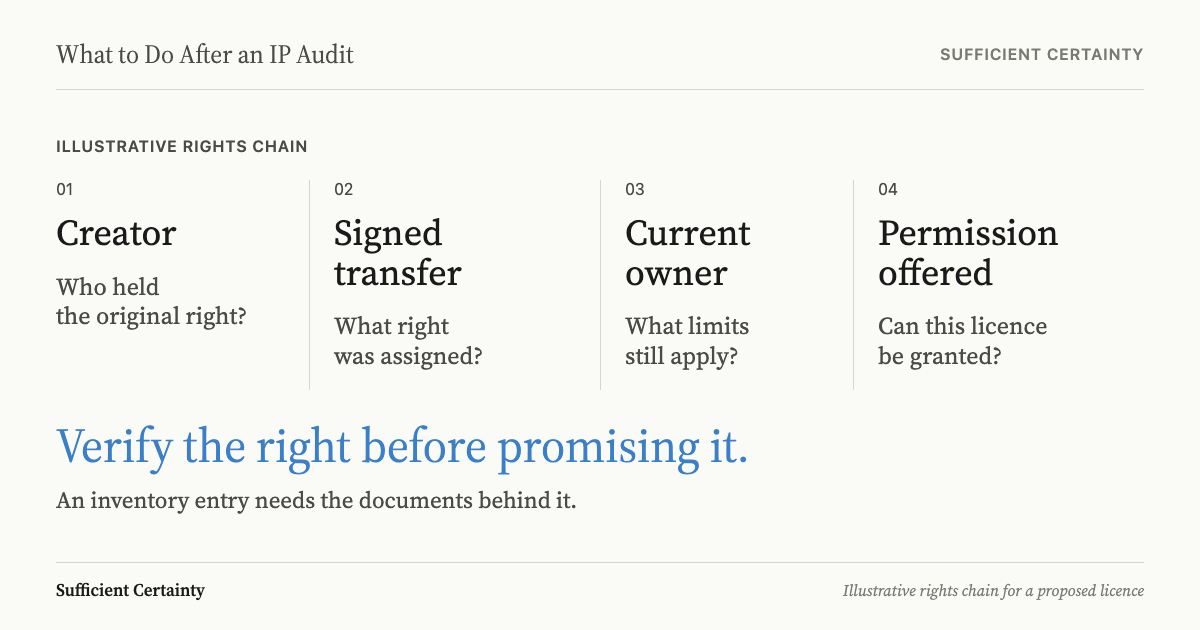
After an IP audit, trace one asset needed for the proposed licence back to its creator and signed transfer documents. A longer inventory can leave the most important permission unresolved. Check the right required for the offer before authorising its commercial use.
An IP audit reviews the intellectual property a business owns or uses to identify its rights and related commercial issues.
An asset inventory does not establish permission to license
A completed IP audit can locate valuable rights and identify gaps in their protection. It can also reveal third-party material used in the business. These findings help the owner decide where to spend effort. The next step is to select the commercial proposal that matters now. An attempt to clear every recorded asset equally can delay the one offer that requires a decision.
WIPO describes an IP audit as a review of IP owned and used by a business. Its guidance includes checking proof of ownership and the terms on which others can use assets. This matters because a business may use material legitimately while having no authority to license it to a customer. Record what the audit established for each important asset.
Look for the evidence behind any label such as owned or licensed. A patent number identifies a registered right. A supplier invoice shows a payment. A signed contract may describe what was transferred. These documents answer different questions. The audit should make it possible to locate the document supporting the particular right the business plans to offer.
Select the proposed use before deciding which audit findings need to be resolved. The relevant frame is the permission required for an offer. That may be narrower than ownership of the entire asset. It may also be wider than the permission needed for the business to use that asset internally. Write the intended customer use in ordinary words.
For a current business licensing its own work, the task is to connect that use to available rights. A buyer reviewing a target has a different commitment to assess. The discussion of legal due diligence concerns findings that affect an acquisition. Here, the business already holds the inventory and needs to decide what it can responsibly commercialise.
Your IP inventory needs to support the specific permission the next customer contract will promise. Start the Walk →
Which rights does the proposed deal require?
Describe what the customer will receive and what the customer may do with it. Identify the product or version involved. State where use will occur and how long it will continue. If the proposal permits further licensing, name that permission explicitly. A broad commercial description can conceal a permission that the underlying agreement never granted.
Test the audit against the actual offer, including any exclusivity promised. An asset can be available for use while being subject to earlier licences. A customer asking for exclusive rights may require something the business cannot supply. Ask the responsible adviser to explain the restriction and the options it leaves. Do not convert an unresolved point into a warranty merely to keep negotiations moving.
A worked illustration shows the mismatch. Suppose a completed audit contains the following two entries for the same software component. The example is hypothetical. It does not describe Stanford or another business. Both statements belong on the same review page because each affects whether the proposed customer licence can be approved.
The contradiction needs a decision about the offer. The business could obtain broader permission or remove the component. It could offer a narrower use if that still serves the customer. Those choices concern the commercial purpose as well as the legal wording. The organisational governance task is to make the person approving the promise responsible for the evidence behind it.
Ownership also differs from permission to operate. The USPTO explanation of patent rights says that a patent provides a right to exclude others. It does not itself grant a right to use an invention. An audit of owned patents therefore cannot automatically establish freedom to operate for the product that uses them.
This distinction changes the investigation. A missing assignment calls for evidence of transfer from the creator. A restriction in an incoming licence calls for a reading of the permission granted. Possible infringement calls for a separate analysis of other rights. Ask the question that matches the gap instead of requesting a general assurance that the IP is clear.
Stanford and Roche disputed the link from inventor to owner
In Stanford v Roche, decided in 2011, the US Supreme Court considered ownership of an invention associated with federally funded research. Its opinion is reproduced by Cornell LII. The Court held that the Bayh-Dole Act did not automatically vest title to federally funded inventions in federal contractors.
The opinion describes researcher Mark Holodniy signing a Stanford agreement promising to assign rights. He later signed a Cetus visitor agreement containing a present assignment. Roche acquired relevant Cetus assets. Stanford subsequently obtained assignments and patents, then sued Roche for infringement. The competing agreements became central to whether Stanford could pursue that claim.
The Court described the ordinary rule that an interest acquired by someone other than the inventor must trace back to the inventor. For an owner preparing a licence, the relevant lesson is to check the creator agreements. A funding relationship and later patent registration do not resolve a missing transfer by themselves. The particular agreements and applicable law matter.
Payment for work and possession of its results are not substitutes for checking the right acquired. For the reader, that means locating the relevant creator agreement and every material transfer. Have an appropriate adviser assess what the documents accomplish. Do not assume a clause used for one type of right works identically for every other type.
Check dates and asset descriptions against the version now being offered. A transfer covering an early invention may leave later work to examine. A company name change may explain an apparent gap. A missing signed schedule may leave a real one. The practical task is to distinguish a documentation problem from a right the business never received.
This also gives contract review a precise follow-up question. The reviewer needs to connect the transfer wording to the intended commercial act. Reading an agreement for general completeness will not answer whether a specific customer promise is supported.
Trace the rights needed for the offer
Choose the commercially important right whose absence would most change the proposal. Build a short evidence record from its creator to the business making the offer. Attach the documents supporting each transfer or permission. Identify the remaining restriction in words the commercial approver can understand. Keep confidential material within the established document controls.
Resolve the missing link before approving a promise that depends on it. Name the person who can obtain the document or permission. State what will happen if it cannot be obtained. A narrower offer may still achieve the purpose. Delaying the offer may be justified where the unresolved permission determines whether delivery is possible.
The Universal Decision-Making Method starts with the purpose and the decision being made. Here, the purpose could be earning licence income from a specified asset. Frame the alternatives around that result. Compare the proposed licence with an amended offer or no deal. A larger asset inventory is useful only if it helps decide between those options.
Use the discipline described in assumptions in decision making to expose any unverified claim of permission. Record how much confidence the proposed commitment requires. The business should be able to explain why the evidence is sufficient for this offer and which unresolved points it accepts. This is a specific use of evidence-based decision making.
Keep the approval tied to the asset version and scope actually checked. A new territory or a change in exclusivity can reopen the question. So can a new third-party component. Give the commercial owner a clear reason to return for review. The completed audit then supports a specific permission decision rather than becoming a general certificate that every future offer is safe.
Which document establishes your authority to grant the rights described in the proposed licence?
Work through your decisionNo sign-up. Just pick your decision and start.
Grant Purdy is the co-author, with Roger Estall, of Deciding (2020), and the architect of the Universal Decision-Making Method.