
After a kaizen event, the step before anyone counts the report-out's gains as delivered is to test whether they survive an ordinary week. Haapatalo, Reponen and Torkki (2023) examined 26 Kaizen events in specialised units at Finland's largest academic hospital system: of the 21 units interviewed, 13 achieved long-term results, three could not sustain their improvements and five struggled to make any improvements at all.
Eight of 21 had no lasting result. The authors tied the decline to high workload and a lack of time for improvement work, and found that success in follow-up went with results that lasted.
A kaizen event is a short, focused, team-based improvement workshop, typically three to five days, in which the people who do the work redesign one process.
The newspaper on the wall
The last afternoon of a kaizen event belongs to the report-out. The team presents to the sponsor and senior leaders: the baseline measures taken on day one, the changes trialled on the floor, the results from the trial runs, and a target sheet showing projected gains in lead time, travel distance, wait time or staff hours. The report-out is where the event's numbers become the organisation's numbers.
Anything not finished during the week goes onto the 30-day action list, often called the kaizen newspaper. Each line carries the problem, the countermeasure, an owner and a due date. The newspaper is posted in the work area so the people affected can see what was promised and by whom. Many teams also capture the event on a single page, much like the summary sheet described in what follows an A3 report.
The new process is then written into standard work: updated work instructions, revised layouts, visual controls and training for every shift that did not attend the event. The facilitator hands the process back to the area's supervisor.
Follow-up audits come next. The usual schedule is 30, 60 and 90 days, with some programs adding a 180-day check. Each audit compares current performance against the target sheet and confirms that the standard work is still being followed. When the audits show slippage, the area either reinforces the standard or schedules another event. This sequence sits within the wider family of problem-solving techniques in business, and the sequence is designed as the complete close-out.
A kaizen event compresses months of argument into a week
The value of the format is real. It puts the people who do the work in the same room as the people who fund it, and it forces observation of the actual process rather than the documented one. Changes get trialled on the floor within days instead of waiting for a committee cycle. A week of focused attention can settle arguments that have run for years.
The 30-day list turns loose ends into owned commitments, which is more than most meetings achieve. The audit schedule shows that the method's designers knew gains decay. A field study of 65 events in eight manufacturing organisations by Glover, Farris, Van Aken and Doolen (2011) found that positive attitudes at the close of an event did not automatically carry into sustained commitment, and that what happened after the event shaped it.
Event week runs with backfilled staff, a facilitator on the floor and a sponsor paying attention. The new standard work is written under those conditions, then handed to a shift that has none of them.
So the ritual is sound in design. Like a sprint retrospective, its strength is the discipline of a fixed routine. The weakness is what the routine takes for granted. The target sheet assumes the week-one gains are the gains that persist, that the standard fits normal load, that someone will do the audits, and that projected gains equal realised ones. None of those is tested at the report-out.
Take the target sheet from your last kaizen event, mark which gains were measured during event week and which were only projected, and put a date on the audit that will show which held. Start the Walk →
How many of Saskatchewan's 880 events held?
In Saskatchewan's health sector, Five Hills Regional Health Authority adopted Lean in 2006, and from 2009 the Ministry of Health required every health agency to use it. Lean offices were called Kaizen Promotion Offices. From April 2013 the Provincial Kaizen Promotion Office sat with the Health Quality Council (HQC).
The scale was considerable. According to the Provincial Auditor of Saskatchewan's 2014 report, the Ministry paid its consultant C$23.3 million from 2011 to July 2014, and 880 Lean events took place across the sector from March 2012 to August 2014. A University of Saskatchewan evaluation estimated one type of event, just under a third of the total, at about C$34,000 each before consultant fees.
The program had the audit schedule written in. Under the consultant's work standard, agencies had to complete audits 30, 60, 90 and 180 days after each event and report results to HQC. On paper, the follow-up schedule was complete.
The auditor found that HQC's database had no updated information for 48% of specific process improvements after 30 days, 47% after 60 days, 57% after 90 days and 73% after 180 days. HQC had taken no steps to monitor whether agencies completed the required audits.
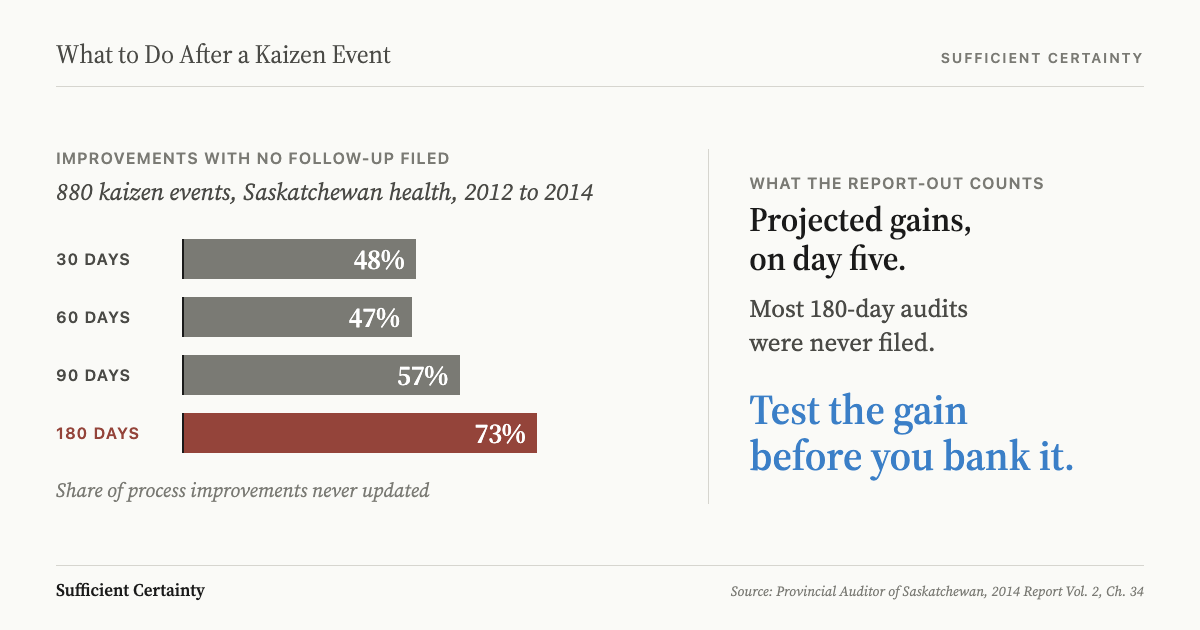
Meanwhile, the monthly reports sent to the Minister listed the number of events, the planned changes and projected gains, and training status. They did not consistently indicate whether agencies had maintained the results of past events or achieved the gains they had projected. The auditor concluded that without that status, it was "impossible for HQC to know whether the use of Lean was actually creating sustainable change."
The auditor did not assess whether Lean worked or offered value for money, and nothing here says it failed. The finding is narrower: the reports counted projected gains, not sustained ones, and the sustainment assumption went untested. Much like an after-action review whose lessons are filed but never checked, the audit schedule existed and the evidence thinned out.
The stakes were not small. Sari et al. (2017) estimated total implementation cost for 2012 to 2014 at C$44 million to C$49.6 million. In an April 2014 staff survey, only 46% of regional health authority respondents agreed that they supported the Lean efforts in their department. In August 2014 the Ministry announced it would not renew the consultant's contract, which was due to end on 30 June 2015.
Testing the target sheet before the gains are banked
The artefacts to check already exist: the target sheet and the kaizen newspaper. Under each projected gain, write the assumption it rests on. Four recur. The new standard work fits normal load, not event-week staffing. The week-one measurement reflects what will persist. A named person owns each follow-up audit. The projected gain equals the realised gain.
Then test each one against evidence rather than intention. Run the new standard on an ordinary shift with no facilitator present and measure it the same way as the baseline. Name the audit owner on the newspaper itself, alongside the date and what happens if the audit is missed. Keep projected and realised figures in separate columns so that one cannot quietly replace the other.
The trigger point is the 90-day audit. No projected saving goes into a budget until the 90-day audit confirms it, and no second event is scheduled in the same area until the first one's results are known. Where a gain has slipped, the question is which assumption failed, a job for root cause analysis rather than another workshop.
The target sheet's projected staff-hour saving enters next year's budget in week one. By the 90-day audit, nobody has submitted one, and the saving is still counted.
The saving stays in the projected column until a named owner measures an ordinary shift at 90 days. If normal staffing cannot run the new standard, the budget learns before it relies on the number.
This is the discipline behind the Universal Decision-Making Method: name what a decision is relying on, then decide what evidence is enough. It sits alongside the wider approach to strategic problem solving. A kaizen event produces a forecast, and a forecast needs checking before it is spent.
The report-out tells you what the team changed in one week. It doesn't tell you whether the change survives an ordinary week's staffing and load.
Work through your decisionNo sign-up. Just pick your decision and start.
Grant Purdy is the co-author, with Roger Estall, of Deciding (2020), and the architect of the Universal Decision-Making Method.