
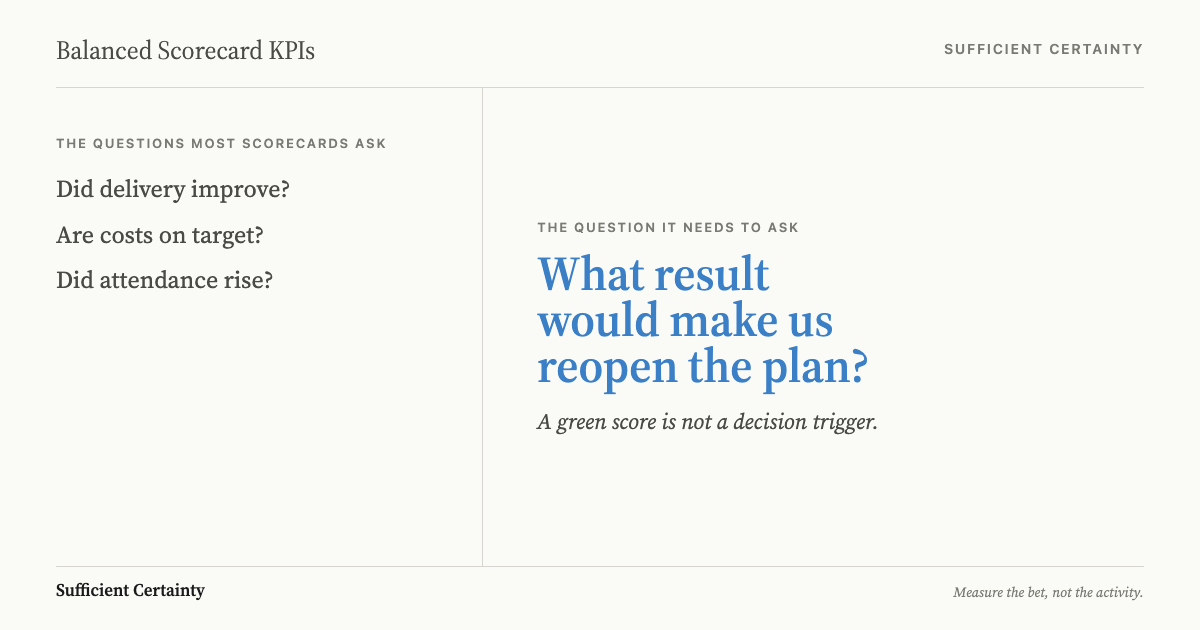
Choose balanced scorecard KPIs by asking one question: which measure, if it turned red, would change what the organisation does next? If the answer is none, the KPI is decoration. Most teams pick numbers that confirm progress. The useful measures are the ones that could prove the plan wrong.
I have seen balanced scorecard KPIs used to praise a service team for cutting its case-closure time. The team closed uncertain cases, reopened them later, and worked the difficult calls where the report could not see them. The number improved. The service did not.
When I sit with a board to choose a scorecard, I start with the question that usually stops the room: what are you actually trying to achieve here? Not the project objectives. Not the KPIs. The result the organisation needs from the strategy.
That is the job. For each strategic objective, choose the few measures that tell you whether it is working, give the relevant person time to act, and cannot be improved by making the underlying result worse. Then record what happens when the number says the plan is in trouble.
A measure can be linked to an objective on paper and still reward the wrong work. The choice is only complete when the measure tells the Decider something useful early enough to do something about it.
Balanced scorecard KPIs are measures linked to strategic objectives that show whether an organisation is making the progress its strategy requires.
1. Start with the strategic objective, not the KPI list
A balanced scorecard connects measures to strategic objectives. So write the objective in plain language before you discuss the data. Not "improve operations." Write the result the organisation is trying to achieve: "deliver orders to the new market faster without damaging margin." The difference matters. The first phrase gives every department a place to hide. The second tells you what the measure has to reveal.
Do not begin with the data you happen to collect. That is how a scorecard ends up measuring what the system finds convenient rather than what the strategy needs to know. Balanced Scorecard UK's KPI guidance makes the same distinction: operational measures can be useful without being strategic KPIs.
Suppose a manufacturer wants to win a new market by offering faster delivery. "Units shipped" may be a perfectly good operating measure. It does not show whether the promise is being kept, whether rework is rising, or whether the margin has disappeared in the rush. Start with the objective and you have a proper candidate set: order-to-delivery time, first-pass quality, and contribution margin from the new market.
Write the assumption beside the objective before you choose among those candidates. Here it is: the factory can shorten lead times without increasing rework or sacrificing margin. That sentence stops the team treating a familiar number as a KPI merely because the finance system knows how to count it.
Take the next KPI on your list and write the strategic objective, owner, and result that would require the plan to be reconsidered. Start the Walk →
2. Ask four questions of every balanced scorecard KPI
Take every candidate measure through these four questions. A measure that fails one is not necessarily useless. It may belong in an operating report, need a companion measure, or need to be dropped. It is simply not ready for the strategic scorecard.
Does it show progress toward the objective?
Ask what would be different in the real world if this number improved. "Training completed" does not show that a new capability exists. It shows that people attended training. The better measure may be the time to perform the new task correctly, or the error rate after the training. Keep the measure that gets closest to the strategic result, not the activity that precedes it.
Can the number improve while the objective gets worse?
This is the question that saves you from a scorecard everyone can game without ever meaning to. The measure can acquire a life of its own: people improve the reported number because it is concrete, while the outcome it was meant to represent quietly deteriorates.
Hood and Piotrowska's research on UK public spending shows why high-consequence indicators become vulnerable when people have good reason to make the reported number look good. Their work on Goodhart's Law and public-spending numbers is not an argument against measurement. It is a warning against allowing one attractive number to stand in for the outcome. Add a companion measure, redesign the measure, or reject it when the number can rise while the objective falls.
Will we see it in time to act?
Lagging measures tell you where you landed. Leading measures can give you time to intervene. A working scorecard often needs both. Contribution margin confirms whether the new-market move paid off; order-to-delivery time can show trouble before the quarter is over. The point is not to collect a fashionable mix. It is to make sure the team can act before the result is locked in.
Who acts when it moves, and what will they reconsider?
A number alone does nothing. For every KPI, name the person responsible for responding and the decision that comes back to the table when the threshold is crossed. Roger Estall and I set out the same discipline in Deciding: a measure is part of monitoring a live decision, not a statistic with a meeting attached. That is where the Universal Decision-Making Method matters.
3. Write a working definition for each balanced scorecard KPI
Do not approve a KPI as a label in a slide. Give each surviving measure enough definition that another manager can run it without an argument about what it means. KPI.org's development guidance rightly emphasises ownership, review, and adaptation. Those details are not administration. They make the KPI usable.
| Field | What to record |
|---|---|
| Strategic objective | The result this KPI helps test. |
| KPI and calculation | The exact measure, source, and calculation rule. |
| Baseline and target | Where performance starts and the change expected. |
| Owner | The person who can investigate and act. |
| Review trigger | The result that requires the relevant decision to be reconsidered. |
For the manufacturer, the entry might read like this:
| Field | Worked entry |
|---|---|
| Objective | Deliver orders to the new market faster without damaging margin. |
| Primary KPI | Median order-to-delivery time for new-market orders. |
| Companion measures | First-pass quality and contribution margin for the same orders. |
| Owner | Operations director. |
| Review trigger | Reopen the delivery promise if lead time improves while quality or margin deteriorates for two review periods. |
That is a scorecard entry. "Units shipped" is not wrong; it simply cannot carry that argument. Put it in the operating report if it helps run the factory. Do not promote it to a strategic KPI because it is easy to find.
4. Approve fewer KPIs and test them in the review
There is no universal number of KPIs, but there is a reliable warning sign: a scorecard that has a measure for every person in the room is usually reporting departmental activity, not strategy. A smaller set is harder to build because every surviving measure has to justify its place. That is the point.
Use the review to test the scorecard before you settle it. Ask the owner to explain what they would do if the measure moved in the wrong direction. Ask another leader how the number could be improved without the objective being achieved. Ask whether the data arrives before the decision window closes. If the answers are vague, the measure is not ready.
The live balanced scorecard versus KPI comparison explains why a scorecard gives measures a strategic home. This is the selection work that makes that home useful. You are not trying to make every important number fit. Balanced scorecard KPIs earn their place when they tell the organisation whether its strategy is working and what it must do when it is not.
Review the scorecard at the rhythm of the decision it supports. Use the same discipline when setting monitoring triggers and assigning decision rights. When the objective changes, or the assumption under it fails, retire or redesign the KPI. Those changes also belong in the review of each funded initiative after building a balanced scorecard, even while its reported targets stay green. A scorecard is not a museum of last year's ambitions.
You could approve another page of KPIs while the one measure that would change the decision stays off the scorecard.
Work through your decisionNo sign-up. Just pick your decision and start.
Grant Purdy is the co-author, with Roger Estall, of Deciding (2020), and the architect of the Universal Decision-Making Method.