
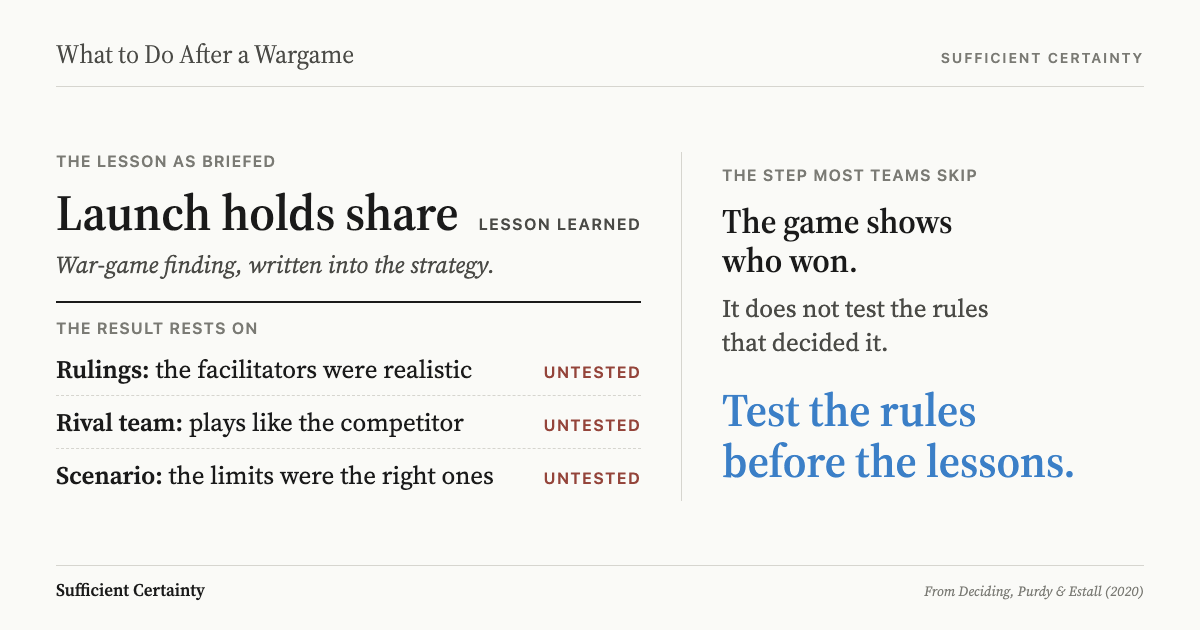
After a wargame, test the assumptions the game was built on before its lessons go into the strategy: the facilitators' rulings on what was plausible, the brief that told the rival team how to play the competitor, and the limits written into the scenario. A game can only surface what its design allows to happen. Japan's navy learned what skipping that check costs at Midway in 1942.
A business wargame is an exercise in which teams play the organisation and its competitors or adversaries, making moves and countermoves to test a strategy before it is committed.
What a wargame delivers
A business wargame puts a strategy in front of an opponent before the market does. One team plays the company. Others play its main competitors, and sometimes customers, regulators or an attacker. Each round, teams make moves, a facilitator or control team rules on what each move achieves, and play continues from the new position. The same shape runs a competitive-response game over several moves, a market-entry game, and a crisis or cyber tabletop compressed into an afternoon.
Run properly, the game produces what a planning meeting rarely does. It forces sequence: who moves first, what each side can see, how quickly each can respond. It exposes friction, such as the pricing approval that takes a week or the call centre that cannot absorb a surge. And it gives a rival team licence to do what the plan's authors would rather not imagine.
John Horn, drawing on more than 100 McKinsey wargames, describes a high-tech company that ran one as the downturn hit (Horn, 2011). After two days of role-play against competitor and stakeholder teams, its executives saw that a strong competitor on the sidelines was likely to enter aggressively. When that competitor announced its bid for market leadership, the company protected its core business instead of rushing into deals.
The outputs are concrete: a hotwash, the immediate debrief, at the end, a map of how each rival is likely to respond, and a revised plan. Rival teams are usually briefed from the company's competitor analysis, and the game sits naturally beside scenario planning, which supplies the futures the moves are played in.
The limits are plain too. However thorough the analysis, Hugh Courtney, John Horn and Jayanti Kar warn, a competitor is almost sure to make some moves the company considered unlikely (Courtney, Horn and Kar, 2009). Even a game built to rank a rival's likeliest moves can only rank the moves its design puts on the table, a limit that also separates scenarios from forecasts. A lesson from one run is a hypothesis about the strategy, not evidence that it works.
What it leaves unexamined
Every lesson a wargame produces is conditional on its design. Three parts of that design do most of the work and are rarely tested afterwards: the rulings that decide what a move achieves, the brief that tells each rival team how its competitor thinks, and the scenario limits that fix the starting position, the timeline and what is off the table.
The rival team looks most like independent evidence, so it deserves the hardest look. Courtney, Horn and Kar describe each competitor team receiving a fact pack about that company and its decision makers. The pack is built by the host company or its advisers from what they already know, and the players are usually its own managers, so the rival they play can end up as the one their employer already imagines. A rival team that plays the house view of the competitor tests nothing.
Rulings are the least visible. Someone decides whether a price cut wins share or a ransomware demand reaches the press, and that someone is a facilitator working from the designers' model of the market. Stephen Downes-Martin, writing in the Naval War College Review in 2013, argued that adjudication breaks down on novel problems, and that a primary cause is "the incorrect assumption that adjudicators are impartial controllers instead of dominant players." A facilitator's ruling is the design team's belief, entered as a result.
Scenario limits come third, and they matter most when the move that would break the strategy sits just outside them: the competitor that exits instead of fighting, the regulator that changes the rules mid-game, the outage that runs longer than the tabletop allows. They are often the same critical uncertainties a scenario exercise would name, fixed as givens instead.
Horn reports that an aerospace and defence contractor asked all 40 executives who would play its game which trends, scenarios and decisions should be tested, so the game would not be "unduly influenced by the hypotheses of its designers." Widening the design group changes whose beliefs are built in but does not remove them.
None of this makes the game worthless. It means the hotwash reports what happened inside the design, and the design itself never appears in the lessons.
Write down the facilitator ruling your wargame's main lesson depends on and ask whether anyone tested it against how the real competitor behaves. Start the Walk →
When the gap cost the Imperial Japanese Navy four carriers
In early May 1942 the Combined Fleet gamed its Midway operation aboard the battleship Yamato, with Rear Admiral Ugaki Matome presiding. The best-known account comes from a 1955 book by Fuchida Mitsuo and Okumiya Masatake, who as one of the umpires rolled the dice. It says that when the dice gave nine bomb hits on the carrier force, sinking Akagi and Kaga, Ugaki cut the hits to three. Kaga was still ruled sunk, then reappeared in a later phase of the games.
That story is contested. Its co-author Fuchida is a shaky witness, and Jonathan Parshall has set out in the Naval War College Review how unreliable his accounts are elsewhere. The Naval War College Museum has argued the ruling was defensible, since high-level bombers rarely hit ships manoeuvring at speed. Parshall and Anthony Tully, in Shattered Sword (2005), still called the games "four days of scripted silliness."
The adversary model is not contested, because it is in the carrier force's own report. The First Air Fleet's battle report records the estimate it sailed on: "The enemy is not aware of our plans," and "It is not believed that the enemy has any powerful unit, with carriers as its nucleus, in the vicinity."
At the games, Yamamoto Isoroku asked what would happen if American carriers suddenly appeared somewhere unexpected while the Kido Butai, Vice Admiral Nagumo Chuichi's carrier force, was attacking the island. Genda Minoru, Nagumo's air staff officer, answered "Gaishu isshoku", roughly one touch of the armoured gauntlet: an easy victory. American codebreakers had read enough of the plan to put three carriers north-east of Midway. On 4 June, dive bombers wrecked Kaga, Akagi and Soryu in one morning attack. Hiryu was hit that afternoon.
The defeat is usually filed under overconfidence after six months of victories. The structural reading is more useful. Whether or not the dice were overruled, each time the game raised the move that sank the fleet, it was waved away. Craig Symonds records that the officer playing the Americans sent his carriers out early onto the Kido Butai's flank, and Ugaki judged the move too improbable to allow. The game continued against an enemy that behaved as the plan required.
The same mechanics can run in a boardroom wargame. A rival team briefed to behave, a facilitator who rules a competitor's bold move implausible, and a scenario that stops short of the worst case all produce a strategy tested against the competitor it expected.
One step before the roadmap
The step belongs between the hotwash and the revised plan. It does not rerun the game. It asks what the game took for granted, and treats every lesson as conditional on assumptions until those are checked. The five-step Universal Decision-Making Method gives it a sequence: Frame, Tentative Elements, Assumptions, Sufficient Certainty, then Implement and Monitor.
Frame restates what the strategy is for, separately from what the game happened to test. A strategy team revising a market-entry plan asks what entry has to achieve, not which moves won the game. The Tentative Elements are the lessons and revised moves, held as proposals. Trace each lesson back to the design choice that produced it: the rulings it relied on, what the rival team was briefed to do, and what the scenario ruled out.
That trace is the Assumptions step. For each lesson, ask whether it would survive a different ruling, a freer rival or a wider scenario. A crisis team revising its crisis playbook after a cyber tabletop might find its recovery timeline holds only because the exercise capped the outage at a day. Where a lesson would not survive, it rests on the design rather than the play.
Sufficient Certainty then decides which of those assumptions to test, weighted by the cost of being wrong: a second game with the limit lifted, a rival team briefed by people who know the competitor from outside, or intelligence on what the competitor is actually doing.
Implement and Monitor carries the rest into the strategy as named signals, such as the competitor announcement that would show it is not playing the part the game gave it, with a threshold agreed in advance. A wargame tests a strategy against its designers' picture of the opponent. The step before the roadmap tests the picture.
You could write the wargame's lessons into the strategy and still leave the rulings and rival brief behind them untested.
Work through your decisionNo sign-up. Just pick your decision and start.
Grant Purdy is the co-author, with Roger Estall, of Deciding (2020), and the architect of the Universal Decision-Making Method.