
After a value-chain analysis, ask the owner of the next activity what one proposed change will require. An activity can appear cheaper in the spreadsheet while the receiving team’s extra work sits in a separate budget. Record the condition that would require another review before approving the change.
Value-chain analysis examines the activities that create customer value and how their costs, choices and connections affect competitive advantage.
A value-chain map connects work with customer value
A completed analysis gives a manager a way to examine work across the business. It identifies activities involved in creating and delivering a product or service. The next task is to choose which activity to change, and explain how that change will improve the result for customers.
The Harvard Business School Institute for Strategy and Competitiveness describes activities as the basic units of competitive advantage. Its account includes the wider system of suppliers and distribution channels. This makes the analysis useful for examining connections that an individual department’s budget can leave unclear.
Keep that perspective when preparing recommendations. Describe the customer benefit, the activity that produces it, and the evidence behind the proposed improvement. This supports strategic thinking because the choice concerns how the business creates value. It also helps distinguish the choice from the delivery schedule, as explained in strategic thinking and strategic planning.
Assess the proposed change across every activity needed to deliver the customer benefit. For a proposed purchase change, include the work needed to receive, check, use and support the item. A lower purchase price might require different inspection equipment. Treat that possibility as a question for the receiving owner, rather than assuming either a saving or a problem.
The next activity means the work that depends on the proposed change. It need not be the next box on a diagram. Customer support might depend on information created much earlier in product development. Ask its owner whether changing that information would require new instructions, training or a different response to customers.
The Institute’s account of strategic positioning connects competitive advantage with choices about activities. Use that connection to explain why the recommendation matters. A proposal to remove a quality check needs to show how the customer’s required quality will still be delivered.
Activity recommendation
- Identify the proposed saving
- Name the activity to change
- Assign the implementation owner
Linked activity review
- Confirm the receiving team’s requirements
- Include the work transferred elsewhere
- Record a signal for another review
A cost-benefit analysis can help compare alternatives once these requirements are known. Preserve the links between activities when putting numbers against them. A saving is a proposal to verify across linked activities before it becomes a reason to approve.
Which signal would require a review of the activity change this analysis recommends? Start the Walk →
What changes for the next activity?
The map records a view of how the business works at a particular time. A proposed change alters part of that arrangement. Ask the receiving owner what must remain true for the next activity to produce its required result. The answer might concern input quality, available capacity or the time allowed for checking.
For a hypothetical change to purchasing, ask which specification the receiving team needs and who can confirm it. Then ask how that team will detect a departure. This turns a general concern about downstream effects into a specific condition that can be checked during implementation.
Keep assumptions in the decision visible. An owner’s acceptance of a proposal may depend on being able to inspect each delivery. If the proposal also reduces inspection staff, those two changes need to be considered together. Approval of each activity in isolation would leave their connection unexamined.
Give each important connection a signal that can require the decision to be reviewed. Define the signal in terms the receiving team already uses. It might be an input failing an agreed test, a missed dispatch commitment, or a requirement for unplanned rework. Select the signal that would make this particular change unacceptable.
- Activities and their estimated costs
- Proposed changes and expected benefits
- The receiving activity’s confirmed requirements
- Evidence that the new input works
- A named person watching the connection
- A signal requiring another review
The map may contain some of this information already. Check that it is current and specific to the proposed change. Monitoring needs a person who can see the signal and an agreed response. A scheduled meeting does not explain what to do when an unacceptable input arrives between meetings.
Check the proposed saving against any extra work the receiving owner identifies. Keep the evidence and its date beside the estimate. If a receiving requirement changes during implementation, review the cost and customer benefit again. The original comparison may need to be revised even when the changed activity meets its own target.
Record where the evidence will come from and who receives it. Choose a review interval that allows action before the customer commitment is missed. A trigger must arrive early enough for someone to change the plan. If that is impossible, reconsider the proposed change before committing.
Toyota’s 2011 recovery depended on linked activities
Following the March 2011 Great East Japan Earthquake, Toyota had to restore production across damaged supplier connections. Its company history of the recovery reports damage at 659 supplier sites, including later-tier suppliers. Toyota estimated that procurement problems could affect 1,260 items and up to 80% of its global vehicle production. That was an estimate of potential exposure, not a measured final production loss.
According to Toyota, purchasing, engineering, production and production-engineering groups developed responses with suppliers. Where restoration was not feasible, work included alternative parts and production preparations. The account identifies the damaged Renesas plant in Ibaraki as a microcomputer bottleneck for several automakers. Industry recovery work enabled a partial restart in June, rather than September as initially projected.
Toyota reports that its Japanese plants returned to normal operating levels in early July. Nearly all global production sites had normalized by September. These are the company’s retrospective recovery milestones. They should be kept separate from the earlier estimate of vehicles that might be affected.
The history describes recovery work, rather than a Porter value-chain workshop. The connection to value-chain analysis is an analytical comparison: a change involving procurement also required work in engineering and production. For a proposed substitution, check what the receiving activity needs before treating availability as permission to use it.
Apply that comparison carefully. In an ordinary improvement proposal, the question might be whether a different input can pass the existing inspection and production process. Confirm who can make that assessment. If it requires a new test or a process change, include that work in the recommendation and its cost.
The useful lesson for the reader is about deciding across linked activities. This article’s proposed monitoring approach is an application, not a claim about Toyota’s controls. Record a failed acceptance test as a reason to revisit an approved substitution. That connects evidence from the receiving activity to the decision that introduced the change.
Record the trigger before approving the change
Make a short change record before the recommendation goes into the implementation plan. Include the activity being changed, the intended customer result, the receiving activity and its owner. Write down the requirement that owner has confirmed. Attach the evidence supporting it, rather than referring only to the completed analysis.
The Universal Decision-Making Method provides a sequence for this review:
- Frame. State the customer result the change must improve and the commitments it must preserve.
- Tentative Elements. Describe the proposed activity change and an alternative, including keeping the existing arrangement.
- Assumptions. Record what the receiving activity needs to accept the changed input.
- Sufficient Certainty. Decide which evidence is needed before authorizing this change, considering the consequences of being wrong.
- Implement+Monitor. Assign someone to observe the agreed signal and identify who can revise the decision.
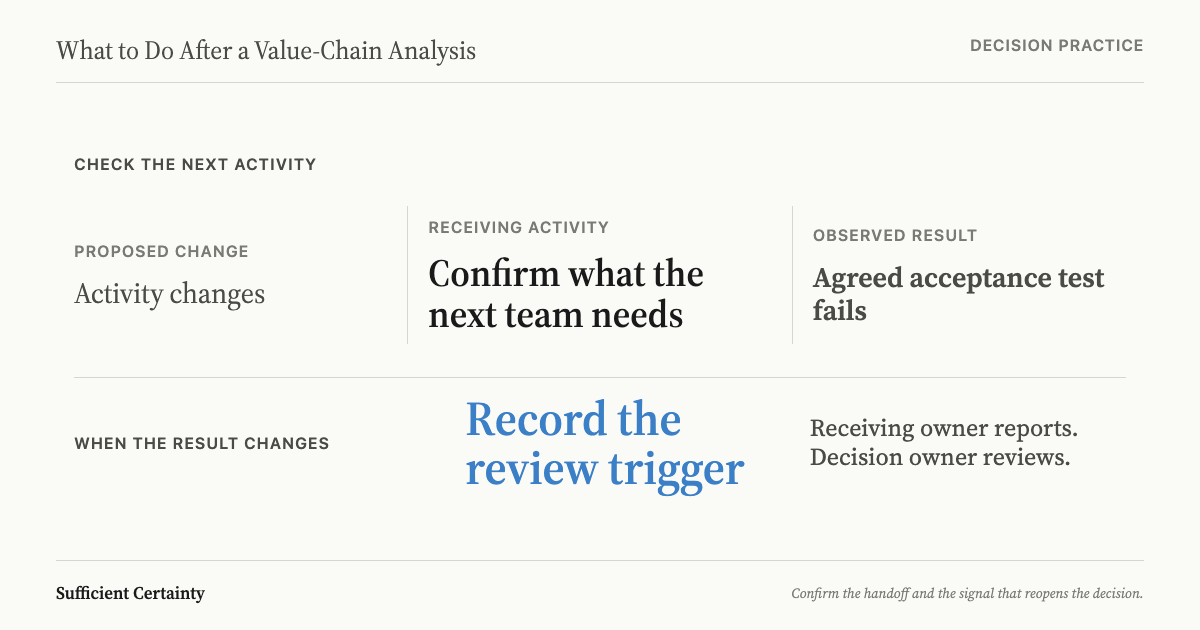
Write the trigger as a complete instruction. For a hypothetical input substitution: if the replacement fails the agreed acceptance test, the receiving owner reports it immediately. The person authorized to decide then reviews continued use before another affected batch enters production. Set the actual test and response using the requirements of that operation.
Approve the change with its review trigger and response recorded together. Confirm that the person observing the signal can reach the person authorized to act. If the evidence is unavailable, narrow the change or postpone approval while obtaining it. A limited trial may be appropriate when its consequences can be contained.
This is part of strategic decision-making: choosing an improvement while preserving the conditions needed to deliver it. Keep the change record with the implementation plan. When the trigger occurs, review the affected connection and the decision behind it. Update the map if the arrangement changes.
Before approving the activity change, record who will notice a failed handoff and who can revise the decision.
Work through your decisionNo sign-up. Just pick your decision and start.
Grant Purdy is the co-author, with Roger Estall, of Deciding (2020), and the architect of the Universal Decision-Making Method.