
A steering committee I sat in on had been running a system rollout for eleven weeks. Adoption was at 38 per cent. The sponsor wanted a recommendation by Friday: Kotter, ADKAR, or a custom engagement plan. The change lead had prepared a slide comparing all three and a fourth option labelled "blended approach." Nobody in the room had asked the question that would have saved them the deck: why is adoption at 38 per cent?
The answer was not framework selection. The operations team had told their supervisors, repeatedly, that the new system doubled the data entry required for a routine safety inspection. That objection had been logged as "resistance" and routed to the communications workstream. That is information about the system, not an attitude problem. Choosing which change management approach fits a rollout with strong resistance is the wrong first move when the resistance is carrying real data about the decision.
A change management approach is the combination of methods, sequencing, and support structures an organisation uses to move people from the current way of working to a new one after a change has been decided.
Strong resistance is not one condition
Oreg, Vakola, and Armenakis reviewed 79 quantitative studies of change recipients' reactions and found that the antecedents split into at least three distinct channels: the content of the change, the process by which it was introduced, and the internal context surrounding it. A belief that the change is harmful calls for a different response than a skills gap or a broken trust relationship with the sponsor. Lumping all three under "resistance" and reaching for a single model is the mistake I see most often in the organisations I work with.
Ford, Ford, and D'Amelio made the sharper point in their 2008 review: the change agent's own actions and omissions can produce the resistance they then complain about. The framing of the change, the quality of the sponsorship, and the willingness to hear competing views all shape what happens on the shop floor. Diagnosing "the people" without examining the sponsor's own framing and follow-through is incomplete work. The resistance is often telling you something about the change, not just about the people.
If the objections challenge the decision, reopen it
The first diagnostic question is whether the resistance targets the substance of the change or the way it is being carried. When people say the purpose is unclear, the expected outcome is unrealistic, or the feasibility has not been tested, that is not resistance to implementation. That is a challenge to the bet the organisation is about to make.
In the Universal Decision-Making Method, this is where I pull the work back to the beginning: state the purpose, state the desired outcome, name the assumptions the decision rests on, and ask what evidence would make you pause. If the strongest objections land on those assumptions, the responsible move is to reopen and test, not to select an engagement model and push through. A change management approach chosen before the decision has been tested is mobilisation on hope.
When the decision is sound but trust or meaning is missing
I see a different pattern when nobody disputes the substance of the change but people cannot see how it connects to their work, or they do not believe the sponsor will protect them through the transition.
Lawson and Price described this at a European retail bank with more than 30,000 employees: the change was sound, but adoption required four conditions that no framework could shortcut. People needed a credible purpose, reinforcing structures and processes, the skills to act on it, and respected colleagues modelling the new behaviour in front of them. Two years in, the bank was about halfway to its targets, and branch queuing times had fallen by more than 30 per cent.
The bank's progress came from sustained, local, credible work over years. I have watched consultants sell a twelve-week engagement as a substitute for that kind of patience. The consulting firm collects its fee either way; the organisation discovers the shortcut was an illusion eighteen months later.
Kotter's coalition model fits this pattern because it builds commitment through people who already carry authority on the ground. But the coalition is a way to test and carry a decision that has already been examined; using it to manufacture consent for a decision that has not been tested is a category error, and it is the error I see repeated when sponsors confuse coalition-building with persuasion.
Name whether the resistance in your rollout challenges the decision, the sponsor, or the conditions, before you select a model to manage it. Start the Walk →
When people lack the capability or the rollout overloads operations
Sirkin, Keenan, and Jackson analysed 225 change initiatives and built their DICE diagnostic around four measurable project conditions: duration between reviews, integrity of the project team, senior commitment, and the additional effort required from employees. Projects scoring above 17 on their scale were statistically likely to fail.
That is a project-condition failure, not a resistance problem. What those four factors actually measure is whether the team is ready for the change at the operational level, not whether the people have the right attitude.
I sat through sessions where a sponsor commissioned "engagement workshops" to close a gap that was structural, not attitudinal: the operations team was already stretched, a new system doubled their data entry, and the project team lacked authority to make decisions between review cycles. The workshops were cover; they let the sponsor report progress to the board without repairing the conditions that made progress impossible.
No amount of messaging will close that gap. The rollout needs its execution conditions repaired or its scope reduced, and when operations cannot pause for the rollout, that reduction is not optional. I treat these as secondary elements of the decision: the supporting features that make successful implementation more likely. They matter, but they cannot rescue a primary change that was never tested.
In my experience, a related failure appears when the context shifts after launch. The decision was sound, the approach was fitted, and then something in the wider operating environment changed: a regulation, a supplier, a market assumption. Oreg and colleagues noted in their 2026 review that responses to change are not static; support and opposition can coexist and shift as the rollout progresses.
The response is not to double down. It is to treat the original assumptions as live instruments, not settled history, and decide again. Continuing because of the investment already made is not a decision about whether the change is still sound. That is a decision about sunk cost, and it should be named as one.
Fit the change management approach to the diagnosis
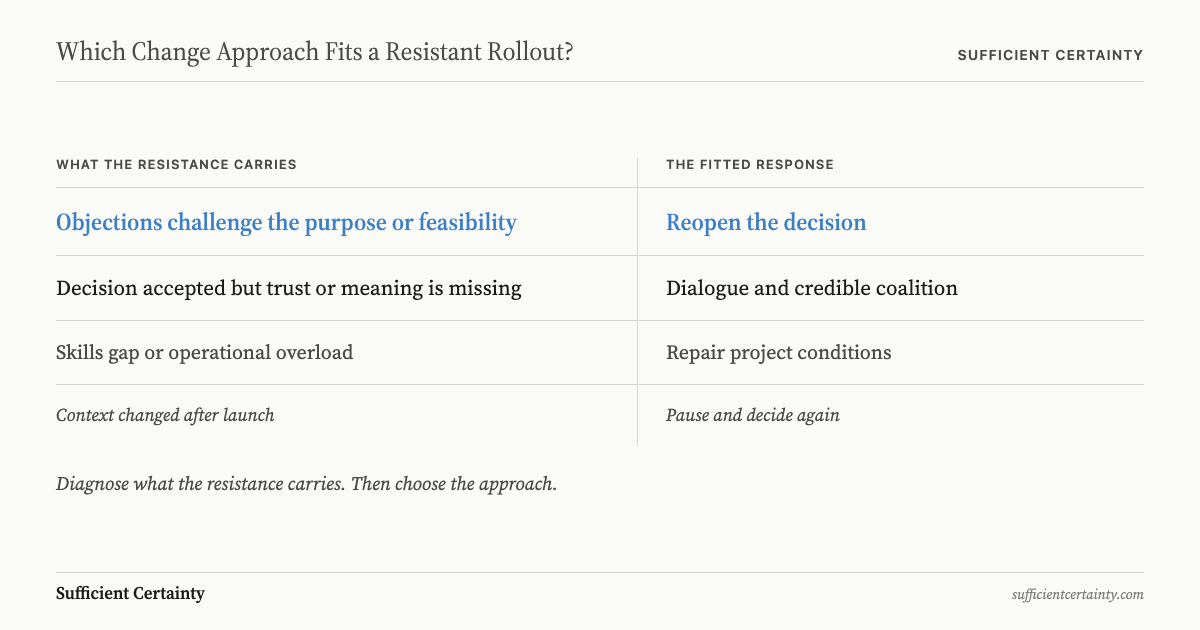
The sequence I use in practice is shorter than any framework comparison deck. Start by separating what people are objecting to. The cause determines the approach, and the four causes call for four different responses.
When the strongest objections challenge the purpose, the expected benefits, or the feasibility of the change, no implementation approach fits yet. The decision itself needs reopening. Surface the assumptions it rests on, test them, and decide again before any rollout work continues. ADKAR awareness campaigns and Kotter coalition-building are the wrong tool here; they mobilise commitment to a decision that may not deserve it.
When the decision is sound but people cannot connect the change to their work or do not trust the sponsor, the approach that fits is sustained dialogue and credible local advocates. Kotter's coalition model belongs here: people who already carry authority on the ground demonstrate the new way of working and make the purpose visible. Communication alone will not do it. The conditions Lawson and Price described took years, not a twelve-week engagement.
When people accept the change but lack the skills or the operational capacity to execute it, the problem is structural. The approach that fits is project-condition repair: shorter review cycles, team capability, realistic effort estimates. Sirkin, Keenan, and Jackson's DICE factors are the diagnostic. Fix the conditions before asking for more commitment.
When the context shifts after launch, the approach that fits is a pause. Treat the original assumptions as live instruments. If a regulation changed, a supplier moved, or a market assumption broke, the decision needs re-examination, not more change management. A force-field analysis mapped to the actual diagnosis will do more than any comparison of branded models.
In Deciding, Roger Estall and I made the case that every decision rests on assumptions, and that those assumptions need to be surfaced and tested before commitment. Choosing which change management framework to apply is a legitimate question, but it belongs after the diagnosis, not before it. A framework selected to manage resistance that is actually telling you the decision was weak will spend credibility, burn time, and produce the outcome the operations team was trying to warn you about.
You could pick the framework and still push a decision the shop floor already diagnosed.
Work through your decisionNo sign-up. Just pick your decision and start.
Grant Purdy is the co-author, with Roger Estall, of Deciding (2020), and the architect of the Universal Decision-Making Method.