
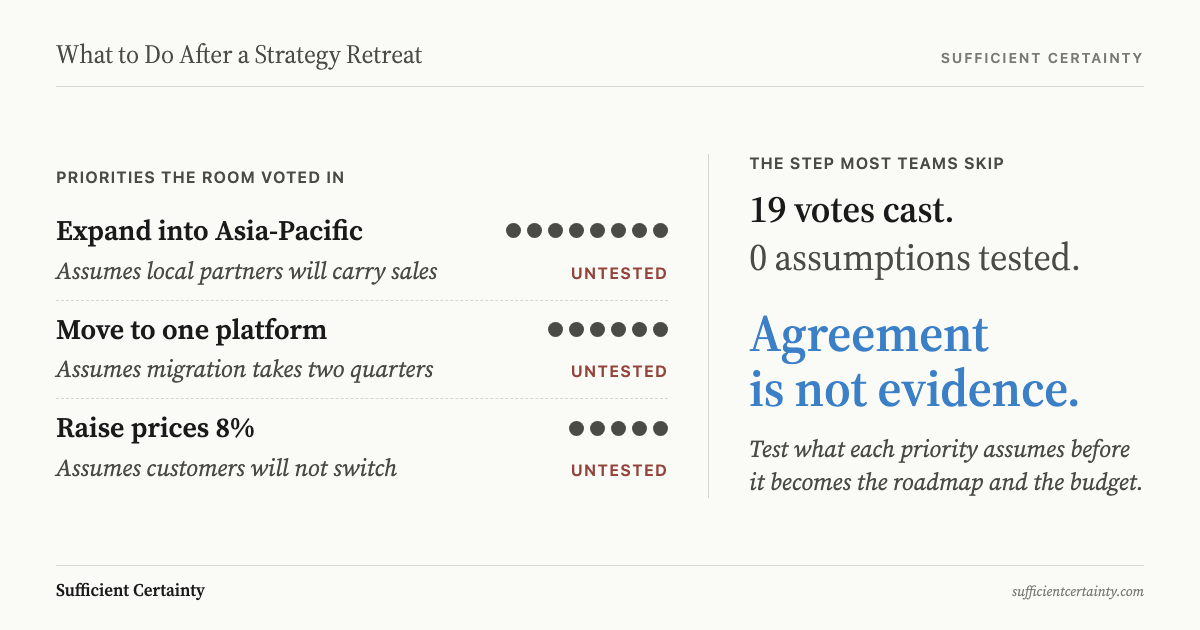
After a strategy retreat, test the assumptions under the priorities the room agreed on before they harden into the plan and the budget. The retreat proves the leadership team can sign up to the same words. It does not prove that the conditions behind those words hold, or that everyone who nodded meant the same thing by them.
A strategy retreat is an off-site meeting where a leadership team steps away from daily operations to review direction and agree a short list of strategic priorities.
What a strategy retreat delivers
A retreat buys something the operating calendar never supplies: the whole top team in one room, for a day or two, with nothing else on the agenda. The usual format reviews performance, scans the environment, debates options and converges on three to five priorities, each with an owner. It is the moment in the year where strategic thinking comes before strategic planning, rather than being squeezed out by it.
Distance from the office matters. Executives who spend most weeks defending their own function are asked to argue about the whole organisation. Trade-offs that stay buried in monthly reporting get forced into the open, because a short list cannot hold every request. A retreat run well is one of the few places where competing priorities are ranked by the people who own the budgets.
The retreat also produces shared language. A phrase such as "win in the mid-market" or "become the regional leader" gives the organisation a way to talk about direction that did not exist the week before. Leaders return with the same slide, the same wording and a public commitment to it. Used well, that language lets a regional manager check a local decision against the direction without waiting for the annual plan.
Then there is the social product. Leaders who have argued in person and reached a conclusion together tend to defend that conclusion afterwards. A retreat converts private opinions into a public position the team can be held to. For anyone working on strategic thinking at the top of an organisation, that is a real asset.
What leaves the room is a list of priorities, a set of owners and a mandate to turn both into a plan. What does not leave the room is any evidence that the priorities will work.
What it leaves unexamined
Every agreed priority rests on conditions. A growth target assumes demand exists at the planned price. A capability bet assumes the organisation can hire or build the skills in time. A partnership priority assumes the partner wants the same thing. These assumptions get argued over, sometimes loudly. A retreat has a mechanism for agreeing priorities and none for testing them. The agenda ends when the list is agreed.
The format also favours convergence. Time is fixed, the chief executive usually has a view, and success is measured by whether the list gets agreed. Doubts that would take a week to resolve get parked, and parked doubts rarely return. The room confuses alignment with consensus, and the pull toward agreement is the same pressure described in research on groupthink.
Silence in the room is not the same as support. After Netflix announced, then abandoned, a plan to spin its DVD business off as Qwikster in 2011, Reed Hastings recounted in No Rules Rules that dozens of managers and VPs came forward afterwards to say they had not believed in it. One said the finance team had gone along because everyone else seemed to.
Agreement on the words also hides disagreement on meaning. Sull, Homkes and Sull (2015) found that executives change and dilute strategic messages as they pass them on, and that only half of middle managers could name any of their company's top five priorities. The dilution starts at the retreat. Take one agreed priority, "make Asia-Pacific the growth engine", and follow it out of the room.
Each reading is reasonable. Each commits the organisation to a different plan. A priority everyone agreed to can still be three different decisions.
Pick the priority the retreat agreed on fastest and write down what has to be true for it to deserve next year's budget. Start the Walk →
When the gap cost the UK Cabinet its Chequers agreement
The merits of Brexit are beside the point; the process is the lesson. On 6 July 2018, Prime Minister Theresa May took her Cabinet to Chequers, her official country residence, to settle the UK's proposal for its future relationship with the EU. The statement issued that day said the Cabinet had met "to discuss and collectively agree" the UK's vision. At its core sat a free trade area for goods, backed by a common rulebook and a facilitated customs arrangement.
Two assumptions carried the agreement. The first was that ministers who signed up to the collective position would defend it outside the room. The second was that the EU would accept its economic framework. The EU was not present, and its own guidelines, adopted that March, said a future agreement could not amount to participation in the single market or parts of it.
The first assumption failed within two days. Late on 8 July, Brexit Secretary David Davis resigned. His resignation letter said the common rulebook would hand "control of large swathes" of the economy to the EU, and that the job needed "an enthusiastic believer in your approach, and not merely a reluctant conscript." He had made the same objection at Cabinet, and the statement recorded collective agreement regardless. Foreign Secretary Boris Johnson resigned the next day. Both had been at Chequers.
The second assumption failed at the informal EU summit in Salzburg. On 20 September, European Council President Donald Tusk told reporters that "the suggested framework for economic cooperation will not work", because it risked undermining the single market. Cabinet unity had lasted two days; the EU's verdict on the economic core came eleven weeks later.
Collective agreement at a retreat records who was in the room, not who believes the conclusion. When agreement is recorded over voiced objections, the room has taken a vote, and a vote does not commit the people who lost it. A position that depends on a counterparty's response has to be tested with that counterparty before anyone relies on it.
One step before the roadmap
The insertion point sits between the retreat and the planning cycle, before any priority becomes a roadmap line or a budget bid. Each priority is treated as a draft to be tested before it earns a place in the plan. The five-step Universal Decision-Making Method gives that test a structure.
Frame each priority as the decision it commits the organisation to: which market, which investment, by when. List the Tentative Elements, the options and draft commitments still on the table. Surface the Assumptions each one depends on, written down by its owner, not recalled from memory. Decide what Sufficient Certainty looks like: an acquisition warrants more evidence than a pilot. Then Implement and Monitor against a named indicator, with a trigger for reopening the priority if it moves the wrong way.
Two tests are cheap and fast. Ask each executive to restate the priority in one sentence, in writing, without consulting the others, and compare the answers. Then list the assumptions in the decision that rest on someone outside the room, whether a customer, regulator, partner or supplier, and find a way to check them before money moves.
The same discipline applies after turning a SWOT into strategy, where retreat agendas often begin. Testing the priorities in the fortnight after a retreat costs far less than discovering, a year into the plan, that the room never agreed on them.
You could turn the retreat's priorities into a roadmap and still leave the assumptions the room agreed on untested.
Work through your decisionNo sign-up. Just pick your decision and start.
Grant Purdy is the co-author, with Roger Estall, of Deciding (2020), and the architect of the Universal Decision-Making Method.