
Halo effect bias is the cheapest source of borrowed evidence in any organisation. One admired trait does the work of ten, and because the glow arrives looking sensible, nobody notices the substitution. Prestige starts carrying claims it has not earned, and the room stops asking what the evidence actually proves.
In 2000 Fortune put John Chambers on the cover and asked whether he was the best boss in America. Cisco was worth more than half a trillion dollars. A year later it was explaining a multibillion-dollar inventory write-down. The man had not changed much. The market’s mood had. That is halo effect bias at corporate scale, and it starts flattering the evidence before the meeting has even begun.
Usually they are borrowing prestige. A rising share price or a polished chief executive starts doing work that proper evidence should have done. In the wider field of cognitive biases, this one is especially troublesome because it arrives looking sensible. One good trait does the work of ten, and nobody notices the substitution. It can slide quickly into representativeness bias, because once the glow lands people start treating the admired thing as the model for everything around it.
Halo effect bias is the error of letting one favourable impression spill across unrelated judgments, so an admired trait starts carrying claims it has not earned.
Halo effect bias lets winners borrow wisdom
Winning companies get described as wise in departments nobody has actually tested. I have watched that habit for years, and Rosenzweig documented it cleanly in his critique of business delusions. When the numbers are strong, people start calling the company clever on strategy and leadership as well. When the numbers turn, the portrait gets repainted in reverse. It is a neat little trade for commentators who dislike saying, “we do not know yet.”
I have seen boards do the same thing with less glossy paper. A run of good results makes a chief executive sound sharp on questions the results have never tested. A famous brand makes an acquisition feel safer than it is. Sponsors like that flattering frame because half the lobbying is done before the meeting starts. Advisers like it because yesterday’s winner is easier to bill for than today’s uncertainty.
Cisco matters because the glow did not stay on the magazine cover. It changed what people thought counted as evidence. Success started standing in for judgment. After that, objections sounded churlish and caution sounded slow. The room was no longer testing the case. It was shielding a borrowed prestige it had already decided to admire.
Strip the prestige from your current hire, leader, or deal and see what evidence still stands. Start the Walk →
How halo effect bias gets into the frame
The halo does its first damage in the frame. Instead of asking what the evidence shows, people ask how to back the star without looking obstructive. The admired trait gets smuggled into the question as if it has already proved the answer.
That is why I start with Frame the decision in the Universal Decision-Making Method. If the question is bent, everything downstream bends with it. Roger Estall and I kept seeing the same move in Deciding: someone imported a flattering assumption before the options were even on the page. By the time the meeting began, the preferred answer was already dressed as common sense. Internal sponsors are rarely eager to disturb that arrangement.
Once the glow lands, it can work like anchoring bias. The first admired fact stays put while every later fact gets dragged toward it. Business journalism helps, of course. Hero stories are cheaper than admitting uncertainty, and much easier to repeat (especially after the hero has made the cover).
Why halo effect bias survives the warning label
People often tell me the cure is awareness, as if naming the problem were serious work. Thorndike’s 1920 paper made the point a century ago. Army officers liked a soldier’s bearing and then handed him the rest of the virtues as a bundle. They were not being obviously corrupt. They were being respectable, which is worse, because respectable mistakes are the ones institutions keep.
Nisbett and Wilson showed the same trick in their 1977 experiment. Students watched the same lecturer presented as warm or cold, then rated unrelated details differently. Even when the researchers suggested that the overall impression had coloured the judgment, the students brushed it off. The mind had already edited the evidence, then produced a tidy explanation after the fact.
That is the part advice pieces usually miss. Prestige makes thin evidence feel sufficient before anyone has even named the inference. Once a leader or a winning streak has been admired, unproved claims start arriving with a false stamp of approval. It also feeds overconfidence bias, because people feel more certain than the facts justify while telling themselves they are simply being fair.
How I catch the halo before it decides for us
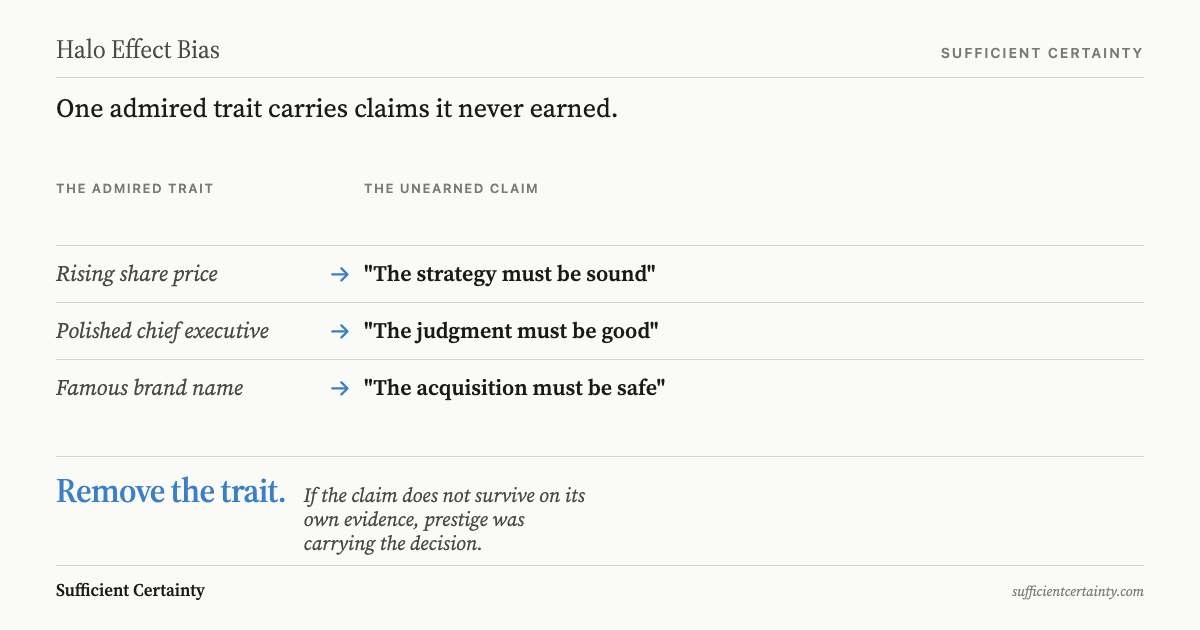
I do not try to out-stare this bias. I assume it is already in the room, so I go straight to Recognise assumptions. If someone says a company is well led, I ask what that admiration is supposed to prove about the live decision, better margins or a safer acquisition. Then I write the admired trait in one column and the claim being smuggled through it in the next. If the second column cannot stand on its own, the halo is carrying the case.
Wirecard is the nastier example because the halo went institutional. The company became a national champion, the sort of ornament people like to point at. The Financial Times kept reporting trouble. German regulators turned on the critics instead. The European Parliament brief after the collapse reads like a manual for borrowed prestige. Admiration and official pride softened scrutiny until EUR1.9 billion of supposed cash turned out not to exist.
Broken machinery usually has shareholders. Auditors had fees to protect, and regulators had no appetite for admitting that the national champion might be rotten. Once people are paid or publicly attached to the story, they do not become eager sceptics.
That is the hard part of overcoming cognitive biases. I strip the admired trait out of the decision and restate the case without it, no famous name and no recent win. If the argument still stands, fine. If it falls over, even better, because now we know the admired trait was doing the work.
You could trust the polished chief executive again and miss what the evidence never earned.
Work through your decisionNo sign-up. Just pick your decision and start.
Grant Purdy is the co-author, with Roger Estall, of Deciding (2020), and the architect of the Universal Decision-Making Method.