
Overcoming cognitive biases does not start with naming them. It starts with changing the decision process so that the assumption underneath the preferred answer has to be stated and tested before anyone commits. Awareness is a seminar topic. A process that forces challenge at the right moment is a countermeasure.
Every article on overcoming cognitive biases offers the same sermon: slow down, seek diverse views, consider the opposite. Fine, if sermons altered decisions. I have watched teams repeat those pieties while approving a depot consolidation built on one unspoken claim, that a single site could absorb Christmas volume without wrecking service. Those are habits, not countermeasures.
The Universal Decision-Making Method is a decision process that exposes and tests the assumptions carrying a decision before preference hardens into judgment.
Roger Estall and I wrote Deciding after watching rooms do this again and again. People speak about bias as if it lives inside a defective personality or a bad habit. In my experience, it usually has much better accommodation than that. It is lodged in the question, then protected by a process that mistakes paperwork for thought. That is why cognitive biases in business keep surviving training programs that address the person instead of the target. Once that machinery is in place, decent people can endorse foolish decisions with a perfectly straight face.
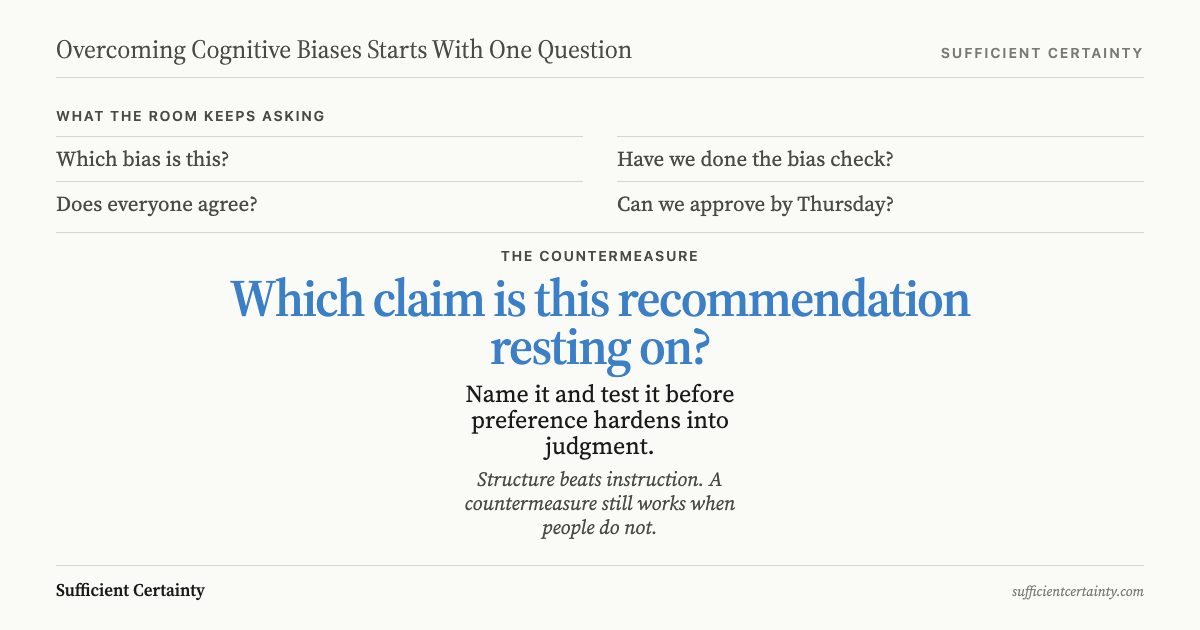
That is why I do not put much faith in advice that tells executives to slow down and be more open-minded. Fine sentiments, lovely in workshops, nearly useless when a sponsor wants approval by Thursday. The room needs a countermeasure, something that forces a claim into daylight and makes someone defend it. A sermon depends on virtue. A countermeasure still works when people do not.
Overcoming cognitive biases means changing the decision process so the hidden assumption under a recommendation is exposed and tested before preference hardens into judgment.
Why most advice on overcoming cognitive biases fails
In Morewedge and colleagues' 2015 paper, one intervention cut six biases by more than 30 per cent straight away, and the stronger version was a game with feedback, not a warning. Structure beat instruction. That is awkward if your business is selling warnings.
Fasolo, Heard, and Scopelliti's review of 100 experimental studies lands in roughly the same place. Changing the environment of the decision tends to work better than trying to improve the person inside it. I have seen that for years. A tired executive under time pressure does not become reliable because a slide mentioned confirmation bias. The meeting has to stop the rush, force the awkward question, and expose the sponsor's favourite assumption before it hardens into policy.
I have watched committees insert a "bias check" line into a paper and then congratulate themselves on maturity. The assumption still glides through untouched, now with virtue attached. Knowing the names of biases and heuristics suits everyone who wants evidence of seriousness without the nuisance of a real test. The System 1 vs System 2 label is the tidiest example: a room can recite dual-process theory and still let the fast answer sign the paper. It is governance theatre, and theatre is often cheaper than thought, at least until the bill arrives.
Work the decision in front of your team through the five steps and force the hidden assumption into the open. Start the Walk →
Overcoming cognitive biases starts with the hidden assumption
The first useful question is not which label from the usual types of cognitive bias list fits best. It is which claim is this recommendation resting on. When a team tells me to discontinue a product line or hold a launch date, I ask them to write down the assumption doing the heavy lifting. I want the assumption, not the slogan. The room often gets quieter at that point, because overcoming cognitive biases begins when people can no longer pretend the answer arrived by immaculate conception.
I have seen the same thing in pricing. Someone says we should come in 8 per cent under the market leader, and for the next forty minutes that guess behaves like a law of nature. In reality it is just an assumption about what customers value and whether our channel can carry the volume at that margin. That is why the Universal Decision-Making Method puts so much weight on Recognise assumptions. Once the price is rewritten as a claim that can fail, the glamour goes out of it quite quickly.
This is also why some structured techniques disappoint me. The CIA's Tradecraft Primer treats Analysis of Competing Hypotheses as a way to discipline judgment. Then Dhami, Belton, and Mandel tested analysts using it and found they did not follow all the steps, and the technique could increase inconsistency and error. I was not shocked. ACH tidies up hypotheses that are already on the page. If the wrong frame is in charge, or the missing option never made it into the room, the matrix arrives too late. The usual lists have the same weakness. They label the trap after the horse has bolted.
The room has to make disagreement safe
Bias survives because most rooms punish the person who names the awkward assumption. Seniority settles the matter before evidence does, then everyone calls the result alignment. So I keep coming back to two blunt questions: who disagrees, and which fact, if it turned up tomorrow morning, would strengthen the opposing case more than this one? Those questions are not elegant. They are meant to make advocacy slightly harder.
I once sat through a chairman's introduction that said I was there to ask the question this paper was hoping to avoid. I laughed, because he was right. Most organisations say they want challenge. What they usually want is challenge that does not embarrass the sponsor or slow the timetable. That is one reason cognitive biases in decision making survive so happily inside respectable governance. Respectable governance, after all, can absorb a surprising amount of nonsense if the minutes look tidy.
If the junior engineer cannot puncture the favourite story, the room is not testing the decision. It is rehearsing obedience. The naysayer role matters for that reason, and so does hearing the awkward voice before the senior one closes the door. People like to say the best idea wins. In many meetings the best idea is lucky if it gets a hearing.
This is the part organisations resist. A vocabulary lesson on psychological biases is safe. Giving a junior person permission to puncture the boss's favourite answer is not safe at all. One looks like development; the other interferes with status and timetable. Guess which one gets funded first.
Monitoring is what keeps the bias from coming back
A weak assumption you catch today has an annoying habit of returning next month dressed as precedent. It shows up in the dashboard or the sponsor's update, and suddenly repetition is being mistaken for proof, which is representativeness bias collecting its rent. That arrangement suits sponsors, governance staff, and any adviser who sold the original answer. Approval is far more comfortable when everyone can pretend the thinking ended with the vote.
So decide, before approval, what signal reopens the call. If the depot consolidation depends on one site absorbing Christmas volume, say what late-delivery pattern kills the case. If the pricing bet depends on customers accepting a premium, say what early sales result proves you were flattering yourself. That is why overcoming cognitive biases has to continue after approval. The method stays attached to the assumption that carried the decision, otherwise approval becomes a hiding place rather than a conclusion.
Without that discipline, overcoming cognitive biases turns into another slogan pinned to the wall while the last vivid incident or the loudest confident voice does the work of evidence. That is how availability bias walks back into the room wearing a tie and carrying last quarter's story. Bias survives less from ignorance of the vocabulary than from rooms that prefer tidy approval to an exposed assumption, which is splendid news for the people paid to preserve tidy approval.
You could preach slow thinking and still approve the same untested assumption.
Work through your decisionNo sign-up. Just pick your decision and start.
Grant Purdy is the co-author, with Roger Estall, of Deciding (2020), and the architect of the Universal Decision-Making Method.