
I have read every best decision making tool comparison published this year. Nine out of ten are numbered lists that organize software by feature count, price tier, and user rating. Not one asks whether the tool tests what the preferred option depends on.
The pattern repeats across industries. A team picks the highest-rated tool, applies it to a material commitment, and the decision fails on a condition the tool never examined. I have watched this in boardrooms and on project sites for nearly 50 years; the failure is never in the analysis.
I built the Walk so that the room tests what the recommendation depends on before anyone commits. It produces a Decision Record that names every assumption the decision rests on and sets the signal that would bring the room back together if conditions change. That is what "best" should mean when the stakes are material.
A decision making tool is a structured method that organizes options, applies criteria, and produces a recommendation a team can act on.
What the best decision making tools actually measure
Scoring and comparison tools do something well: they apply weights to criteria and produce a ranking that answers one question, which option scored highest against the stated criteria. For a bounded choice with clear alternatives, that answer is sufficient.
The limitation is not in the scoring; it is in what the scoring leaves untested. A weighted matrix tells the room which option matches the criteria but cannot tell the room whether those criteria rest on a sound premise, or whether the top-ranked option depends on a condition the team has not verified.
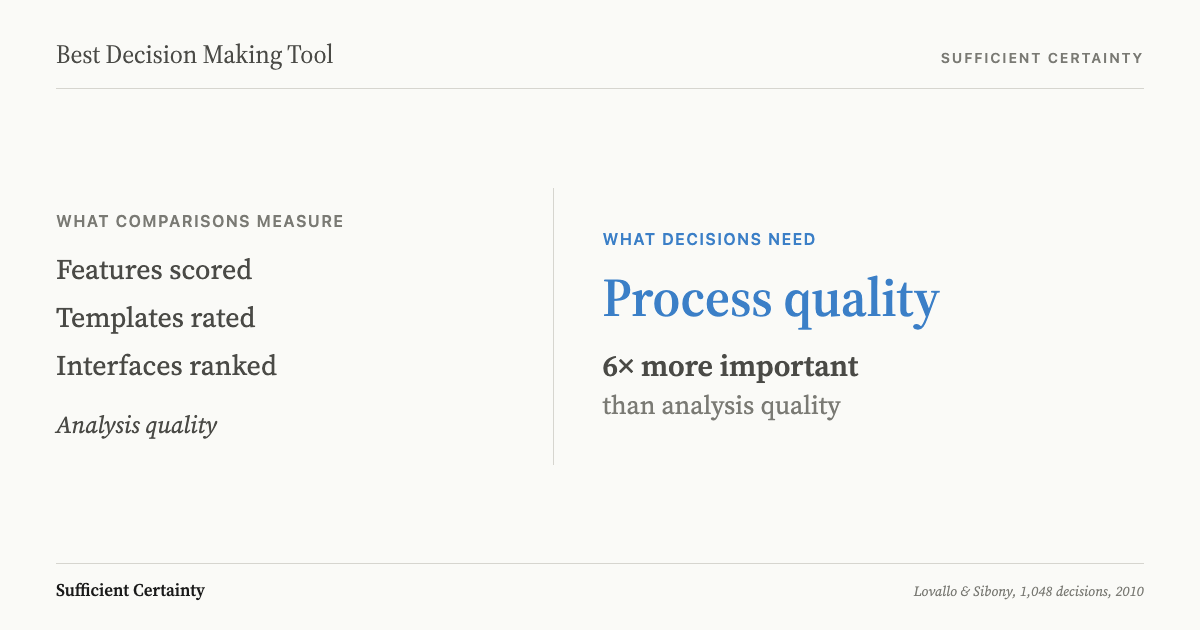
Every comparison article I have read this year organizes decision making software by features and price tiers. That is a sensible way to compare software; it is not a sensible way to compare methods for making a decision that commits resources. The features describe how the tool operates and say nothing about whether the decision it supports will hold.
The question a best decision making tool must answer is what has to be true for the highest-ranked option to work. No comparison list addresses that question, because answering it would mean admitting that the comparison itself is not the decision.
Risk-based tools face the same limitation. A risk based decision making tool ought to test the assumption underneath the preferred option; most produce a register of rated risks instead. That register records what the room discussed at one point in time and does not tell anyone whether the decision is ready.
When a scoring tool is enough
I do not argue that a scoring tool is always wrong. A low-stakes choice where the downside is manageable does not need structured assumption testing. A weighted matrix or a scoring template handles it; the Walk is not for every choice, only the ones where a wrong premise has consequences the team cannot contain.
The question is whether the decision reaches beyond the team. A department head choosing a vendor whose delivery timeline determines a product launch is not making the same kind of call as someone picking project management software; the vendor decision rests on an assumption about capacity that a feature comparison cannot test.
If that assumption fails, the launch date moves and the cost is real. When the downside is containable, score and choose. When what the decision depends on reaches beyond the team's control, the room needs the full method and a Decision Record on the table before the commitment hardens.
In my experience, the decisions that most need this scrutiny are the ones the team treats as routine. An operations manager consolidating two production lines takes it as given that the integration will work as specified; the project timeline depends on that premise, and nobody will raise it because the room has already moved on to cost savings.
Take the option your team just ranked first and name the assumption it rests on before the comparison decides for you. Start the Walk →
What best decision making tool comparisons miss
At the 2010 Abu Dhabi Grand Prix, Ferrari had the most advanced decision support system in the paddock: real-time telemetry processing track position data for pit strategy. The system processed the data correctly, and the strategic team used the output to pit Fernando Alonso to cover Mark Webber. Aversa, Cabantous, and Haefliger documented what happened next.
The system never flagged that Webber was not the title rival; Sebastian Vettel was. The pit call handed the championship to Red Bull, and Alonso lost by four points. The best tool in the field failed because no feature in the system evaluated the assumption driving the team's response.
The system would have topped any comparison that year: highest data resolution, fastest processing in Formula One. Every evaluation criterion pointed to Ferrari. The one that mattered, whether the team was acting on a correct assumption about the title rival, was not in the system at all.
The scale is unusual; the mechanism is ordinary. I have sat in project steering meetings where the data was clean and the team chose a vendor based on a capability claim from a slide deck that nobody tested independently. The claim was the untested element, and the project failed on it.
That is not an edge case. Lovallo and Sibony tracked 1,048 business decisions made by over 2,200 executives and found that process quality was six times more important than analysis quality in predicting outcomes.
Every best decision making tool comparison evaluates the analysis factor, which accounts for one-sixth of the variance. The process factor matters six times more, and no feature list measures it. The Walk forces exactly that process: it makes the room name the assumption the preferred option depends on and judge whether the evidence is sufficient before the room locks in.
The comparison industry has every incentive to keep scoring features. Features are countable; process quality is not. A list of things you cannot count does not sell advertising.
What the Walk produces instead
The Walk produces a Decision Record. At the top: the decision and the Purpose that justifies it. Below that: the assumptions the decision rests on, together with the evidence the room judged sufficient. The final entry is the monitoring signal and the name of the person who would reopen the call if conditions change.
Milkman, Chugh, and Bazerman reviewed the evidence on what actually improves decisions and concluded that structural process changes outperform analytical tool upgrades. The entire premise of a best decision making tool comparison, that picking the right software will improve outcomes, is the error their review identifies.
Most decision making tools for teams produce a ranking or a vote. Not one produces a record that names what the team was assuming and what evidence was judged sufficient. When that decision is revisited six months later, the team has a number in a spreadsheet and no trace of the reasoning.
In every post-mortem I have attended, the answer is the same: the tool gave the room a score and nobody tested what the score depended on. A Decision Record answers that question before it is asked, because the assumptions and the evidence threshold are written down before the commitment is made.
That is what I mean by Sufficient Certainty: the room judges the evidence as good enough for this decision, with the remaining uncertainty understood and owned. A ranking tool offers certainty about the comparison; it offers no certainty about the assumption the comparison rests on.
The Walk exists because most rooms skip that document unless the method forces it. It works through the Universal Decision-Making Method and produces a Decision Record with the assumptions named and the monitoring signal set. Roger Estall and I wrote Deciding because the gap between what decision making tools produce and what decisions actually need is where organizations break.
You could pick the top-rated tool and commit on the assumption it never examined.
Work through your decisionNo sign-up. Just pick your decision and start.
Grant Purdy is the co-author, with Roger Estall, of Deciding (2020), and the architect of the Universal Decision-Making Method.