
Bargaining power of buyers becomes real the moment your largest customer sends a renewal email with a number lower than your forecast. The question is not whether they have leverage. The question is whether the leverage is genuine or performed, and what concession costs less than losing the account.
A commercial director once came to me with a renewal email, a board paper due in eight days, a forecast showing one account at 31 per cent of next year's revenue, and a buyer demand for a 12 per cent cut because "two competitors are lower". He did not need a lecture on Porter. He needed something he could say in the room without kidding himself. That is when bargaining power of buyers stops being an MBA phrase and turns into a seller's problem.
If you want the broader frame first, read what Porter's Five Forces actually measures. Here I am interested in the harder moment after the force map. Somebody still has to say if price moves, what must come back in return, and whether the account is worth keeping at all.
Bargaining power of buyers is the extent to which customers can move a seller's price or terms, drawn from the alternatives they hold and the seller's reliance on them.
When does bargaining power of buyers justify a price cut?
It justifies a cut only when you are buying something real, and when you have stopped pretending that revenue and margin are the same thing. The most common failure here is cowardice dressed up as commercial realism. A team says, "We have to keep them," when what it means is, "We do not want to test whether this account is still worth having."
Cirrus Logic's 2025 annual report is a brutal example of customer concentration. Apple represented about 89 per cent of fiscal 2025 net sales, after 87 per cent in 2024 and 83 per cent in 2023. Once dependence gets that far, the price discussion is already late. The live question is how much of the company's freedom is tied to one account, and what contribution margin makes that worth living with.
I would write the claim down before I moved a cent. In the Universal Decision-Making Method, that means naming the assumption instead of letting it hide inside sales rhetoric. The assumption I want written down is simple: the discounted account still clears our floor and still leaves us free enough to act later. That is the same test a live negotiation strategy has to pass before the renewal call, not during it. I have written elsewhere about forcing assumptions into plain language, because this is exactly the sort of meeting where people speak fluently in abstractions and become frightened by a sentence anyone can understand.
The other thing I want on the table is containment. Sellers love to treat one discount as local and temporary. The evidence says otherwise. Crecelius, Fischer, Scheibehenne, and Kranzbuhler modelled customer-specific discounts in multichannel markets and found the profitability damage from spillovers was nearly three times the cost of the original concession. The effect was even worse for higher-loyalty customers. That matters because most executives still talk as if the first cut ends the matter. It often starts it.
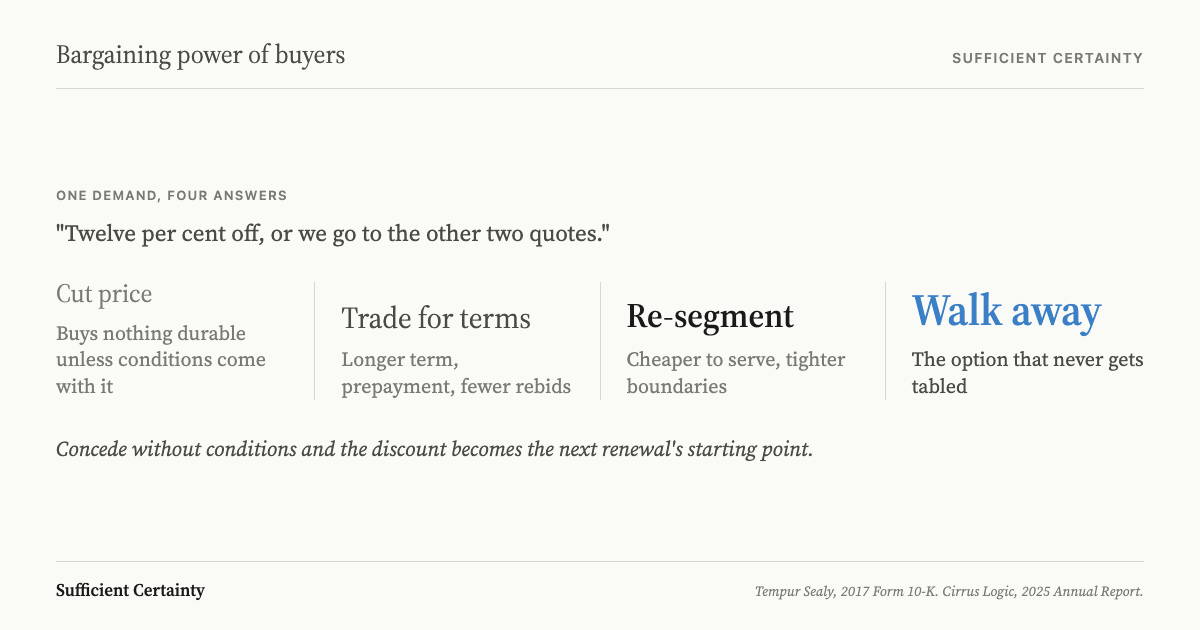
So yes, sometimes you do cut price. I have signed that recommendation myself. But only when the buyer's alternatives are real, the lower number still works after service costs, and the seller knows exactly what precedent it is setting. If those conditions are foggy, the discount is not prudence. It is surrender written in finance language.
Write down what the concession has to buy you, and the margin floor that decides whether the account is worth keeping. Start the Walk →
Terms beat a discount when switching is the real pain
Terms beat a naked discount when the buyer's real pain is not the invoice line but the work of changing supplier. People speak about switching costs as if they were some mystical lock-in device. Often they are plain things like qualification work or the nuisance of teaching another supplier how the place really runs. If that is the buyer's friction, answer that friction instead of cutting the headline price and praying it stays contained.
Alexander MacKay's paper on contract duration puts numbers on that nuisance. He estimates transaction costs at 10.9 per cent of total buyer costs on average, with a median share of 15 per cent and a ninety-fifth percentile above 32 per cent. That is what many sellers miss. The customer may not need a lower unit price as much as it needs fewer rebids and less requalification every time the contract comes up.
Gartner's 2024 Form 10-K shows how a seller can answer that without pretending buyers have no power. Nearly 75 per cent of Gartner's contracts were multi-year at the end of 2024, and the filing says roughly 80 to 85 per cent of annual and multi-year research contracts bill the first full service period on signing. In the Q1 2025 earnings call, management said multi-year contracts have "no true out clauses". That is not theatre. It is contract architecture doing real work.
When I see buyer power, I want to know whether a lower price buys term or prepayment. Those survive the meeting. A naked cut survives too, but in the wrong way, because it trains the buyer. That is bargaining power of buyers written into a term sheet. The force diagram is only a map of pressure; the decision sits inside the term sheet.
Reshaping the account when bargaining power of buyers will not shift
Re-segment when the account still has value, but only if you stop serving it like a premium relationship. Treating hold firm and cave as the only alternatives is lazy thinking. Sometimes the real answer is to keep the revenue on a different shape, lower-touch and under tighter boundaries. If the buyer wants a cheaper relationship, give it a cheaper relationship.
This matters most when concentration is already warping behaviour. Cirrus Logic again is useful because an account sitting at 89 per cent of sales does not merely influence the quarter. It changes how the whole company thinks. Once one customer carries that much weight, people start calling dependence "strategy" and special treatment "partnership". The words get fancier as the freedom disappears.
Roger Estall and I wrote Deciding because this sort of drift is common. Teams let a structural fact, one dominant buyer, do their thinking for them. Then they present that dependence as if it were an external law of nature. It is an exposure. If the account can work only at a lower price, I want to know what work we can remove and what service promise we should stop carrying. That is why I prefer to turn force ratings into claims the room can test instead of leaving them as coloured boxes.
Re-segmentation also gives you something concrete to monitor. If the narrower service model still turns into special pleading six weeks later, the seller learns quickly that the cheaper account was never going to stay cheap. That is a live signal, and I would put it into the monitoring plan rather than wait for the next renewal to rediscover the same problem. I covered that discipline directly in the piece on monitoring after a decision, because bad commercial concessions usually arrive twice, first as an exception, then as a habit.
When to walk away
You exit when keeping the account teaches the rest of your market that your price is imaginary, or when the concessions needed to keep it will leave you weaker next year than you are now. This is the option most teams whisper about and then avoid, because exit sounds dramatic and price erosion sounds practical. In some cases the dramatic option is the adult one.
Tempur Sealy's 2017 announcement is the clean case. Mattress Firm and Sleepy's together represented 21.4 per cent of 2016 sales, and the buyer wanted what the company called significant economic concessions. Tempur Sealy refused, issued termination notices on 27 January 2017, and redirected its effort toward other retail partners. According to the 2017 Form 10-K, sales to Mattress Firm fell 85.7 per cent year on year, yet excluding Mattress Firm the company's net sales increased 8.1 per cent in 2017.
No bluffing, and no nonsense about "sending a message". Just a judgement that the channel economics and brand position were worth protecting, even at the cost of a painful near-term revenue hit. Most boards can understand that if somebody states it plainly enough.
If I were writing the paper for that meeting, I would not drown it in strategy prose. I would say the buyer's alternatives appear credible and the requested concession becomes the next renewal's starting point. If the account clears our floor only by removing work or winning harder terms, fine. If not, we should leave. Then I would date the monitoring points and give them owners. The method does not rescue you from a hard commercial choice. It does stop you from pretending the choice is softer than it is.
You could grant the discount this week and negotiate against it every year after.
Work through your decisionNo sign-up. Just pick your decision and start.
Grant Purdy is the co-author, with Roger Estall, of Deciding (2020), and the architect of the Universal Decision-Making Method.