
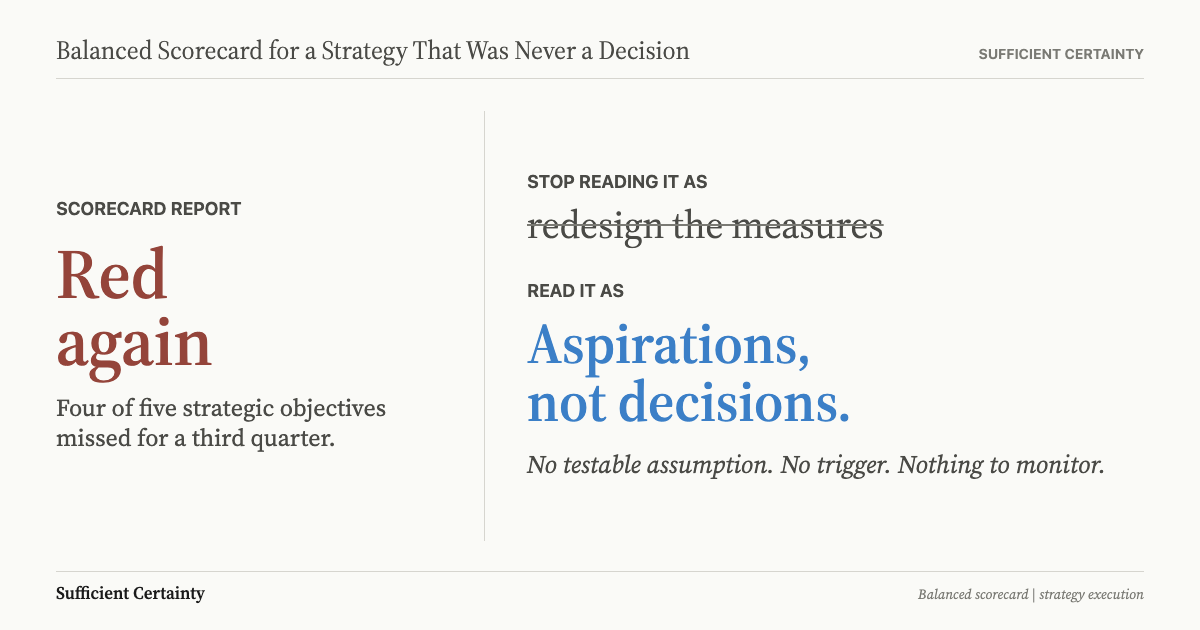
A balanced scorecard for a strategy that keeps missing execution usually has the wrong diagnosis. The measures go red quarter after quarter and the team redesigns the measures. The question nobody asks is whether the strategy was ever a decision or just an aspiration that inherited a dashboard.
I sat through a quarterly business review last year where the balanced scorecard showed red or yellow on four of five strategic objectives, for the third quarter running. The chief strategy officer presented the same dashboard, used the same language about "cascading objectives" and "alignment gaps," and proposed the same remedy: redesign the measures. It was another balanced scorecard for a strategy that keeps missing execution, and every person in the room was about to treat it as a measurement problem.
The conversation after the dashboard presentation ran along familiar lines. Someone suggested the measures were lagging rather than leading. Someone else questioned whether the targets had been set too high. The head of operations asked whether the scorecard should include new metrics for project milestones. Every response assumed the scorecard itself was the problem. None questioned what the scorecard was being asked to measure.
The measures were fine; the scorecard was doing precisely what it was designed to do: report whether the organisation was making progress against its stated strategic objectives. It was reporting, accurately, that it was not.
The problem was in what the strategy document called "objectives." They were aspirations, not decisions: "become the market leader in customer experience" and "achieve operational excellence across all divisions." Both phrases sounded specific enough to act on; neither named a decision anyone could actually make. No one had specified what would change, what assumption that change rested on, or what would trigger a revision. A balanced scorecard for a strategy that keeps missing execution reflects the quality of the decisions behind the strategy, not the quality of the measures on the dashboard.
A balanced scorecard for a strategy that keeps missing execution is a measurement system showing persistent shortfalls because the objectives behind it describe aspirations rather than decisions with testable assumptions.
What a red balanced scorecard is actually reporting
When I review a scorecard that has been red for two or three quarters, the instinct in the room is almost always to examine the measures. Did we pick the wrong KPIs? Are the targets too aggressive? These are reasonable questions, but they assume the measures are the weak link. In most cases I have seen, they are not.
The pattern is visible at industry scale in the fate of enterprise risk management. The COSO Enterprise Risk Management framework has been promoted for two decades as the standard for organisational risk oversight, yet survey after survey returns the same result: persistently low scores on what its advocates call 'maturity.' If the framework improved the quality of decisions, those scores would improve. They do not, because the measures are arbitrary and unvalidated, measuring inputs rather than outcomes.
Organisations keep scoring themselves and keep finding the scores disappointing, then conclude that management and boards simply do not understand the framework. The alternative explanation, that the framework measures the wrong things, rarely surfaces.
When COVID-19 arrived, none of the organisations I have worked with reached for their risk register or their risk appetite statement. They reached for the decisions they needed to make. The measurement apparatus was irrelevant because it had never been connected to the assumptions those decisions depended on. The measures existed because they sounded authoritative, not because anyone had decided what they were supposed to prove.
Organisations still populate their scorecards with metrics such as employee engagement scores and customer satisfaction indices, each of which can be valuable, but only if someone has named the specific assumption it tests and the specific outcome it should predict. Without that link, the measure reports activity, not progress.
Pick the reddest objective on your scorecard and name the assumption it rests on, before the next quarterly review asks why. Start the Walk →
The gap between aspiration and decision
The management literature calls this the "strategy-to-execution gap," and the framing itself is part of the problem. If you frame the gap as one between strategy and execution, you imply that the strategy was sound and the failure happened downstream. A strategic gap analysis that skips assumption-testing embeds the same implication, as does a vision cascaded straight into objectives: the target state is correct, only the distance needs closing. In the infrastructure and insurance organisations I have worked with over four decades, that implication is wrong.
Michael Mankins and Richard Steele surveyed 197 companies with sales exceeding $500 million for a 2005 study published in Harvard Business Review. They found that companies deliver, on average, only 63% of the financial performance their strategies promise. The finding that mattered most was their description of the root cause: strategies were "approved but poorly communicated," making translation into specific actions nearly impossible. The largest single source of the 37% shortfall was misaligned resources: the strategy said one thing, the budget funded another, and the scorecard reported the contradiction without anyone acting on it.
A separate 2013 survey by the Economist Intelligence Unit of 587 senior executives globally confirmed the same pattern. Sixty-one per cent acknowledged their firms "often struggle to bridge the gap between strategy formulation and its day-to-day implementation." Eighty-eight per cent said executing strategic initiatives was essential or very important for competitiveness. That is a 27-point gap between knowing execution matters and being able to do it.
These executives were reporting a specificity problem. A strategy that cannot be communicated to the people who must carry it out was never a decision; it was an intention with a timeline attached. The balanced scorecard, whether built with KPIs or broader performance measures, faithfully reported the only thing it could: that the intention was not converting into action. That is the gap between aspiration and decision, and it sits upstream of every metric on the dashboard.
Why redesigning the balanced scorecard does not help
The standard response to a persistently red scorecard is to rework the measurement layer: add leading indicators, cascade objectives further down the organisation. I have watched an infrastructure client spend six months rebuilding their scorecard after a failed year, hiring the same consultancy that designed the original, only to arrive at the next quarterly review with the same pattern of red and yellow on the same strategic objectives. The upstream problem had not been touched.
The redesign was comfortable precisely because it produced visible activity and filled a board paper, while leaving the strategy itself unchallenged. The firm that sold the original scorecard implementation is usually the firm that sells the redesign.
The balanced scorecard's four perspectives assume that the strategic objectives behind each perspective are sound. If you accept that assumption, then improving the measures can make a difference. If the objectives themselves were never decisions, then the four perspectives are measuring the wrong thing with greater precision. Better dashboards do not produce better outcomes when the objectives behind them were never specific enough to act on.
There is a harder problem beneath the measurement one. Monitoring has value only when three conditions are met: a competent person with authority to act is accountable for reviewing the results; the significance of those results is properly understood; and remedial action is taken when pre-agreed thresholds are crossed. In most scorecard implementations I have reviewed, at least one of those conditions is missing, and frequently all three are. The dashboard exists, the numbers update quarterly, and nobody has a clear mandate to act on what the numbers show. That is a common pattern in organisations where the KPIs were chosen for coverage rather than for their connection to a specific decision.
The scorecard accumulates measures because adding them is politically easier than removing them; each new metric represents someone's priority (or, more precisely, someone's political capital), and cutting it signals that their priority no longer matters. Over time, the scorecard grows into a cumulative record of what the organisation once cared about, rather than a current instrument for monitoring the assumptions that still matter.
In this configuration, the scorecard becomes a reporting instrument rather than a decision instrument. It tells the room what happened last quarter without telling anyone what to do next. That gap cannot be closed by choosing different metrics or adding a leading-indicator layer. It can only be closed by going back to the decision that generated the objectives and asking whether that decision was ever made with enough specificity to monitor.
What the scorecard needs before it can measure anything
The fix is upstream of the scorecard, in the decision the scorecard is supposed to monitor.
When a decision is made properly, the person making it has the clearest understanding of the assumptions that decision rests on. That is the moment to specify what should be monitored, because that awareness degrades quickly. A monitoring system designed weeks or months after the decision, by people who were not in the room when it was made, works from a summary of the original reasoning at best. It measures what seems important in retrospect rather than what actually determined the decision. That is why monitoring should be specified as part of the decision itself, not delegated to a separate measurement team afterward.
In practice, this means each strategic objective on the scorecard should trace back to a specific decision (and usually does not), and that decision should name the assumptions it depends on. Not five assumptions, and certainly not fifteen; the small number, usually two or three, that would reopen the decision if they turned out to be wrong. Those are what the scorecard should monitor. Everything else is reporting for its own sake. The purpose of measurement is to enhance the decisions we make, not to produce reports that give the appearance of oversight.
Take any strategic objective currently on your scorecard and ask: what assumption would need to be wrong for this objective to be abandoned entirely? If nobody in the room can answer that question in specific terms (and in most board rooms I have sat in, nobody can), the objective was never a decision. It was a statement of intent that no one translated into something testable. I have yet to encounter a scorecard that persists in red across three or more quarters where the real fault lay in the measures rather than in the decisions behind them.
When a variance appears on the scorecard, the productive response is not to apply pressure on the team responsible. The variance is a symptom, and the response should be to trace it upstream: does the original decision still hold? Have the assumptions it rested on changed? Is the monitoring itself testing the right assumption, or has the context shifted while the metric persisted on the dashboard out of habit? A scorecard built on this basis looks different from a conventional one, because it connects each metric to an assumption rather than to a strategic theme.
In Deciding, Roger Estall and I treat monitoring as the fifth step of the decision itself, not as a separate exercise imposed after the fact. The Universal Decision-Making Method that emerged from that work connects each objective not just to a measure but to the assumption that would invalidate the measure if it proved wrong. A strategy map built on the same logic makes the connection visible. That is the layer most scorecards are missing. Until it exists, redesigning the measures changes nothing.
You could redesign the scorecard again and spend another quarter measuring the wrong objectives.
Work through your decisionNo sign-up. Just pick your decision and start.
Grant Purdy is the co-author, with Roger Estall, of Deciding (2020), and the architect of the Universal Decision-Making Method.