
Before launching the initiatives in your balanced scorecard, write down what would make you pause each one. A green score can be a reason to inspect a measure more closely. Hitting a target matters only while the measure remains reliable and the action still serves the strategy.
The next scorecard review needs more than updated results. It needs agreed conditions for revisiting the commitments those results support.
A balanced scorecard links strategic objectives to performance measures and actions, using financial and nonfinancial perspectives to guide execution.
Turn scorecard targets into owned initiatives
The completed scorecard connects a strategy to work. Each objective has a measure. Each measure has a target. Initiatives describe the work intended to improve performance. Managers then assign responsibility, commit resources and establish a review schedule. The scorecard becomes part of planning and management meetings rather than remaining a workshop document.
Harvard Business School's explanation starts with a strategy map, then selects measures and sets targets. It describes ongoing tracking and reporting after that design work. This sequence matters: a scorecard is meant to support strategy execution, with connections between objectives, rather than present an unrelated collection of departmental figures.
After completing a balanced scorecard, take the initiative list into the budget discussion. A measure does not assign staff or release money. The person approving an initiative needs to know what action is proposed and which objective it serves. The person delivering it needs authority proportionate to the work.
For each initiative, keep the original reason for funding it beside the owner and schedule. This makes the next review about the commitment as well as the latest result. An increase in a measure may justify continuing the work. It may also require checking whether the increase came from the action the organisation intended.
That distinction begins before launch. Choosing balanced scorecard KPIs helps clarify what the measure represents. The next task is to state what a change in that measure permits the manager to do. Otherwise, reporting can become an obligation without a corresponding decision.
A balanced view makes strategy easier to inspect
The scorecard's value is its connection between current activity and future results. Financial performance alone cannot describe whether the organisation is building the capacity its strategy requires. Including customer and internal-process objectives gives management more places to examine that connection before the eventual financial result arrives.
The Balanced Scorecard Institute describes a strategy map as a picture of cause-and-effect connections between objectives. Those connections make the organisation's reasoning visible. A discussion about resources can address how an initiative contributes to the whole strategy, rather than accept each department's preferred project separately.
Reporting against targets
- Update the result for each objective
- Explain any shortfall against the target
- Keep approved initiatives moving
Reviewing the commitment
- Check what changed behind the result
- Test whether the strategy connection still holds
- Pause when an agreed review trigger occurs
A well-used scorecard already supports learning and review. The distinction is between reporting performance and making the resulting decision explicit. The difference between a balanced scorecard and a KPI matters here: the wider strategy connection should determine how management responds to a result.
Your scorecard tracks targets. Use the Walk to decide what change would make you revisit a funded initiative. Start the Walk →
Which change would make a green score misleading?
The scorecard assumes that the measure still represents the objective. It also assumes that the connection drawn on the strategy map remains useful. Neither assumption becomes true because a cell turns green. Target status answers whether the reported result meets the chosen threshold. It cannot settle every question about what produced the result.
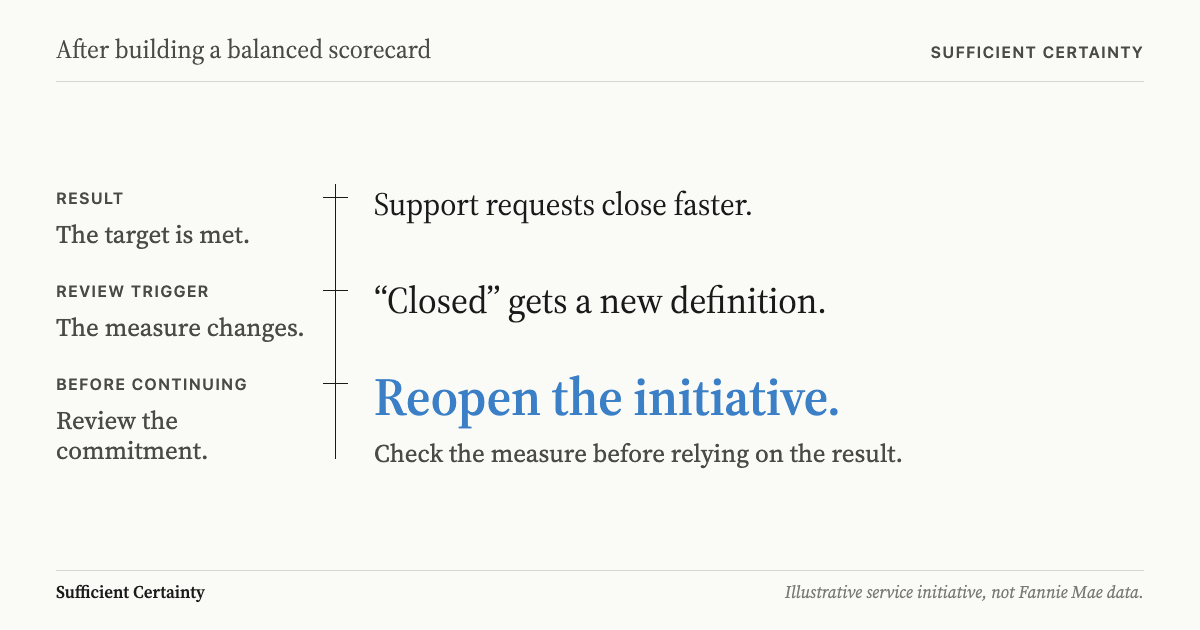
Consider an illustrative service initiative intended to retain customers through faster support. The scorecard measures how quickly requests are closed. The initiative adds staff and changes how requests are assigned. Faster closure would appear to support continued funding. Yet a change in the definition of a closed request could improve the score without improving the customer's experience.
This is a reason to specify a review trigger before the work begins. A change in the closure definition should require checking whether the result remains comparable. Repeated customer complaints about unresolved requests should require examining the claimed connection to retention. These are proposed checks for the illustration, rather than findings about a named organisation.
A target and a review trigger serve different purposes. The target describes a desired performance level. The trigger names evidence that requires the decision-maker to examine the commitment again. A missed target may call for a delivery correction. A changed definition may call for suspending reliance on the measure even when the target is met.
Changes outside the scorecard also matter. A new service obligation could make the current initiative inadequate without changing last month's figures. A supplier withdrawal could remove a condition the delivery plan depends on. Waiting for the next reporting cycle would leave the original commitment operating under changed conditions.
This is the question behind when a dashboard should change the decision. Define the signal early enough for someone to act on it. An alert that arrives after an irreversible commitment provides an explanation, but little ability to change course.
Fannie Mae tied rewards to earnings that proved unreliable
Fannie Mae appears on the Balanced Scorecard Institute's list of scorecard adopters. That undated listing confirms adoption, but does not establish when its scorecard was implemented. It also does not connect the scorecard to the accounting misconduct examined by its regulator.
The separate evidence is OFHEO's May 2006 special-examination report. It examined 1998 to mid-2004. The report found that senior management used improper accounting and earnings management to produce smooth profit growth and meet earnings-per-share targets.
The compensation arrangements made the reported number consequential. In 1998, earnings per share of $3.13 triggered the minimum annual incentive payout. The maximum payout required $3.23. OFHEO found that senior management manipulated earnings to achieve targets and maximise compensation. Its report describes both an incentive problem and failures in the reliability of financial reporting.
The regulator's announcement of the findings states that over $52 million of Franklin Raines's compensation from 1998 through 2003 was directly tied to earnings-per-share targets. This was compensation linked to a result whose apparent success did not establish the quality of the underlying performance.
The case does not show that balanced scorecards cause misconduct. Nor does it show that a review-trigger worksheet would have prevented it. Independent assurance and effective board oversight remain separate responsibilities. A strategy review cannot replace the accounting work needed to establish whether reported earnings are reliable.
The narrower lesson concerns the decision supported by a target. When a number determines whether rewards or resources are released, its reliability is part of that decision. Checking only whether the threshold was crossed leaves the authority to act dependent on an unchecked input. Evidence that challenges the input should interrupt that reliance, even if the displayed result appears favourable.
Write a review trigger beside each strategic commitment
Before the initiative budget is signed, open the scorecard and its initiative list together. Pick a funded initiative. Write the condition that makes continuing it sensible. Then name an observable change that would require its owner to bring the commitment back for review. Keep this note beside the funding decision.
Use a change that someone can recognise and report. For the service illustration, a change in the closure definition is a specific event. It requires a comparability check before management relies on the next result. The trigger should identify the person who checks the evidence and the manager who can pause or change the initiative.
Which change would require a pause even while this scorecard target is met?
Record the response as well as the signal. A changed measure may require checking its source before approving another release of funds. A broken strategic connection may require changing the initiative itself. A trigger opens a review; it does not automatically prove that the strategy should be abandoned.
The Universal Decision-Making Method puts monitoring inside the decision rather than adding it after implementation. Apply that principle to the existing scorecard. Keep performance targets, but attach review conditions to the commitments they support. A short decision record can preserve why the initiative was approved and what would reopen it.
At the next review, ask whether a trigger occurred before discussing the target's colour. That order gives the decision-maker a chance to question the basis for continuing. It also lets an owner report changed conditions without pretending that an old target still answers the current question.
Which change would make you pause a scorecard initiative even while its target stays green?
Work through your decisionNo sign-up. Just pick your decision and start.
Grant Purdy is the co-author, with Roger Estall, of Deciding (2020), and the architect of the Universal Decision-Making Method.