
Overconfidence bias in decision making rarely looks like arrogance. It usually belongs to the careful person whose certainty has outrun the evidence underneath it. The gap between how settled the call feels and how much of the case has actually been tested is where the real cost accumulates.
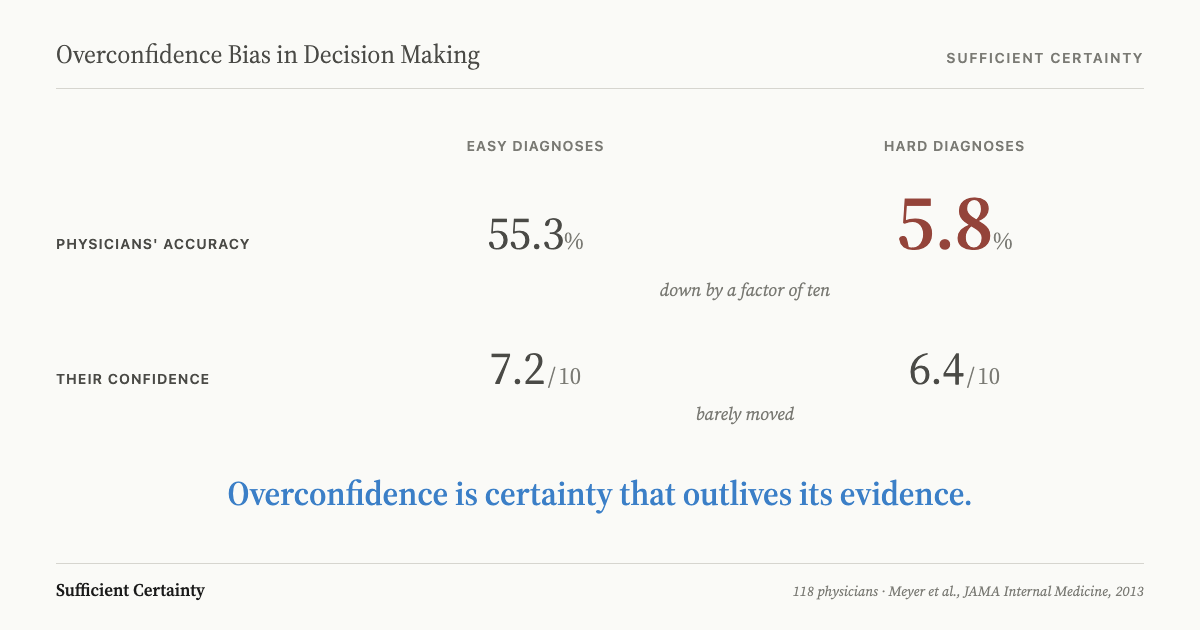
A physician facing a hard diagnosis had a chart full of information and a confidence score only slightly below the one doctors gave themselves on easy cases. In a 2013 JAMA Internal Medicine study, 118 U.S. physicians got 55.3 per cent of easier cases right and only 5.8 per cent of harder cases right, yet their confidence moved only from 7.2 to 6.4 out of 10. The more confident doctors were also less likely to ask for extra tests. Accuracy had collapsed by a factor of ten; confidence gave up less than a point.
Overconfidence looks like caution, and the loud man at the end of the table is a decoy. Deciders are relieved to believe the hard question has already been answered. Sufficient certainty is the point at which a Decider knows enough to act while uncertainty remains, and overconfidence begins when that point is claimed before the evidence justifies it.
Most people file overconfidence under character, a flaw you could spot across a boardroom table. I have stopped expecting that. The version that costs money is certainty claimed before it has been earned, and it usually belongs to somebody who sounds careful. Roger Estall and I wrote Deciding because that mistake kept surviving polite committees and every apparatus that was supposed to catch it. False certainty travels well. It sounds responsible right up to the moment it becomes expensive.
Overconfidence bias in decision making is the gap between how settled the call feels and how much of the case underneath it has actually been tested.
What overconfidence bias in decision making really is
Strip the psychology label off and overconfidence is mostly people sounding prudent while overstating what they know. Don Moore and Paul Healy split it into distinct forms in their 2008 paper "The Trouble With Overconfidence", and the form that matters in real decisions is overprecision: being too sure your estimate is tight and your decision is ready. I have watched rooms full of highly competent people do it without any chest-beating at all. It sits quietly among the other types of cognitive bias because it wears the costume of diligence.
That is why the Universal Decision-Making Method does not ask whether you feel confident. It asks whether you have reached Sufficient certainty. Those are different questions. One is internal and flattering. The other forces the Decider to state what evidence is carrying the decision and what uncertainty still matters. I do not care how confident a Decider feels. I care what evidence earned the feeling.
Why overconfidence bias in decision making gets worse with expertise
Expertise often makes the problem worse because it lowers the felt need to check. In the 2008 study by Malmendier and Tate, CEOs classified as overconfident were 65 per cent more likely to make acquisitions. The sample covered 394 large U.S. firms. Over two decades, acquiring shareholders lost more than $220 billion at announcement. That is what happens when experience shifts the action threshold without improving the reasoning underneath it.
I have seen the same move in less glamorous settings. A senior executive says, in effect, "I know this sector" or "we have done deals like this before", and reputation starts doing the thinking for the room, the halo effect in its purest form. Familiarity gets mistaken for proof. The argument is then carried by seniority rather than by tested assumptions. Once expertise becomes a substitute for verification, the decision has already started to drift.
That is also why awareness training does so little. Tell a seasoned executive to watch out for overconfidence and he will nod along, because he hears it as advice for somebody else. What works is a step that obliges him to show why the evidence is sufficient for this decision.
Stress-test the certainty around your current call and find the proof your process never forced. Start the Walk →
Formal process often protects the wrong certainty
People like to imagine that committees and risk functions are the antidote. I have usually found the opposite. Formal process is often where overconfidence goes to hide, because confidence dressed up as procedure looks respectable. The same pattern runs through every case I examine in cognitive biases in business: the scorecard, not the person, is doing the thinking. The arrangement suits everybody. Risk staff get their registers signed and sponsors get their projects waved through, while judgment never has to face a hard question.
The Prudential Regulation Authority's final notice on Credit Suisse is a clean example. Archegos cost the bank about US$5.5 billion. One internal measure showed the client's portfolio could produce an almost US$1 billion stressed loss of initial margin, and internal analysis pointed to another US$1.27 billion to US$1.49 billion of margin being needed. Even so, credit risk management reported "no immediate counterparty concerns" on 24 March 2021. That sentence is the whole problem: the process and the data were there, but the certainty had not been earned.
The 2026 Transportation Safety Board of Canada report on Titan lands in the same place. OceanGate had not validated the pressure hull's as-built properties against the design assumptions. It did not know how long the hull would remain structurally intact under repeated dives, and it had no reliable basis for thinking its acoustic warning system would provide useful advance warning. Yet operations continued. People call this recklessness after the event. I call it institutional overconfidence before the event.
Process helps only when it forces doubt into the open. That is the test I apply to any advice on overcoming cognitive biases, and most governance apparatus fails it. It gives premature certainty a respectable haircut and sends it into the boardroom.
Sufficient certainty is the check overconfidence hates
The check on overconfidence bias in decision making is plain. Ask what level of certainty this decision actually requires, then ask what evidence supports that level. If the answer is thin, the decision is not ready just because the room is tired of discussing it. That is the discipline inside Step 4 of the method. Most cognitive biases in decision making get caught earlier, at the assumptions step; unearned certainty is the one that survives to the end, which is why the method saves a dedicated question for it.
Run Credit Suisse through that question. The bank's own analysis said the client could produce nearly a billion dollars of stressed margin loss. Step 4 asks what evidence supported "no immediate counterparty concerns", and the honest answer was none worth the name. Asking it costs a meeting. Not asking it cost US$5.5 billion.
I built that step because I got sick of watching Deciders chase maximum certainty in one meeting and fake it in the next. Sufficient certainty cuts between those failures. It tells the Decider either to test the weak assumption or to reshape the decision and monitor it closely.
Some decisions cannot wait for perfect knowledge. Then write down what would tell you that your confidence was misplaced, and reopen the decision when that signal appears. Step 5, Design monitoring, exists for exactly that reason. It is how you stop a live decision from turning into a defended mistake.
Overconfidence bias in decision making does not come wearing a loud tie. It arrives in a formal meeting, in a sentence about being comfortable with the position. I have heard that sentence for years, and it has never impressed me. Evidence should earn certainty, not the other way round.
You could feel certain in the room and skip the extra test that humbles you.
Work through your decisionNo sign-up. Just pick your decision and start.
Grant Purdy is the co-author, with Roger Estall, of Deciding (2020), and the architect of the Universal Decision-Making Method.