
Emotional decision making is not the problem most rooms think it is. The feeling usually carries a warning. The actual failure is a process that never tests the assumption hiding behind the feeling, so the room either obeys its mood or pretends to be rational while following it anyway.
I have watched a chair kill a warning with six words: "Let's not get emotional about this." The phrase sounds adult and disciplined. Most of the time it is neither. It is cover for the people who backed the earlier call and do not want the wager underneath it written down now that the costs are showing. That is emotional decision making.
People talk as if emotion contaminates a decision that would otherwise be clean. My experience is the reverse. Feeling usually tells you that somebody senses danger or loss of control before they can explain it neatly. If the assumption inside that feeling is tested, the warning becomes useful. If it is not, the room either follows it blindly or performs rationality while following it anyway.
Emotional decision making is making a choice on the strength of a feeling before the belief behind that feeling has been examined.
Why emotional decision making is usually an assumption problem
The phrase makes people imagine a panic attack or a table-thumping row. Most of the time it looks much tidier than that. It sits inside the forecast that gets treated as serious and the downside the group quietly refuses to name. When someone tells me, "I just don't like this deal," I do not tell them to calm down. I ask what they think will happen if the deal goes ahead. Once the belief is spoken, it can be examined.
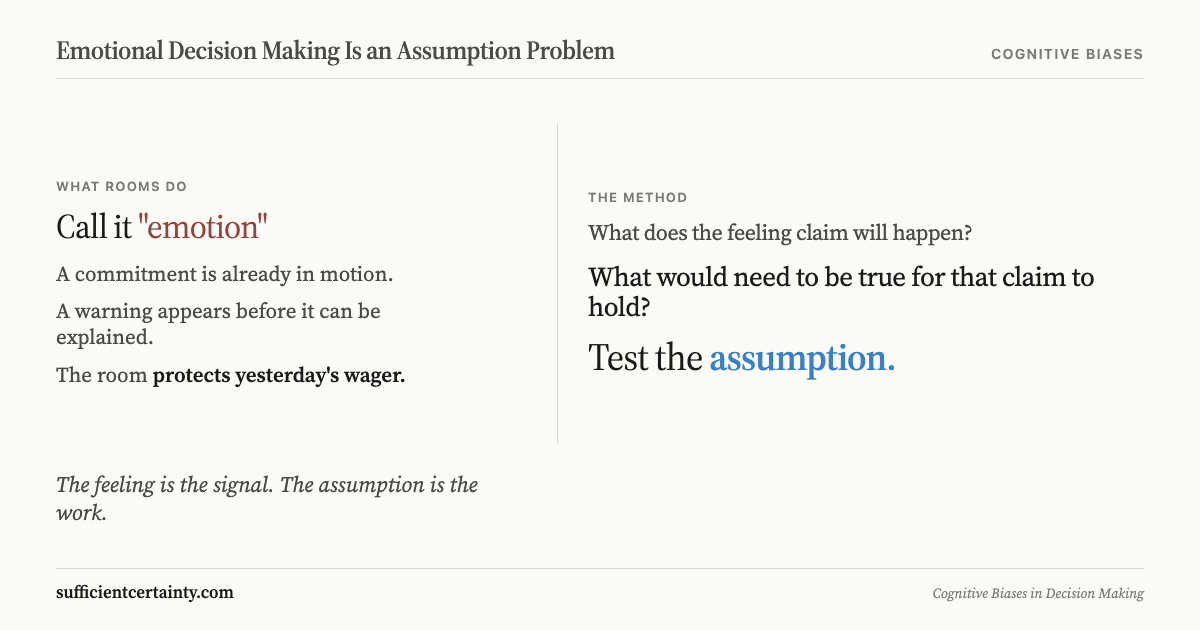
Calling the problem "emotion" suits the people who do not want the wager written down, because once it is explicit the room has to test it. The discipline sits in the Universal Decision-Making Method. Skip that step and the room slides into confirmation bias in decision making, collecting support for the conclusion it was already defending.
Most rooms do not suppress feeling. They launder it. The confident person's hunch gets called judgement, while the anxious person's warning gets called emotion. That distinction is reputational, not analytical. It tells you whose standing the room is protecting, not whose reasoning is sound.
I have watched this in capital allocation committees more than once. Someone raises a concern about an acquisition. The room does not address the concern; it addresses the voice. The deal's champion says something like "let's keep this grounded in the numbers," which sounds like discipline but functions as protection. Once the concern is restated as a plain sentence about what might happen after close, it becomes testable. That single conversion is where the real work begins.
Emotional decision making is different from emotional signal
One of the most useful studies on this point is Antoine Bechara and colleagues. Healthy participants started showing the bodily warning before they could explain the pattern; participants with the relevant damage did not, and they chose worse. The body registered trouble before the explanation was ready. The feeling-versus-reason fairy tale survives because it gives rooms a way to dismiss the warning without answering what it is warning about.
That matters because the usual System 1 vs System 2 thinking retelling still makes a fast feeling sound suspect simply because it arrives before a speech can be made about it. Emotional decision making is not the same thing as emotional signal. I do not take a feeling as proof. A shiver is not evidence, but it is a prompt to ask what does not fit the story the room is telling itself.
In Deciding, Roger Estall and I make the same distinction: a feeling can be the warning, but the decision still turns on the assumption you test.
People who refuse the distinction tend to split every room into the rational voices and the emotional ones. That binary is comfortable because it sorts everyone without requiring anyone to state what they believe will happen next. I have never seen it produce a better decision. It produces a tidier room and a weaker commitment.
The practical move is simple. Turn the feeling into a sentence about what you think will happen. Then ask what would need to be true for that sentence to hold. That is often where the room discovers that it has been treating an assumption as if it were already established fact.
Put the live call through five steps and test whether the feeling marks a real assumption or just noise in the room. Start the Walk →
Emotional decision making looks different depending on the emotion
In a 2001 paper by Jennifer Lerner and Dacher Keltner, fear pushed people towards pessimistic risk estimates and more risk-averse choices, while anger pushed them towards optimism and risk-seeking. Those feelings are not interchangeable. Fear says events are slipping beyond control; anger says someone can be forced back into line. Telling people to "take emotion out" is managerial fraud when the emotions on the table are carrying opposite claims about control.
Corporate rooms often flatter anger and sneer at fear. Anger sounds decisive, so it gets dressed up as leadership. Fear sounds hesitant, so it gets treated as weakness, even when it is the only signal in the room that a consequence has been understated.
If a leader says, "I am furious that procurement has delayed this," I want to know whether the real assumption is that speed matters more than exposure. If a leader says, "I am uneasy about approving this," I want to know what consequence they think has been understated. Those are different assumptions and they need different scrutiny.
The boardroom literature has finally started admitting the obvious. In 2024, a systematic review in Frontiers in Psychology concluded that emotions affect the quality of strategic decisions in boardrooms. Anyone who has worked in governance already knew that. That is one route by which cognitive biases in business get institutional cover. Calling someone "emotional" is handy for people defending an earlier commitment, because it discredits the warning without testing the assumption underneath.
New Coke failed because the feeling was relevant
The New Coke episode is a good reminder that emotion can be dismissed at great cost. According to Coca-Cola's own history page, the company restored Coca-Cola Classic on 11 July 1985 after a backlash that had already driven hotline complaints to about 1,500 a day. That is enough to make the point. The company measured sip preference and missed what customers believed they were being asked to surrender.
The lazy reading is that consumers behaved irrationally. I think the executives framed the decision badly. They treated a sweeter blind sip as if it answered whether people would tolerate a break in a ritual product bound up with memory and brand continuity. The same failure appears in every marketing situation analysis that fills the 5C grid without testing what the entries assume. They were not just buying taste. They were buying the assurance that the thing in the can remained the thing they had always known. Emotional decision making sat inside the executives' test design as much as inside the public backlash.
Once you see it that way, the case stops being a quaint marketing story about sentimental consumers. It becomes a decision failure in which the test was narrower than the commitment. The public reaction did not appear from nowhere. It exposed what the company had decided not to measure.
Across the wider pattern of cognitive biases in decision making, I have found that calling someone "emotional" is most useful to the people defending yesterday's commitment, because it smears the warning without making them test the assumption underneath it.
What changes when the room stops calling it emotion
I have worked with boards that made this shift. The immediate difference is speed. A warning that would have been circled for thirty minutes while people argued about legitimacy gets converted in two: what do you think will happen, and what would need to be true for that to hold. Once those sentences exist, the room either finds evidence or it does not. Either way, the discussion moves.
The less obvious change takes longer. In rooms that still dismiss feeling, the people who sense trouble early learn to stay quiet. The room loses its early-warning capacity and does not notice the loss because the warnings were never recorded in the first place. When the conversion becomes routine, those people start raising problems earlier, because they know the room will test the claim rather than assess the messenger's composure.
That is also why the monitoring step in the Universal Decision-Making Method matters here. You cannot watch for a condition that was never written down. A feeling that stays unnamed cannot appear in a decision record. An assumption that has been stated and tested can. The record then holds what was actually believed at the time the call was made, not a sanitised account drafted afterward to protect reputations.
Emotional decision making does not disappear from rooms that do this work. What disappears is the pretence that it was ever someone else's problem.
You could dismiss the next warning as emotion and leave the assumption untested.
Work through your decisionNo sign-up. Just pick your decision and start.
Grant Purdy is the co-author, with Roger Estall, of Deciding (2020), and the architect of the Universal Decision-Making Method.