
Creative problem solving techniques burn creativity on solutions before testing the problem. IDEO spent five months with a school district and delivered recommendations that assumed stable internet in buildings that did not have it. The hard step is earlier: test the assumption hiding inside the question.
IDEO spent five months with San Francisco Unified School District. It delivered 10 recommendations. One was an app the district could not maintain. Another depended on vending machines in schools that did not have stable internet. Years later only about 70 of 114 cafeterias had been renovated, and a district staffer recalled the obvious question the workshop had missed: "You didn't talk to anyone who works in a school, did you?" That is how creative problem solving techniques usually fail.
Roger Estall and I wrote Deciding after watching rooms do exactly this. The sentence somebody writes on the wall and treats as fact does the damage long before anyone picks up a marker. In the Universal Decision-Making Method, the creative work begins earlier, with the question most workshops dodge: what are we assuming this problem really is?
Creative problem solving techniques are methods for reframing a problem by exposing the assumptions inside it before a team starts generating solutions.
Why creative problem solving techniques suppress creativity
Diehl and Stroebe showed the smaller failure in 1987. Across four experiments, face-to-face brainstorming groups produced about half as many ideas as nominal groups, people working alone whose ideas were later pooled. Their explanation was production blocking: only one person can speak, so the rest wait, then decide the idea is no longer worth saying. Their paper names the mechanism plainly, and it kills the comfortable belief that more noise in the room means more invention.
This is why brainstorming has always struck me as a confidence exercise more than a thinking exercise. The room cannot question the brief and generate ideas at the same time with equal force. One activity will dominate. In practice, the sponsor's brief wins, because it entered the room with authority attached to it. Everyone then competes to look inventive inside a boundary nobody examined.
The larger failure matters more. The few ideas that survive blocking are still aimed at the whiteboard problem statement. If that statement is wrong, the workshop suppresses creativity and misdirects what remains. This is the quiet defect running through every problem solving technique in business: the brief enters with authority, and the room serves it.
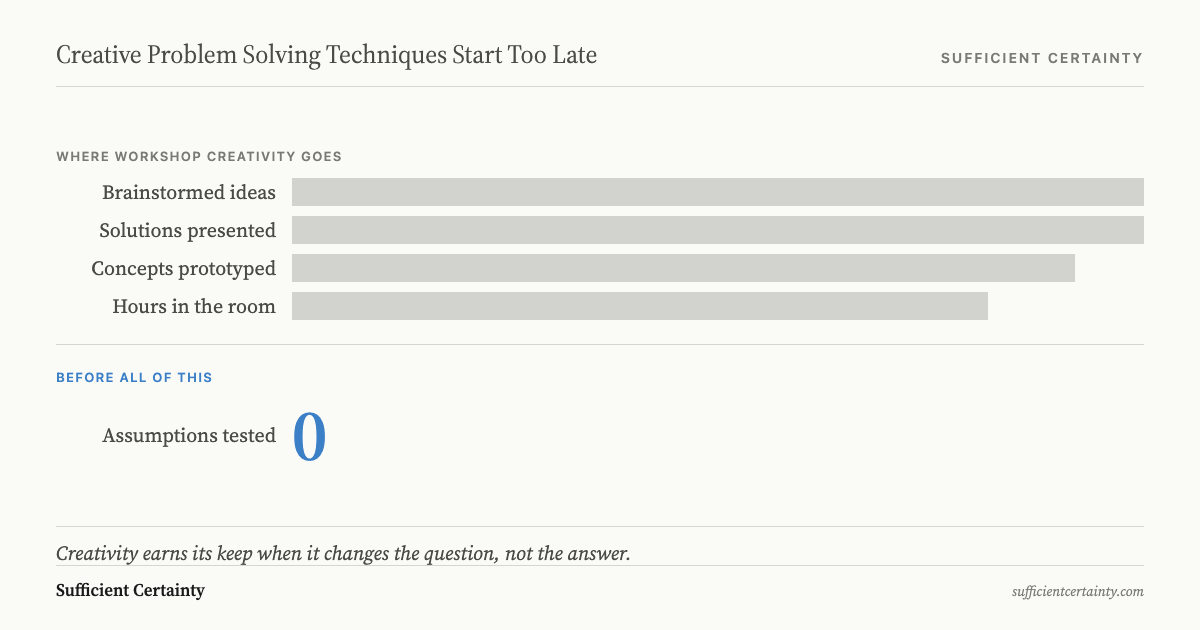
Creative problem solving techniques start with the problem
Thomas Wedell-Wedellsborg surveyed 106 C-suite executives across 91 organisations and found that 85 percent said their organisations were bad at problem diagnosis. A further 87 percent said the cost was significant. His Harvard Business Review piece uses the elevator example: tenants say the lift is too slow, managers think about motors, and the better answer turns out to be mirrors, because the real problem was the wait, not the speed.
Managers like this arrangement because it feels active. Problem definition feels slower and less glamorous. Yet most expensive failures I have seen did not begin with a shortage of enthusiasm. They began with one sentence that nobody wanted to look rude by rewriting. Once that sentence survives the first half hour, the room usually starts serving it. It becomes the furniture, and nobody redesigns the furniture during a workshop.
Magistretti, Pham and Dell'Era argue that problem framing is itself a creative act, and they are right that it is the decisive one. Creativity earns its keep when it changes the question before the room falls in love with the answer.
Run your stuck problem through the five steps and find the unchecked question your brainstorm keeps decorating. Start the Walk →
When design thinking solves the wrong problem beautifully
The Diva Centres case in Zambia is almost too perfect. IDEO.org wanted to help teenagers in Lusaka get contraception and reproductive health guidance. The team came up with nail salons where girls could get advice without embarrassment. Three pilot sites were built. The project won an award.
IDEO planned 10 centres by 2017. That scale never arrived because nobody in the workshop had asked who would pay for the second year. The donors who funded three pilot sites got a photo opportunity. The teenagers who needed the service got nothing durable. The later admission, reported in MIT Technology Review, was blunt: the concept was award-friendly but operationally unserious once donors moved on.
The school-lunch case had the same shape. A short workshop made the dining experience central because it was visible and testable. The questions that decided whether anything survived, who pays, who maintains the equipment, whether the cafeteria has a reliable power supply, sat outside the workshop walls. The people who could answer them had not been invited because their answers would have made the brief less exciting. The same wall appears in the weeks after a kaizen event, when standard work written with a facilitator on the floor meets an ordinary shift.
Both solved the wrong problem beautifully. The discipline that was missing is ordinary: name the assumption carrying the brief and test it before the room spends five months on stationery. That is the real skill behind problem solving skills in the workplace, and it matters more once you cannot see the whole system from the workshop table.
How I use creative problem solving techniques in a real room
I start by forcing the decision into one sentence. Then I ask what has to be true for that sentence to hold. A colleague once told Roger that "Grant Purdy kills good ideas." I take that as proof the process works.
The method puts assumption-testing after options are on the table, but in a creative session I pull it forward, because a room full of post-it notes built on a false premise is expensive theatre, not creative work. Once the assumption is written down, creativity gets sharper rather than smaller. People stop inventing general remedies and start inventing tests, the same shift that the science of decision making demands in any live call. If a workshop cannot tell me which belief it exposed and what would reopen the decision later, it has produced confidence, not insight.
I keep asking one thing before the room picks up the markers: what belief is this problem statement resting on? Until somebody drags that into daylight, the workshop is decoration. That upstream discipline is what strategic problem solving actually requires.
You could close this tab and run your next brainstorm around a question nobody checked.
Work through your decisionNo sign-up. Just pick your decision and start.
Grant Purdy is the co-author, with Roger Estall, of Deciding (2020), and the architect of the Universal Decision-Making Method.