
A decision making coach works on one live choice, not broad professional development. The role is to surface the assumption the Decider has not named, test whether the evidence supports it, and stop when the Decider can defend the call. That is a smaller job than most coaching frameworks admit.
A chief executive once asked me to sit in on a decision about selling part of the business. The papers were thick, the advisers were expensive, and the room had that over-managed calm that appears when nobody wants to own the call. What was missing was not intelligence. It was someone willing to ask what the decision actually rested on. That is the only version of a decision making coach I take seriously.
Most people use the label loosely. They mean someone who helps with decisions. I mean something narrower. Roger Estall and I set that out in Deciding. It is judgement work on a live decision, not personal development stretched over months.
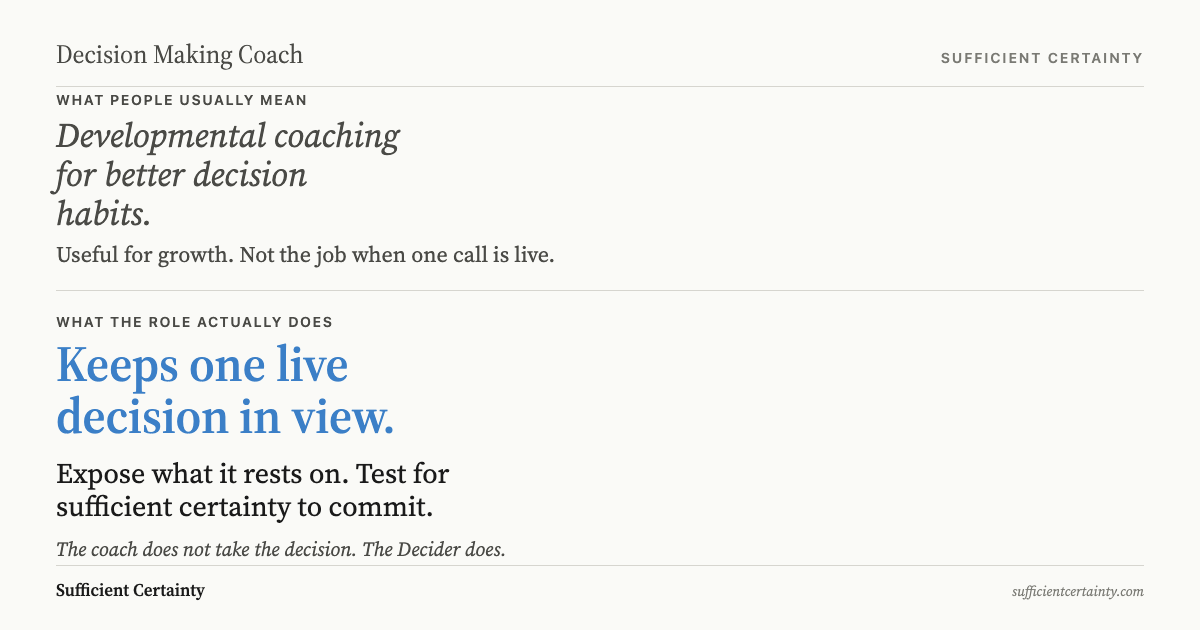
A decision making coach is someone who keeps one live decision in front of the person deciding and tests whether the evidence justifies committing.
What most decision-making coaches actually do
Most coaches sell development work. The Chartered Institute of Personnel and Development says as much in plain HR language: coaching is there to improve skills or work performance. If you want help handling your staff better, hire one. Harvard Business Review prefers a spectrum from directive to non-directive. Also fine. My line is simpler. Once the coach starts supplying the judgement, the work has wandered into consulting. I drew that boundary more sharply in decision coaching and consulting.
The vague label suits people who sell long, soft engagements, and it suits organisations that would rather discuss self-awareness than name a hard choice. Everyone sounds constructive while responsibility goes missing, which is convenient if you sell more sessions for a living. It is good for the seller and no use at all if the board paper is due on Friday. The decision consultant label has the same wobble, which is why I have dealt with it separately.
Bring one live choice to the five steps and surface the blind spot no framework session has touched. Start the Walk →
When a decision-making coach focuses on one decision
The Ottawa Hospital Research Institute is one of the few places that uses this language with some discipline. Their material is useful because it keeps the helper in the proper lane: clarify the choice, then leave the decision with the person who owns it. The setting is health care, but the boundary travels well.
That is close to the work Roger Estall and I did. We were called in when an accountable person had to decide something consequential and the surrounding machinery had become theatrical. In my experience, the machinery is often very pleased with itself. It has packs and workshops, plus enough ceremonial paperwork to reassure everyone that something serious is happening. It still cannot say plainly which assumptions carry the decision. So we dragged the conversation back to the live question, named the assumptions that mattered, and wrote the reasoning down clearly enough that the Decider could defend it later. The Universal Decision-Making Method gives that conversation its shape.
The written reasoning is where most people resist. A verbal commitment in the room costs nothing. Setting down the assumptions that carry the decision, in writing, forces the Decider to own a position someone can revisit. It also reveals gaps that conversation hid. I have watched a board spend two hours debating a property acquisition, reach what felt like consensus, and then discover during the write-up that nobody had verified the lease reversion date. The omission was not carelessness. It is what happens when discussion runs ahead of reasoning. Writing slows the room down enough to notice what it skipped.
Blind spots are the point
Atul Gawande made the point neatly in The New Yorker in 2011. After eight years as a surgeon, he brought in a retired colleague to watch him operate. He did not need motivation and he did not need a seminar. He needed another pair of eyes. Competence does not eliminate blind spots. It often protects them.
The difference between a surgeon and a chief executive in this situation is narrower than either would admit. Both have expertise that becomes a ceiling. The surgeon's muscle memory is the executive's planning template. Neither can see the boundary of what they habitually do without someone standing outside it. That is why coaching in this sense has nothing to do with motivation or self-awareness. It is observation aimed at a specific performance, one decision, under conditions the performer cannot fully see.
I have watched the same thing happen in boardrooms. An old forecast acquires the status of scripture. A planning premise survives because a senior person first said it years ago. A committee keeps circling because nobody wants to insult the author of the spreadsheet. I see this often in difficult business decisions. The room is rarely short of analysis. It is short of honesty about which assumption is doing the heavy lifting.
This is where a decision making coach earns the fee. I am not there to improve executive presence or preside over a feelings recital. When the work is executive decision coaching, I ask what has to be true for this decision to work, and whether the people who must live with the consequences really believe those things are true. That question has a nasty habit of ruining the room’s favourite story, which is one reason it gets avoided.
What the evidence supports
There is decent evidence that coaching works in broad terms. Erik de Haan and Viktor Nilsson’s 2023 meta-analysis in the Academy of Management Learning and Education looked only at randomised controlled trials, 37 of them, covering 2,528 participants, and found a moderate positive effect overall. I like that paper partly because it refuses the coaching industry’s usual self-congratulation and anecdote dressed up as evidence.
What that evidence does not settle is the narrower job I am describing here: helping an accountable person reach judgement on a consequential choice. For that, my test is blunter. Did the discussion expose the assumptions that mattered? Did it show whether enough was known to proceed? If you want the broader category line, find a decision making coach or read the full service page. If the room still cannot say what the decision rests on, the title on the invoice is just decoration.
You could hire another framework and still dodge the next simple question you owe.
Work through your decisionNo sign-up. Just pick your decision and start.
Grant Purdy is the co-author, with Roger Estall, of Deciding (2020), and the architect of the Universal Decision-Making Method.