
System 1 vs system 2 thinking gives useful language for fast judgement and slow analysis, but language is not a switch. Telling a room to be more deliberate on Thursday afternoon has never once changed the outcome. What changes the outcome is a process that forces the untested assumption into daylight before commitment.
I once sat with a board chair staring at an 82-page acquisition paper. The finance model moved the valuation by $14 million, and the seller wanted an answer by Thursday. By Wednesday afternoon nobody had said what had to be true for the deal to work. People like to call this system 1 vs system 2 thinking. In the room it felt cruder. A preference had arrived early, and the paperwork was there to make it look respectable.
Kahneman gave us useful language for fast judgement and slow analysis. He did not give an organisation a switch. When the board meets on Thursday, telling people to be more deliberate is close to useless. The favourite answer usually arrived earlier, and the paper has been hired to escort it into the room.
System 1 vs system 2 thinking is a way of describing two modes of judgement: fast, intuitive thinking and slower, deliberate reasoning.
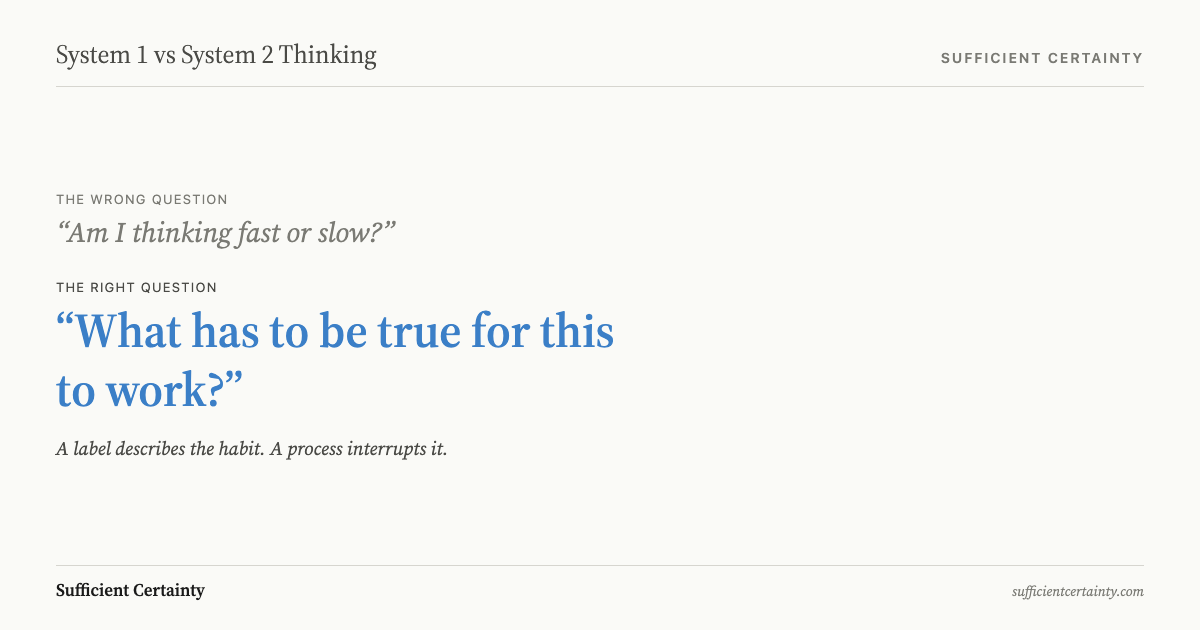
System 1 vs system 2 thinking is a description
Executives also flatter themselves that speed proves mastery. It often proves only that nobody wants to be the person who slows the train. I have watched perfectly intelligent people defend a bad timetable as if it were evidence. Deadlines do not think; they merely bully.
Once a date is on the cover sheet, people start treating the date as evidence. It is nothing of the kind. It is only pressure with a calendar attached.
The distinction helps because it explains why the first plausible answer feels like judgement. It does not tell the room what to do at 4:15 on Wednesday when the revenue line is still an article of faith. A surprising amount of commentary treats the label as progress. I do not. Naming the machinery is easy; stopping it from ratifying a mood is the job.
The fashionable move is to spot the bias afterwards and feel clever for naming it. I have seen whole workshops built on that trick. The room leaves with a cleaner vocabulary and the same habits. System 1 did not lose; it simply picked up a lanyard. The emotional signal that was pointing at the untested assumption gets classified as mood and ignored.
If you want the wider map, my piece on cognitive biases in decision making covers it. Here the problem is narrower. System language turns decorative the moment people think naming fast judgement counts as controlling it.
System 1 thinking earns trust only in narrow conditions
Daniel Kahneman and Gary Klein made the practical point in a McKinsey interview: intuition earns trust where the environment repeats itself and feedback comes back quickly and clearly. Board decisions fail that test on every count. The feedback arrives late and often corrupted. If the deal works, people praise leadership; if it fails, they blame execution. Almost nobody revisits the original assumptions while the same people are still in the room. Under pressure and with ambiguous evidence, the room slides back towards automatic judgement, exactly as the authors of Outsmart Your Own Biases warn. That is where overconfidence bias in decision making starts passing itself off as experience.
Take the decision in front of you through the five steps and pin down the trigger that stops fast thinking closing it. Start the Walk →
A checklist can still fail if it becomes ceremony
The best argument for slowing a decision is operational. In the WHO surgical checklist study, complications fell from 11.0 per cent to 7.0 per cent and deaths fell from 1.5 per cent to 0.8 per cent after teams used a 19-item checklist across eight hospitals. The surgeons did not become wiser between one quarter and the next. The checklist forced a pause and a conversation before action.
I am not sentimental about checklists. A good one acts as a brake before commitment. A bad one is a relic that proves the meeting occurred. Most organisations cannot tell the difference because the form is easier to audit than the conversation. Paper is easy because it has manners; assumptions do not.
The Ontario follow-up matters just as much, because it stops this turning into checklist devotion. Hospitals reported 92 per cent compliance within three months and 98 per cent within six, yet the population study reported by ICES found no meaningful improvement in mortality or complications. That version of a checklist is adored by compliance managers and governance staff. It also keeps consultants in work selling reassurance. The form says slower thinking happened. The underlying decision is still running on habit. I see the same thing in committee governance, which is why so much of cognitive biases in business is really institutional preference in a good suit.
System 1 vs system 2 thinking needs a trigger
I do not care whether the room can recite dual-process theory. In a live meeting I use the Universal Decision-Making Method in a much less glamorous way than the name suggests. I stop the room and make them Frame the decision again. Then we Recognise assumptions behind the favoured answer and ask what would count as Sufficient certainty for a decision with consequences this large. Much of the advice on overcoming cognitive biases still assumes people will catch themselves in time. In my experience the paper is usually ahead of them.
If the room has locked itself onto one answer too quickly, we also go back and Develop options. Not because more options are automatically wise, but because one favoured option lets fast judgement hide inside certainty. The second option does not need to win. It only needs to break the spell.
When Roger Estall and I wrote Deciding, we wanted something a board could use before everyone started performing certainty. My first question is simple: what has to be true for this recommendation to work? Then I make someone name the first sign the bet is failing, and who will see it first. That usually kills the polite fiction that the paper was complete.
What passes for analysis in many organisations is really a search for cover. People want a document they can point at later. They do not want an assumption that can be checked next month in front of the same people. One creates accountability; the other creates minutes.
If the recommendation depends on demand holding up, write that down. If it depends on a regulator staying quiet, write that down as well. Then Design monitoring around those claims, not around the monthly pack that arrives after the damage. That is where system 1 vs system 2 thinking becomes useful instead of decorative. Once fast judgement gets paperwork strapped to it, the people who benefit are usually the ones paid to certify the process, not the ones who have to live with the decision.
You could name the bias and still let fast thinking sign the paper.
Work through your decisionNo sign-up. Just pick your decision and start.
Grant Purdy is the co-author, with Roger Estall, of Deciding (2020), and the architect of the Universal Decision-Making Method.