
Cognitive biases in business are rarely personal failings. They are built into the targets and reporting lines that tell people which answer is safe. Train the individual and the structure still rewards the wrong conclusion. The only useful countermeasure changes the decision process, not the workshop slide deck.
I have sat in executive workshops where the team spent three hours on anchoring and confirmation bias and nodded through a slide deck on better judgment. Ten minutes later they were back in the monthly operating review, staring at a cross-sell league table and a bonus dashboard nobody wanted to question. That is how cognitive biases in business usually survive.
The room needed permission to question the target and a process that forced the hidden assumption into the open before status settled around it. Bias training stays popular because it leaves the target alone, which suits the sponsor who set it and the executives being paid to hit it.
Cognitive biases in business are predictable errors in organisational judgment caused by hidden assumptions that go untested inside targets and status hierarchies.
Cognitive biases in business are usually built into the target
In business, bias often arrives before the meeting starts, because the scorecard already tells people what counts as success. The cleanest modern example is Wells Fargo. The U.S. Department of Justice settlement says the bank paid USD3 billion after employees opened millions of accounts or products without customer authorisation, and says senior leaders knew about "gaming" as early as 2002. That misconduct ran until 2016. Sixteen years is not a lapse in self-awareness. It is an institution defending the wrong frame.
Once success is defined as product volume, every later discussion bends around it. Complaints become noise and dissent looks disloyal. Branch staff learn quickly that a customer without another product is a failure, while a dubious extra account looks like initiative. What many people call confirmation bias is often something larger and uglier: managers teaching the organisation which evidence is welcome because their rankings and pay depend on the target surviving. If the decision had been framed around customer value rather than cross-sell numbers, much of the later rationalisation would have died on the table. That is why I start with Frame the decision. At Wells Fargo, the cross-sell target framed the room before anyone opened their mouth.
Cognitive biases in business survive when challenge is ceremonial
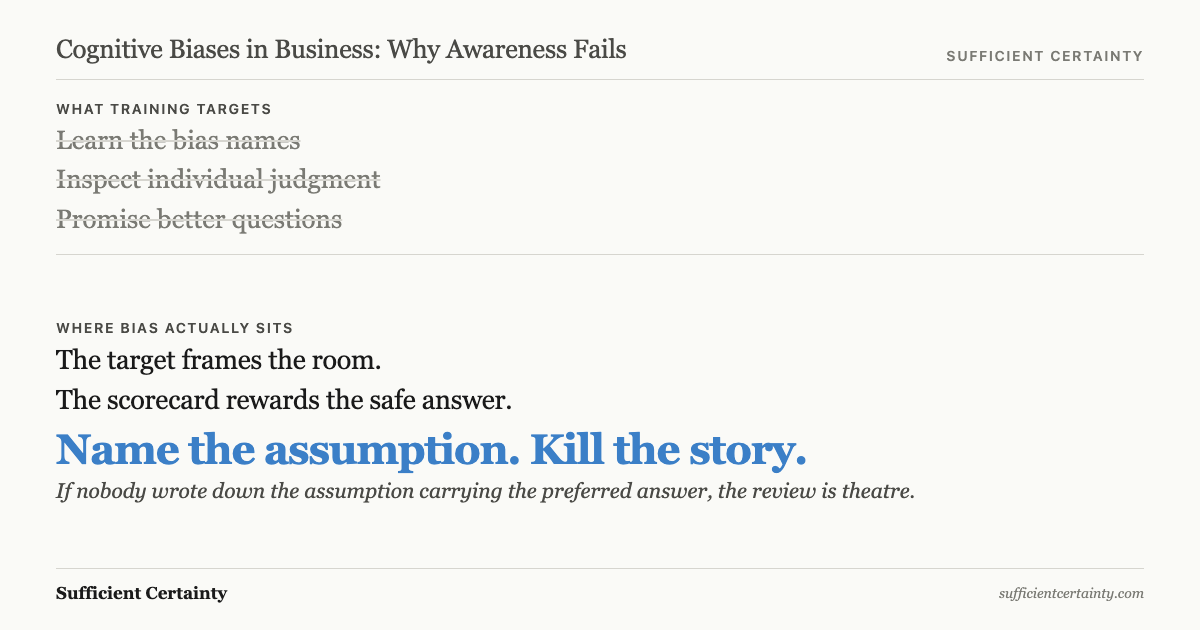
Boards fail on bias when disagreement is treated as theatre rather than interruption. The APRA prudential inquiry into Commonwealth Bank of Australia described complacency "from the top down" and a consensus style that reduced constructive criticism. The sharpest line in that report was the missing "should we?" question. Plenty of organisations ask whether they can hit a target. Far fewer ask whether the target deserves obedience when reopening it would expose the executives who sold it to the board, and the directors who applauded it in the minutes (always easier than admitting it should have died earlier).
The same weakness appeared at Carillion. The parliamentary report said the company entered liquidation with nearly GBP7 billion in liabilities and just GBP29 million in cash, while the board stayed focused on bonuses and flattering accounts of the business. Non-executives and auditors were present, but presence is not challenge. Once a board starts protecting the story that made it successful, contrary evidence has to fight status as well as optimism. I do not get much comfort from tidy labels like halo effect bias. The harder question is who in the room can stop sign-off before the nice story eats the company.
Why cognitive biases in business survive training
They survive because training asks individuals to inspect their minds, while the organisation keeps rewarding the preferred answer. Hino Motors is a blunt example. The Department of Justice resolution valued the global case at more than USD1.6 billion and said Hino improperly imported and sold more than 110,000 diesel engines in the United States from 2010 to 2022. Engineers fabricated test results, and software effects were kept out of sight. Nobody there needed a seminar on integrity. Certification had to "work" because production schedules and bonuses were sitting on top of it. The fiction was costly to challenge, which is why it lasted.
In my experience, that is what awareness sessions miss. They make bias sound private, something living inside a manager's skull. In practice the stronger force is public: the target is already on the wall, and the sponsor has already signalled which answer is safe. People do not need to become strangely irrational. They just need to read the room and protect the story the room is rewarding. Sorting that into System 1 and System 2 adds vocabulary. It does not add a checkpoint.
Once the answer is fixed, evidence stops being evidence and becomes raw material. I have watched that happen in boards and audits for years. A bad number appears and is explained away before the meeting moves on. Roger Estall and I wrote Deciding because the failure was usually embarrassingly plain: nobody had written down the assumption carrying the preferred answer, and nobody had named the margin miss or audit finding that would reopen it. Overcoming cognitive biases is a structural job. In the Universal Decision-Making Method, the step that matters here is Recognise assumptions. Name the bet. Write the trigger that kills it.
Test your next business call against the target itself and see which assumption your process is protecting from challenge. Start the Walk →
The fix is to test the decision, not the personality
My practical fix is plain. Frame the decision around the real purpose, not the internal target, then write down the assumption carrying the answer and the review trigger that reopens it. If the assumption is that customers will tolerate a price rise, say the churn number that proves you were fooling yourself. If the assumption is that a control issue is isolated, say the next audit result that sends the decision back upstairs. That is where cognitive biases in decision making stop looking psychological and start looking organisational. If the room cannot say this in simple language, it is not deciding. It is defending a belief system with better stationery.
I also want an audit chair or non-executive with actual standing to stop sign-off when the assumption starts wobbling. I do not care whether that person is popular. I care whether the process gives them the power to delay the paper and make the sponsor answer in public. If challenge is left to good manners, the senior voice wins and everyone calls it alignment, which is a handsome word for obedience. Give challenge a recognised seat, and the room is far more likely to catch the assumption it was about to smuggle through.
When I talk about cognitive biases in business, I mean a process willing to humiliate the target before the target humiliates the firm.
How to reduce cognitive bias where it actually matters
Bias training produces awareness. Awareness, in my experience, changes nothing. I have watched people walk out of a half-day session able to name anchoring, confirmation bias and the sunk-cost fallacy, then sit down in a procurement review the following week and do exactly what they did before. The vocabulary is new. The process is identical. The preferred supplier still wins.
The structural fix is not better thinking. It is better process. Specifically, it is a process that forces the room to write down what it is assuming before the answer hardens around it. Most organisations skip that step because it is uncomfortable. Writing an assumption in plain language makes it testable, and testable assumptions are harder to protect.
I once sat in a procurement review for a facilities contract worth several million dollars a year. The incumbent had held the contract for nine years. The evaluation panel scored three bidders against weighted criteria, and the incumbent came out on top. That looked tidy until you examined what had happened in the room.
The first number anyone saw was the incumbent's price, tabled early because someone wanted to "set the baseline." That is pattern-matching dressed as method. Every later price was judged against it. Cheaper looked risky. More expensive looked greedy. The anchor had been set before the panel opened a single tender response, and nobody noticed because it felt like preparation.
Then confirmation bias finished the job. The panel spent forty minutes on the incumbent's track record and fifteen on each challenger. Questions to the incumbent were soft: "Can you maintain the current service standard?" Questions to the challengers were pointed: "How would you handle the transition?" The room was not comparing three options. It was defending one option and interviewing two threats. The scoring sheet said rigour. The behaviour said preference.
The antidote is not teaching the panel to recognise anchoring. They could have recited the definition and still done the same thing, because the process never forced the assumption into the open. The assumption carrying that decision was simple: the incumbent's past performance predicts future performance under a new contract. Nobody wrote it down. Nobody asked whether the evidence for it would survive a hostile reader, somebody looking for reasons the assumption might be wrong.
That is what I mean by surfacing assumptions. Not a workshop exercise. A plain sentence on paper that says: we are betting on this, and here is what would show us we were wrong. Once the assumption is visible, the room can judge whether there is sufficient certainty to proceed or whether the evidence is thinner than the confidence suggests.
In that procurement case, a hostile reader would have noticed that the incumbent's service record included two contract variations that quietly lowered the original scope, a complaint pattern that had been reclassified rather than resolved, and a price that only looked competitive because it was being compared against itself from three years earlier. None of that survived five minutes of honest scrutiny. All of it had survived nine years of comfortable renewal.
The lesson is not that procurement panels are careless. It is that bias lives in the process, not the personality. If you want to reduce cognitive bias where it actually matters, stop asking people to think better and start making them write down the bet. Then ask who in the room is allowed to say the bet looks weak. If the answer is nobody, or nobody junior enough to lack a stake in the outcome, you have a ceremony, not a decision.
You could enter your next review and still let the target think for you.
Work through your decisionNo sign-up. Just pick your decision and start.
Grant Purdy is the co-author, with Roger Estall, of Deciding (2020), and the architect of the Universal Decision-Making Method.