
Making decisions in groups requires one owner and a method for testing what the decision rests on. Without both, the group will produce agreement that feels thorough and miss the single assumption that would have changed the outcome. Structure decides the quality. The participants decide the content.
Making decisions in groups works when the group contributes knowledge and one person commits. It fails when the group treats contribution as a vote and commitment as consensus. The structure that separates the two is not complicated, but most organisations have never built it, and the absence is what converts every group decision into a negotiation.
When I talk about making decisions in groups, I do not begin with voting tools or workshop theatre. I begin with two flights. On Qantas Flight 32 in 2010, 469 people survived because one captain kept ownership clear while five flight crew built a shared picture of a badly damaged aircraft. At Tenerife in 1977, 583 people died because the cockpit and tower were acting on assumptions nobody forced into plain words.
I have taught both cases for years because aviation is brutally honest about muddled authority. A board can survive a vague paper and a room full of nodding for another quarter or two. A flight deck cannot. Most advice on group decisions still sells process as though the problem were missing technique. In my experience, the real failure is softer and more dangerous: nobody has settled who owns the call and which premise the call rests on.
Making decisions in groups is the practice of using shared discussion to test a choice before one accountable person closes the call.
Shared ownership is where group decisions break down
Group decisions stall when ownership is shared, because discussion expands to fill the hole. Paul Rogers and Marcia Blenko wrote in Who Has the D? about work across 350 companies and found that only 15 per cent of executives thought their organisations helped them outperform competitors. They were being polite. When I ask, "Who closes this decision?" and the answer is a committee title, I know the room is asking for cover, not judgement. That arrangement suits governance staff who like shared fog in the minutes, and facilitators who can always prescribe another workshop when nothing closes.
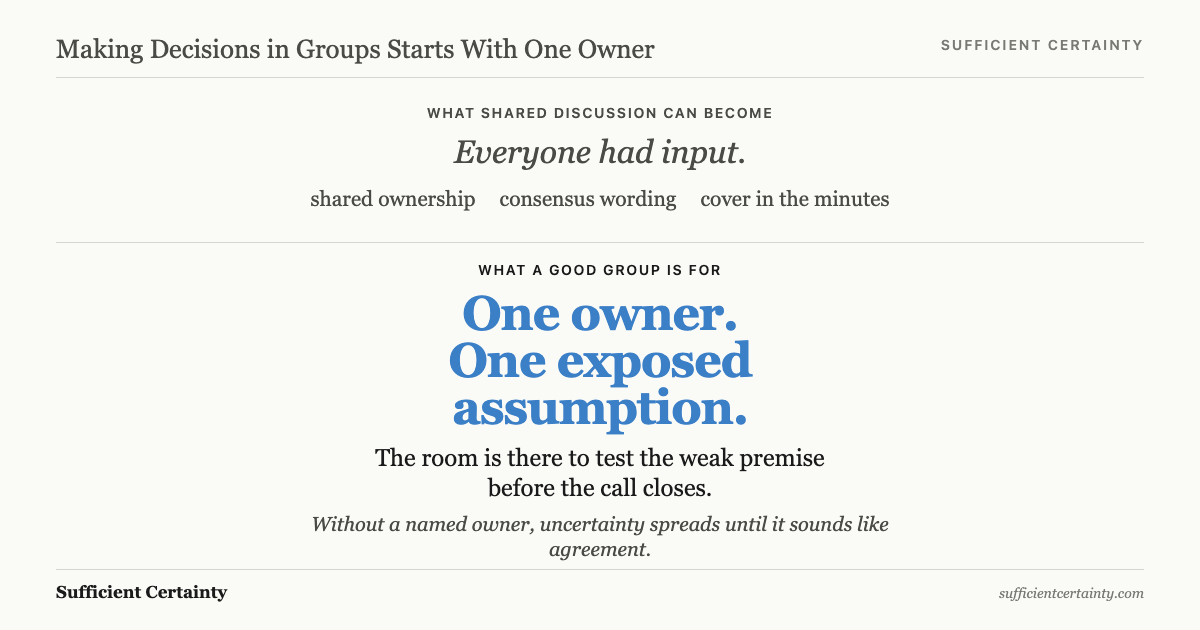
One owner does not mean one thinker. It means one person cannot hide. I am not interested in room-wide ownership, because once everyone owns it, nobody does, and the paperwork grows to protect that fiction. Everyone else is there to widen the picture, challenge the favourite option, and say what the owner cannot see. That is the useful part of collaborative decision making: the room does the testing, and one person still carries the result.
The danger starts when assumptions stay private
In group work I usually ask a ruder question: which quiet premise is this room betting on? Once that is written down, half the theatre drains away. On QF32, the crew did not waste time trying to democratise authority after the engine failed. The captain kept command, but the crew built a common model of what the aircraft could still do. The official record shows a crew handling around 100 ECAM messages in the air and still getting the aircraft home. They worked the problem in public, checking, questioning, and recalculating as they went. That is what a serious group adds, tested understanding rather than a show of hands.
Tenerife is the uglier lesson. The captain behaved as though take-off clearance and runway clearance were settled facts. They were not. The assumption stayed implied, rank did the rest, and 583 people died. I do not read that as a failure of meeting etiquette. It was a failure to drag the live condition into the open. The questioning habit behind these group decision making techniques is simple: force the weak point into words while there is still time to change course.
Give your next group decision one clear owner and surface the private assumptions before the room calls it consensus. Start the Walk →
One owner makes the room faster, not slower
People assume a bigger room must be slower. The evidence does not say that. In a study led by Maria Yang, teams with a single leader making the final selection finished about 24.8 per cent faster than consensus teams, with no meaningful overall quality penalty. In my experience, making decisions in groups gets faster when the room knows who closes the call and what would count as enough to stop.
That is why I am cautious about loose talk of consensus group decision making. Genuine consensus appears after opposing views have been tested until the stronger answer is obvious. Most of what organisations call consensus is shared cover. It suits committee secretariats, because the minutes can say "the group agreed", and it suits consultants, because they can sell the sequel workshop when the compromise fails. I have watched senior people invite challenge and then punish the first person who gives it, so I would rather fill the room with people who know where the preferred option is weak than with ranked spectators.
A group decision is still open until the reopen signal is named
Roger Estall and I built the Universal Decision-Making Method because committees disappear into fog if you let them. For this problem, three parts matter most. Frame the decision so nobody can hide inside a woolly brief. Recognise assumptions so the room has to name the premise it is betting on. Design monitoring so the owner knows which missed supplier date or sales threshold brings the decision back.
Any decent team decision making process leaves with a watch owner and a threshold, not a vague promise to keep an eye on things. That concrete watchpoint is what separates a decision from a well-attended discussion. If the supplier misses 30 September, the operations head reopens the decision on Monday. If first-quarter demand falls 15 per cent below plan, the sponsor brings the paper back to the board. Until somebody is named against a condition like that, the decision is still open, whatever the minutes say.
That, to me, is the point of making decisions in groups. The group is there to test the judgement, not to dilute responsibility. The people who benefit from the fuzzy version are easy to spot: workshop sellers and governance teams who prefer ambiguity in the paperwork. Bad group process nearly always breeds another memo and another assurance note, because paper is safer than judgement for people who do not want the exposure. The collaborative decision making examples that end in wreckage share that root: procedure replaced judgement and nobody noticed until reality arrived. I would rather have a shorter meeting, a named owner, and one exposed assumption than another handsome pack of papers explaining why nobody could quite decide.
You could walk into your next group decision and still leave ownership blurred.
Work through your decisionNo sign-up. Just pick your decision and start.
Grant Purdy is the co-author, with Roger Estall, of Deciding (2020), and the architect of the Universal Decision-Making Method.