
Consensus in group decision making is treated as a sign of quality. It is usually a sign that the strongest objection was traded away to keep the room comfortable. Sound decisions survive challenge. Consensus protects decisions from challenge, and that protection is where the failure begins.
Consensus in group decision making is a reliability hazard. It rewards the option that offends nobody, which is rarely the option that addresses the actual uncertainty. The alternative is not autocracy. It is a process where the decider hears genuine challenge, tests the assumptions the decision depends on, and commits without waiting for unanimous comfort.
A board chair I worked with once walked into the room carrying a 42-page paper and minutes from three committee meetings. The compromise had been shaved down so carefully that 11 people could live with it. He asked me if this was what consensus group decision making looked like. I told him it looked like a room that had grown tired of resisting itself.
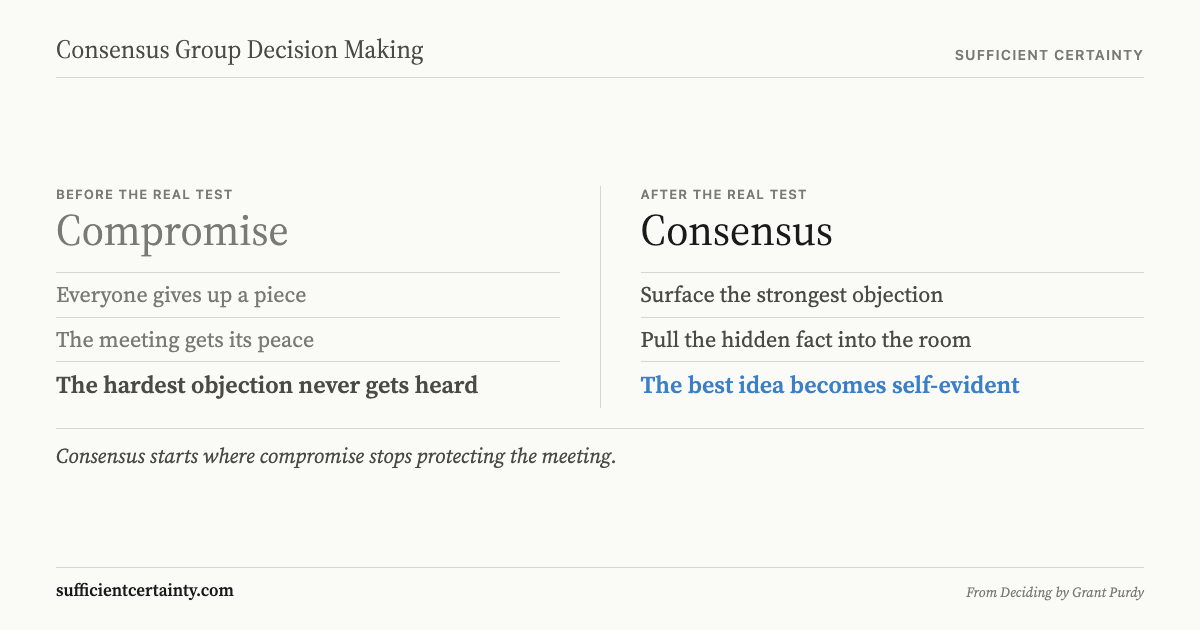
A room has not reached consensus when everyone trims the answer to keep the meeting calm. If everyone gives up a slice so the meeting can end, the group has bought peace and called it judgment.
Roger Estall and I wrote Deciding after we had watched committees do exactly that for years. Consensus has a lovely reputation because it sounds civil. It also gives facilitators who bill by the workshop a tidy line for the minutes: consensus reached. In truth, a weak agreement is still weak after everyone smiles at it.
Consensus group decision making is the point at which the strongest objection has been tested hard enough to support the choice or stop it.
Consensus group decision making starts with the hard objection
The useful thing about the ESIIL guide is that it admits consensus has limits. It treats it as a method for consequential choices that need real buy-in, and says it works best in groups of about 6 to 10. Push much beyond 20 and the thing becomes cumbersome unless the process is tight. In my experience, that is exactly right. Once the room gets too large, objections stop changing the decision and start decorating the paperwork.
The IETF's note on rough consensus makes the next point properly. Agreement is not a headcount. A view backed by 100 people can still fail if 5 objectors have exposed a flaw nobody has answered. A view backed by 5 can stand if the louder objections have been understood and resolved. That is why I rely on the techniques I use in group decisions before anyone reaches for a show of hands.
Rooms that treat silence as agreement drift toward groupthink faster than anyone in them notices.
Use the five steps on your stalled group decision and find the objection your consensus process keeps smoothing over. Start the Walk →
Consensus group decision making collapses when the hidden fact stays hidden
Stasser and Titus showed the problem cleanly in their 1985 study of 72 four-person groups. Shared information dominated the discussion. Unshared information that could have changed the choice struggled to affect the outcome. I have watched the same thing happen in boardrooms for decades. A thick paper gives everyone safe material to comment on, which committees always find comforting. Meanwhile the one person who knows the contract assumption is wrong, or the delivery timetable is fiction, keeps quiet because the room has already organised itself around safer facts.
So I do not ask a room whether it agrees. I ask each person what they know that the others may not know, then I ask what that new fact does to the current favourite. That sequence sits inside the Universal Decision-Making Method, and it matters because hidden information does not surface by good manners alone. Somebody has to drag it into the light, which is rarely popular with governance staff who would rather move to the next agenda item.
People often imagine consensus fails because someone is difficult. In my experience, it fails more often because the room rewards neatness. The person with the awkward fact can feel the temperature drop the moment they speak, and most people are not paid extra for wrecking a comfortable meeting. That is why managing disagreement in teams has to start with the disputed assumption, not the person who raised it.
Dissent is only useful when the room has a job for it
De Dreu and Michael West found this in two field studies, one with 32 teams and another with 48. Their paper on minority dissent and innovation showed that dissent helped when participation in decision making was high. That does not mean endless talking. It means the dissenter has enough standing for the challenge to be examined instead of being smoothed away by the chair or parked for later, which in committee language often means never.
Darcy Leach found something similar in her study of 12 consensus-based groups. The efficient groups had a clear purpose and enough skill to work through objection properly. The weaker groups got trapped in vagueness and bad process. I see the same thing. Consensus group decision making sounds humane, which is why it attracts people who prefer a smooth meeting to a sound decision. Facilitators who sell process do nicely from that arrangement, and so do the governance staff who protect the template. The organisation pays for it. So does who belongs in the room, because a room full of agreeable people is usually a room built to produce surrender.
One Decider still has to decide when enough has been tested
Consensus does not remove ownership. One Decider still has to judge whether the important objections have been carried far enough to act, or whether the objection itself is the reason to stop.
Committees like to pretend ownership has dissolved into the group, but making decisions in groups never works that way. When the compromise unravels, somebody still has to answer for it, which is why fake consensus remains such a pleasant habit for people who advise but do not decide.
I have chaired groups where full agreement never arrived and the decision was sound because the strongest challenge had done its work. I have also watched rooms produce a polished compromise that left everyone mildly comfortable and the organisation poorly served. What matters is whether the room has reached sufficient certainty or merely escaped conflict. The real difference between alignment and consensus turns on the same test.
That is why I treat consensus as a demanding form of collaborative decision making, not a courtesy ritual. When the room starts trading slices of the answer so everybody can keep face, the answer is decaying in public. When the objection has either broken the option or failed to break it, the decision can stand. Only then has consensus earned the name.
You could leave with compromise and feel the strongest objection waiting outside.
Work through your decisionNo sign-up. Just pick your decision and start.
Grant Purdy is the co-author, with Roger Estall, of Deciding (2020), and the architect of the Universal Decision-Making Method.