
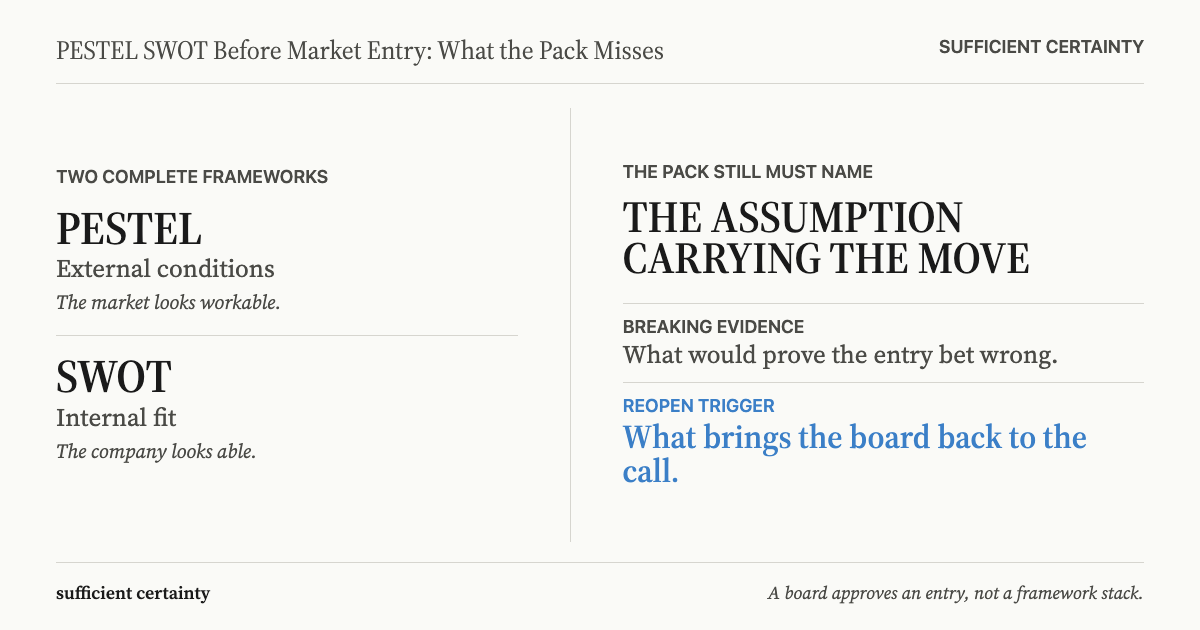
Running PESTEL SWOT before market entry satisfies the board pack without testing the bet. Two matrices can be finished, formatted, and presented while the assumption carrying the entire investment sits unnamed between them. The real work is writing the sentence that says what must hold true.
I have sat in rooms where the country deck was finished and someone asked for a late SWOT slide so the board pack looked complete. The problem in that moment is simple: the pack looks finished before anybody has written the bet that could still sink the move.
Most advice on pestel swot before market entry answers the wrong question, because it tells teams how to stack the tools and says almost nothing about how a board should stop two tidy matrices from hiding an untested assumption. That is why so many packs feel rigorous and still fail at the point of decision.
PESTEL and SWOT before market entry is a sequencing approach that scans external forces and internal fit but leaves the decision exposed unless the load-bearing assumption is stated.
PESTEL SWOT before market entry can still leave the decision unmade
Laurence Minsky and David Aron argued in Harvard Business Review in 2021 that teams should begin outside the business and only then move inward. Fair enough. A market can close the door before an internal capability discussion matters. The trouble is that a generic PESTEL analysis makes collection look like judgement. Once the headings are on the page, a board sees coverage, not necessarily relevance.
The problem gets worse because the framework rewards completeness. A team that has touched every heading appears diligent, even if half the items are background noise. The board inherits a false sense that uncertainty has been reduced, when in fact it has only been rearranged.
That matters in market entry because the external scan can keep expanding while the decisive sentence remains unwritten. A team can describe regulation, currency pressure, or the economic factors that could kill market entry and still leave the room unable to say what has to be true for the move to work. The categories are not the decision. They are only places to park observations.
When I call PESTEL due-diligence theatre, this is what I mean. The headings create the appearance that the outside world has been handled. They do not force anyone to choose which external condition is load-bearing, what evidence would weaken it, or what would make the board reopen the case.
Name the assumption your market-entry case depends on and set the evidence that would force the board to reopen it. Start the Walk →
PESTEL SWOT before market entry still leaves you with two lists
The same trap sits inside SWOT analysis. It is usually introduced as the balancing tool after the external scan: now that the market is described, the company can test fit. In practice, the second matrix often just gives the pack another place to sort information. Terry Hill and Roy Westbrook wrote in 1997 that real SWOT exercises produced long factor lists, weak prioritisation and little follow-through. They examined more than twenty applications and reported an average of more than forty factors. That is inventory, not strategy.
This is why the orthodox sequence answer is so weak. It settles the order of frameworks and never asks how the board will know the entry thesis has stopped being credible. Sequencing is administration. Decision quality comes from naming the belief that can fail.
One sheet says a social norm may resist the offer. Another says the company has scale and sourcing strength. Both statements may be true; neither tells the board what belief connects them strongly enough to justify entry. Until that belief is written in plain language, the board is not deciding. It is admiring the preparation.
Home Depot in China shows what both frameworks miss
Home Depot in China is a clean example because the external signal was visible and the company strengths were real. According to May Hongmei Gao's 2013 case study, Home Depot entered China in December 2006 by acquiring twelve Home Way stores. On 13 September 2012, The Home Depot announced that it would close its remaining seven big-box stores in China, affecting about 850 associates and taking an after-tax charge of about $160 million.
The 2012 release also said about 170 associates would continue in specialty stores and sourcing operations, which makes the point sharper. The company was not leaving China completely. It was retreating from the big-box DIY bet.
Gao's published article, based on thirty-seven interviews and more than five hundred pages of transcripts and field notes, argues that the deeper mismatch was between an American do-it-yourself retailer and a market more disposed to do-it-for-me services. A plausible PESTEL row could have captured the social pattern. A plausible SWOT row could have captured Home Depot's scale, supplier reach and retail discipline. The unanswered sentence sat outside both boxes.
My reading is that the load-bearing assumption was simple: enough Chinese customers would adopt DIY behaviour for the big-box format to work. That sentence could have been attacked before scale commitment. Evidence from pilots or service attachment could have weakened it early. Without that sentence, the frameworks describe the setting but never expose the bet.
What to put in the board pack after the frameworks
After the framework slides, I want a short decision note. The Universal Decision-Making Method forces the missing move: Recognise assumptions, then Design monitoring. The discipline is the same in assumptions in decision making generally and in market entry specifically. Write the decision in a sentence that could be false, then say what would disconfirm it and what event would force the board back into the room.
The disconfirming evidence must be concrete enough to embarrass the original entry case. "Monitor customer response" is too soft. The team should nominate the measure that would prove the bet weak and the period in which it expects to see it. That is what stops a failed market-entry thesis from lingering under a pile of familiar slides.
Boards often ask for sensitivity analysis or monitoring after the vote. That is too late if the assumption has never been named. The approval note should say in advance which evidence counts as bad news and how much of it the company will tolerate before reopening the entry case.
For the Home Depot case, the note could have started like this:
Decision: Enter urban China with a large-format DIY home-improvement store.
Assumption: Enough customers will choose DIY purchases over done-for-me fit-out services.
Disconfirming evidence: Pilot customers keep buying installation help, or repeat purchases stay concentrated in contractor-led work.
Reopen trigger: Two consecutive reporting periods below the DIY uptake threshold used in the entry case.
McKinsey surveyed 416 senior executives in 2025; 21% said their companies passed four or more of its strategy-quality tests. The article points to stronger practice where assumptions and rationales are documented and reviews are scheduled. One chief executive example revisited strategy every six months. The exact cadence is less important than the discipline, because a market-entry decision should arrive with its own reopening condition rather than wait for disappointment to reveal the bet.
PESTEL can scan the outside world, and SWOT can test internal fit; neither deserves the last word. A board approves an entry, not a framework stack. If the pack cannot state the assumption carrying the entry, the evidence that would break it, and the trigger that would reopen the call, the frameworks have not improved the decision. They have only made the due diligence look complete.
You could finish both frameworks and still approve a market-entry bet nobody tested.
Work through your decisionNo sign-up. Just pick your decision and start.
Grant Purdy is the co-author, with Roger Estall, of Deciding (2020), and the architect of the Universal Decision-Making Method.