
After a PESTEL analysis, most teams file the grid and move to planning. The step they skip converts each factor into a testable assumption rated by significance to the decision. Without that conversion, PESTEL is a sorting exercise that catalogues conditions but tests nothing about whether the recommendation can hold.
What to do after PESTEL is the question most guides skip because PESTEL was never designed to answer it. The framework sorts factors into categories without testing which one matters to the decision or what assumption it challenges. The step after PESTEL is connecting those factors to a specific decision and testing the assumptions that decision depends on.
A team I worked with presented a PESTEL analysis to the board committee: fourteen slides, three weeks of research, six categories populated with data points, trend lines, and regulatory citations. The analysis was thorough by any conventional standard. The chair read the final slide, paused, and asked one question: what does this actually mean for the decision we need to make?
The room went quiet, because the grid had no answer. It had sorted the environment into categories. It had not tested whether any of the observations it contained were facts or assumptions, and it offered no mechanism for converting a completed scan into a course of action.
That silence is where most PESTEL analyses end, and understanding what to do after PESTEL analysis starts with recognising that the grid was never designed to take you further.
What to do after PESTEL analysis: convert each factor into a testable assumption and rate its significance against the decision.
Why a full PESTEL analysis still leaves the decision unmade
PESTEL sorts the wider environment into six categories: political and economic conditions, social and technological shifts, environmental constraints, and legal requirements. That sorting is genuine work, because it forces a team to look beyond the immediate commercial picture.
I have sat through enough PESTEL presentations to notice the pattern: the framework treats every category with equal seriousness, and the output looks the same whether a factor will determine the success of the decision or whether it has no practical bearing on the outcome at all. Six columns, each populated, each looking equally consequential. That symmetry is not analysis.
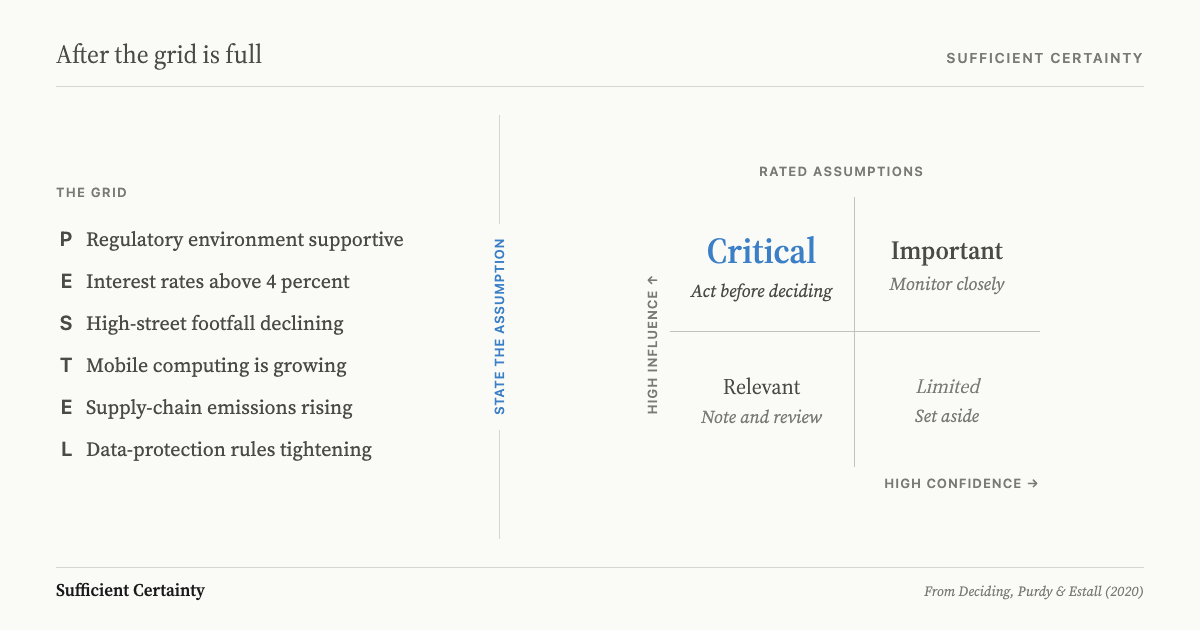
A standard PESTEL analysis also draws no distinction between a fact and an assumption. "Interest rates are at 5.25 percent" is a fact today; "interest rates will remain above 4 percent for the duration of this project" is an assumption about the future. Both sit in the Economic column and look identical on the slide.
The second one could be wrong in ways that break the entire decision, and the grid provides no mechanism for flagging it. I have watched boards approve strategies built on grids like this without anyone testing whether a single entry was fact or assumption.
Once you recognise that the completed grid is a collection of assumptions dressed as observations, the question becomes practical: which assumptions matter, how confident are you in each one, and what would you do differently if any of them turned out to be wrong? The examples in published PESTEL analyses show the same pattern: thorough grids, untested assumptions.
Convert each PESTEL factor into a testable assumption
The step that converts a filed PESTEL into a live decision tool is mechanical: go through the grid factor by factor and, for each entry, write down the assumption your decision depends on. "The regulatory environment is supportive" becomes "we are assuming that the current licensing regime will not change within eighteen months." The second version can be tested, tracked, and acted on if it turns out to be wrong. The first version sits on a slide indefinitely, indistinguishable from every other observation on the page.
Intel is one of the most instructive cases I know of for what happens when this step is skipped. In 2006 the company sold its XScale ARM-based mobile processor division to Marvell for USD 600 million. XScale was generating roughly USD 250 million in annual revenue and powered devices including the BlackBerry 8700.
Intel stated that the sale would allow the company to concentrate on its core business, meaning high-performance x86 processors. Within twelve months, Apple launched the iPhone. ARM-based chips now power virtually every smartphone on the planet; Intel's share of the mobile processor market is zero.
Intel had completed the environmental scan. The company knew mobile computing was growing, because it was already in the mobile chip business. The failure was not in scanning but in the step afterwards: nobody wrote down "x86 will remain the dominant computing architecture" as an assumption to be tested, because it did not feel like an assumption.
Bryce Hoffman observed in Forbes: "None of those assumptions were tested, because none of them felt like assumptions. They felt like reality."
The template Roger Estall and I built for Deciding exists for precisely this reason: for each environmental factor, state the assumption, rate its significance, and record the volatility indicators that would signal the assumption has changed. The situation analysis template provides the column structure for recording each assumption with its significance and volatility ratings.
Convert the PESTEL factor your decision depends on into a testable assumption and rate it before the board meets. Start the Walk →
Rate each assumption before the board acts
Converting factors to assumptions produces a list, and the list will be long because a thorough PESTEL covers dozens of observations. The critical step is distinguishing the assumptions that could determine the outcome from the ones that make no practical difference.
Two questions do the work: how much does this assumption influence whether the decision succeeds, and how confident are you that the assumption holds? Plot the answers and the picture clarifies.
An assumption that carries high influence with low confidence is the one that could sink the decision; it gets tested before anyone commits. An assumption with low influence and high confidence is safe to park.
Wilko, the UK value retailer, is a case I use in workshops because it illustrates what happens when assumptions are never rated. The company collapsed into administration in August 2023 with 400 stores, GBP 1.2 billion in revenue, and 12,500 employees.
Every PESTEL factor relevant to the sector was visible and publicly documented: the cost-of-living crisis was boosting value retail, competitors were relocating to cheaper retail-park sites, e-commerce was expanding, and high-street footfall was declining year on year.
Wilko's direct competitors thrived in the same environment. Home Bargains grew revenue 10.2 percent to GBP 3.8 billion, and B&M grew 8.5 percent to GBP 4.4 billion. The difference was not in the scanning.
Wilko kept 97 percent of its stores on the high street while competitors operated from out-of-town retail parks, and the assumption that the high-street model remained viable for a value retailer was never tested. Had anyone applied the significance matrix, the result would have been unambiguous: high influence on outcome, low confidence in the assumption. That is the Critical quadrant, and it would have forced a decision about location strategy before the losses became terminal.
A full situation analysis connects this kind of assumption-rating to the broader context of the decision.
What the 21 percent do differently
McKinsey surveyed 416 senior executives in late 2024 and found that only 21 percent of strategies passed four or more of their Ten Tests of Strategy. That figure had dropped from 35 percent a decade and a half earlier.
The companies that passed, which McKinsey called Strategy Champions, shared one practice that separated them from everyone else: they documented their assumptions (not the comfortable ones; all of them) and tested them on a six-month cadence. Champions updated milestones and reallocated resources based on what assumption tests revealed. The remaining 79 percent treated strategy as a finished document.
In the organisations I have worked with, the gap between those that convert environmental analysis into decisions and those that file it is never a difference of analytical effort. Most organisations already conduct some form of environmental scan.
What separates the 21 percent is the step after the scan: converting outputs into testable assumptions, rating each one by significance, and reviewing those ratings on a schedule tied to how quickly each factor could change.
The Universal Decision-Making Method structures exactly this conversion; the third step, Recognise assumptions, exists because the space between environmental analysis and a defensible decision is where most strategies quietly fail. Keeping those assumptions under review once the decision is made is a separate discipline, and the guide to keeping a situation analysis useful after approval covers the monitoring side in detail.
If your PESTEL analysis is already done, the work ahead is narrower than it appears, and I can tell you from having guided this conversion hundreds of times that the critical assumptions usually surface within the first hour.
Go through the grid factor by factor; for each entry, write the assumption your decision depends on. Rate each assumption by its influence on the outcome and your confidence that it is correct. Any assumption that lands in the Critical quadrant gets further investigation to raise confidence, or it changes the decision.
That is the step the grid was never built to take, and it is the step that separates a completed PESTEL from a decision the board can defend. If your team uses the PESTLE letter order, what to do after a PESTLE analysis walks through the same conversion.
You could complete every category on the grid and still leave the assumption underneath the decision untested.
Work through your decisionNo sign-up. Just pick your decision and start.
Grant Purdy is the co-author, with Roger Estall, of Deciding (2020), and the architect of the Universal Decision-Making Method.