
A strategy manager sent me a 42-slide deck on a Thursday night. It had six clean columns and a note from the sponsor saying, “Can you redo this as STEEPLED before Monday?” That is usually when people start searching steepled vs pestel.
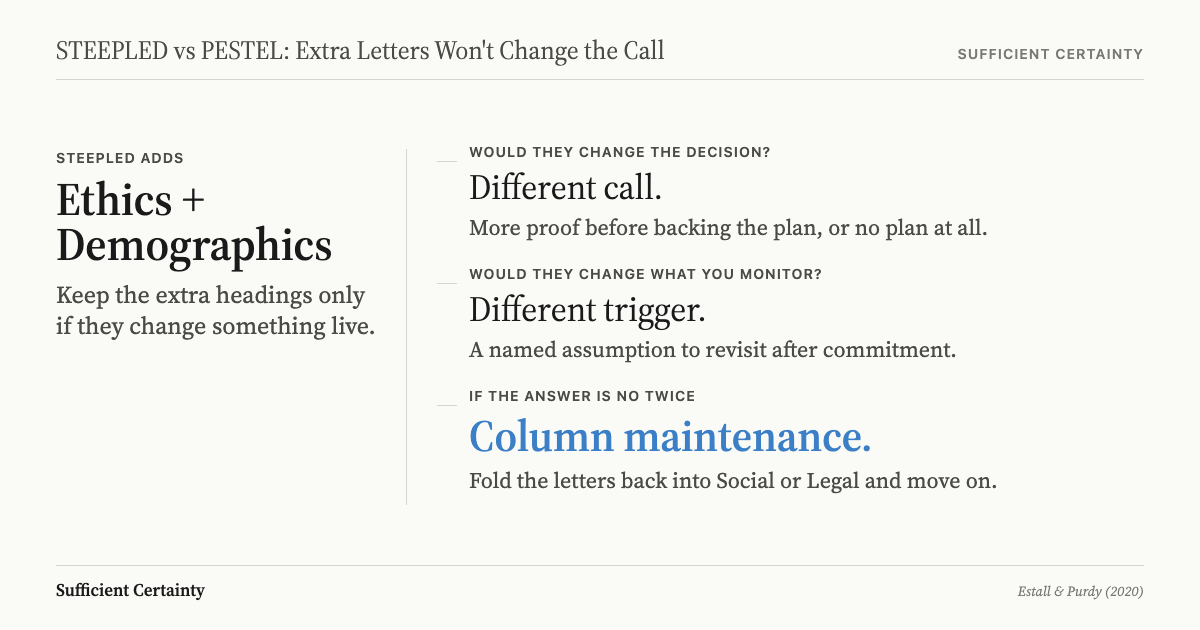
In my experience, the useful answer is plain: keep the extra letters only when ethics or demographics would change the decision or change what you must watch after you commit. If not, you are paying for column maintenance.
STEEPLED vs PESTEL is a choice between two environmental-scanning templates, where STEEPLED separates ethical and demographic factors that PESTEL usually leaves inside broader social or legal analysis.
When STEEPLED vs PESTEL matters
If you need the base scan, start with the main guide to PESTEL analysis. If you need the shorter family tree, I covered that in the piece on the PEST analysis framework. For this decision, the real test is narrower: would a separate Ethics or Demographics column force a different call?
The South African National Treasury treats STEEPLED as early scanning inside supply-market analysis, which is sensible. The headings help you look around before you commit; they do not choose for you. That is why these debates drag on. The sponsor gets diligence theatre without making a call, and the adviser gets to redraw the deck instead of naming the assumption that could still break the plan.
When someone insists the extra headings matter, I ask a Tuesday-morning question: what changes if we use STEEPLED instead of PESTEL? Usually the answer is that the deck gets reshuffled and nobody has to defend the awkward assumption yet. That suits the internal champion who wants a process badge, and it suits the outside adviser who would rather decorate the scan than expose a weak judgement.
The UNDP Foresight Manual puts these frameworks in the same scanning family, and I agree because Demographics usually sits inside Social already while Ethics usually sits inside Social or Legal. When either one would change the plan, I pull it out and record it as an assumption inside the Universal Decision-Making Method. When it would not, I leave it where it is and spare everyone the extra furniture.
I also want a reopening signal. If the ethical issue worsens, or the demographic trend moves faster than expected, I want the team to know exactly which assumption has failed. Most acronym fights never get that far. They stop at the tidy grid, which is perfect for paperwork and useless for a live decision.
Ethics deserves a separate line only when it can stop the plan
Ethics deserves its own heading when the ethical issue can stop the plan outright, or force so much proof that the proposal starts looking shaky. If it cannot do that, it is usually social sentiment or legal exposure wearing a more flattering badge.
Boohoo is the clean example. After allegations about labour abuse in Leicester suppliers, the company commissioned Alison Levitt QC’s independent review. The review said the allegations were substantially true and described severe weaknesses in supply-chain oversight. Later reporting on investor claims said the episode wiped about 40% off Boohoo’s value in July 2020, which The Guardian summarised when the litigation surfaced.
I do not look at that case and think, “If only someone had added an Ethics box.” I think the company lived on an assumption it had no right to trust. If your growth plan depends on suppliers being clean enough to survive scrutiny, record that assumption and demand proof before you trust it. Without that discipline, STEEPLED just gives the sponsor another page to wave around, and the consultant another excuse to sell box-filling as governance.
I see the same trick in bad SWOT analysis. The artefact looks busy, so people pretend the judgement happened somewhere else, when somebody still has to say in plain language what must be true for the plan to work.
Name the one external factor that would change your recommendation, whichever set of headings you scanned under. Start the Walk →
Demographics deserves its own line only when it moves demand or labour
Demographics deserves separate treatment when demographic change would shift demand or labour enough to alter the decision. If it will not, the extra D is mostly a relabelled Social column with better stationery.
The strongest case for splitting it out comes from the McKinsey Global Institute’s 2025 work on demographic change. It says the ratio of prime-working-age people to those aged 65 and over fell from 7.4 in 1997 to 4.0 in 2023 and is projected to fall to 2.4 by 2050. It also says people aged 60 and over are likely to drive about half of urban consumption growth in advanced economies and China. For care demand or workforce supply, that is decisive, not decorative.
If you are pricing for older customers, or relying on a workforce that is already hard to hire, those numbers are not background context. They hit revenue and staffing directly, and in that kind of decision Demographics is the hinge the whole plan swings on.
If I were deciding on a care-services expansion or a regional workforce plan, I would break Demographics out at once. I would state the assumption in ordinary words and set the condition that would make me revisit it. If I were deciding on a short-run supplier switch for industrial fasteners, I probably would not. In that case Demographics stays inside Social unless it starts moving price or availability.
I am not interested in giving every context factor equal status just because someone mentioned it in a workshop. If you need to think further ahead, scenario planning can help. A live decision still needs a sharper filter than “we covered it on slide 18.”
How I settle STEEPLED vs PESTEL for this decision
I settle it with two blunt questions. If Ethics or Demographics turned out differently from what we assume, would we choose a different course? If yes, how much proof do we need before we back the plan?
Roger Estall and I built this habit while writing Deciding, because ordinary scanning kept flattering people. A neat grid made them feel industrious while the live assumption sat there untouched. That is why steepled vs pestel is usually the wrong argument. The real argument is about which assumption can still sink the decision, and who is hoping nobody names it. In market-entry work, that often means saying which economic factors could kill the entry before the acronym debate earns another slide.
The academic version of the same point appears in Garnett and his co-authors’ 2016 paper in Trends in Ecology & Evolution. They had to add a separate weight-of-evidence layer because scanning on its own did not connect cleanly to credible policy choices. If the list needs a second method to rank it, the list was never the decision.
Once the assumption is named, the next move is practical. Either gather more information now, or proceed and monitor the assumption like an adult instead of treating it like workshop wallpaper. Arguing about one more letter is cheaper than either, which is why so many organisations keep doing it.
So my answer is simple. If the extra heading changes the decision, or changes how much proof the room needs, keep it. If it changes nothing, collapse it back into the main category and move on. STEEPLED vs PESTEL matters only when the extra letters make you confront an assumption that somebody, usually a cautious sponsor or a comfortable adviser, would rather leave blurry.
You could spend the weekend redrawing six columns into eight and still owe the same answer.
Work through your decisionNo sign-up. Just pick your decision and start.
Grant Purdy is the co-author, with Roger Estall, of Deciding (2020), and the architect of the Universal Decision-Making Method.