
A situation analysis example teaches something only when it shows the assumption that broke. Most published examples stop at tidy categories. Four real failures show how a respectable analysis can still miss the single assumption carrying the entire recommendation, because the grid never asked for it.
A situation analysis example teaches nothing unless it shows what the analysis changed about the decision. Most display tidy grids without explaining which assumption the grid tested, what the decider learned, or what monitoring followed. An example that only demonstrates format is a template, not a case. A useful example shows the decision and the assumption behind it.
When someone asks me for a situation analysis example, I assume a deadline is involved. A manager has been told to write "situation analysis" above a section of a plan. They open the search results and find neat grids and borrowed headings, with the quiet suggestion that once the boxes are full the thinking is finished.
That suggestion is convenient, which is why it survives. The sponsor who commissioned the work gets cover, and the consultant gets something respectable to hand over. Somewhere a template vendor counts another download, which is about as close as a grid usually gets to evidence.
The Decider gets the bill. That is the small awkwardness missing from most examples. The person who has to sign the recommendation needs to know which belief is carrying it, not merely that the paper has achieved symmetry.
The four cases below are not cautionary wallpaper. They are public reminders that large organisations often have plenty of paper before they make an expensive mess. Tesco exited the United States with a £1.2 billion hit. Quibi raised $1.75 billion and shut within months. Amazon wrote down unsold Fire Phones. Ford researched a market that had moved by the time the Edsel arrived.
Good research should be able to bite. If a finding could never change the recommendation, it is decoration, and decoration should not be allowed to invoice by the day. Anyone can fill a box. The test is whether the box can push back before the room spends real money and reputation on it in public.
The broader guide to situation analysis is elsewhere. This piece has one job: show the point at which analysis stops being a document and starts justifying a decision.
A situation analysis example is a worked case showing how facts and assumptions led to a recommendation, and which signal would stop or reopen it.
What a Situation Analysis Example Should Show
A proper situation analysis example keeps the decision in the centre. A blank situation analysis template cannot do that work for you. It should show the sentence that could have killed the recommendation. If it cannot show that sentence, it is just a decorated conclusion.
In Deciding, Roger Estall and I put the decision first in the Universal Decision-Making Method because context belongs to this decision, not to the organisation at large. If you need permission to bless an answer already chosen, the internet has no shortage of stationery.
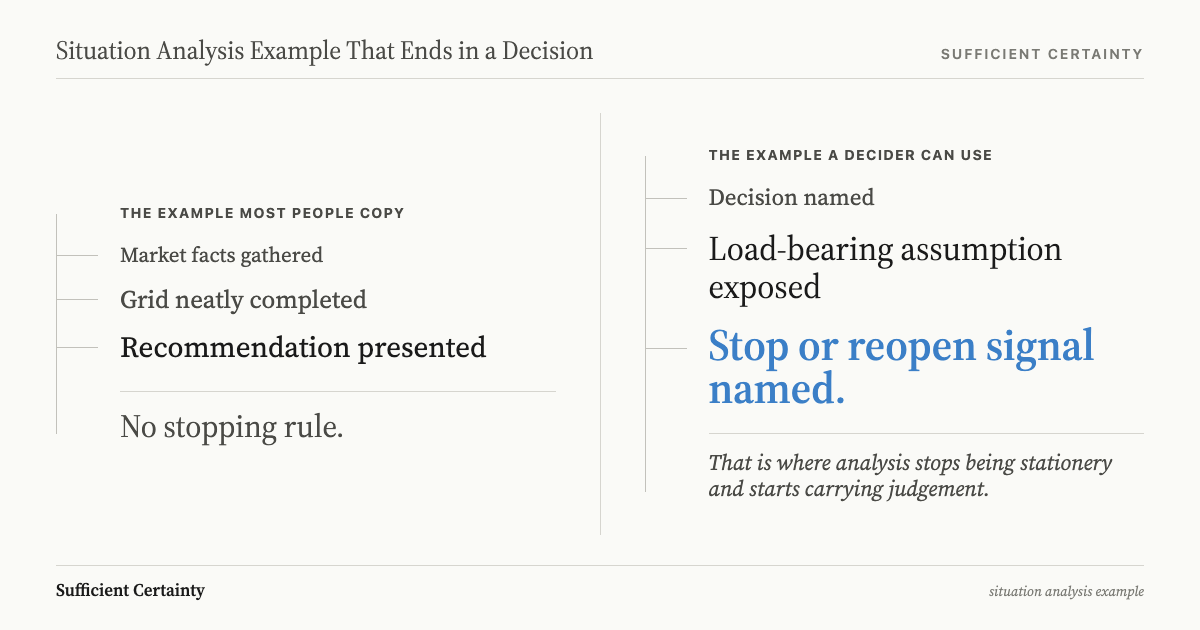
A finished situation analysis example should make that handoff visible: the decision in view, the context being relied on, and the load-bearing assumption together with the evidence that would make commitment justified or foolish.
The format below is deliberately severe. It has no room for the comforting essay about trends. It asks one nasty question per case: which observed condition was being asked to carry more weight than it deserved?
| Case | Decision | Apparent context | Hidden assumption | Stop or reopen signal |
|---|---|---|---|---|
| Tesco | Build a US grocery chain from scratch | A gap in American convenience retail | British shopping habits would travel | Basket size and repeat visits in the first stores |
| Quibi | Fund a mobile-first premium video service | Commuters with short attention and good phones | People wanted studio drama in ten-minute pieces | Retention past the free trial |
| Fire Phone | Enter the smartphone market | Amazon could build the hardware and the store | Capability would create demand | Sell-through at full price before the discount |
| Edsel | Launch a new mid-price car division | A prosperous middle market moving upmarket | The research still described the buyer | Mid-price segment share as the launch date neared |
Tesco Is a Situation Analysis Example Without a Stopping Rule
Tesco's Fresh & Easy exit is the cleanest public case I know for testing market-entry assumptions without pretending I have read Tesco's board papers. In its 2012/13 preliminary results, Tesco said the US business would be treated as a discontinued operation and put the total impact at £1.2 billion after tax. The public result cannot prove what the internal analysis said, but it shows the bet that failed.
Decision: enter and scale a US convenience grocery business.
Apparent context: a large grocery market and a company with proven retail discipline.
Hidden assumption: enough American shoppers would adopt the Fresh & Easy format often enough for the model to work.
Stopping signal: early store economics showing that customer habits were not bending toward the format, rather than ordinary launch losses.
The useful question is not whether Tesco knew retail. Of course it did. The useful question is whether the chosen locations and shopping pattern were proving the specific bet. A thicker market-entry pack would not have saved the decision; the choice of SWOT or PESTEL for a market-entry decision would not have answered it either. A named rollout threshold might have.
This is the kind of line a committee dislikes because it removes the fog. Once the threshold is written down, "early days" stops being a magic phrase. The decision has to earn its next tranche of money.
Stress-test your own situation analysis against a dated assumption and see whether the recommendation still has a stopping rule. Start the Walk →
Quibi Looked Like a Situation Analysis Example Until the Customer Appeared
CNBC reported that Quibi had raised $1.75 billion before launch, projected more than 7 million subscribers after year one, and had about 500,000 subscribers only weeks before shutdown. It is hard to imagine a more respectable-looking pile of context. Mobile video was growing. Streaming subscriptions were familiar. Famous people were attached, which is often mistaken for evidence by people who should know better.
Decision: launch a paid, mobile-only short-video service.
Apparent context: people watched video on phones, and subscription entertainment had become normal.
Hidden assumption: viewers would pay for short-form mobile video when free short video already existed and televisions had not resigned.
Stopping signal: subscriber conversion and daily use showing that the product was not a new category, but an awkward paid version of behaviour already served elsewhere.
Quibi's failure is useful because it exposes the politeness of bad analysis. No one wants to write "people may admire the founders and still refuse the product" in a launch paper. It sounds rude. It is also the sentence that would have mattered.
The analysis did not need another slide about mobile behaviour. It needed a mean little test of willingness to pay. If the answer was weak, the glamorous context was merely decoration around a bad offer.
The Fire Phone Shows Capability Is Not Demand
Amazon's own third-quarter 2014 release disclosed a $544 million operating loss, and reporting in The Guardian tied a $170 million write-off to unsold Fire Phones. Amazon could make and sell a phone, but the decision rested on whether buyers would switch.
Decision: enter the smartphone market with Fire Phone.
Apparent context: Amazon had loyal customers and a powerful retail ecosystem.
Hidden assumption: retail loyalty would overcome existing phone platforms and their switching costs.
Stopping signal: evidence that customers wanted an Amazon phone enough to leave their existing platform, not merely that Amazon customers liked Amazon.
The badge says data-driven. Too often it means the team measured its own capability and forgot to measure the buyer's willingness to move. Capability is comforting because it lives inside the organisation. Demand has the bad manners to live outside it.
This is why "we can build it" is such a dangerous sentence. It feels operational, so it sounds adult. It does not answer the customer question. In this case, the customer question was the whole case.
The Edsel Shows Why Context Needs a Date
The Edsel has the shelf-life problem written all over it. Time reported that Ford introduced the car in September 1957, dropped it in November 1959, and spent $250 million on development and launch costs. Ford was not wrong to study the medium-price segment. It was wrong to treat the study as if the segment owed Ford its continued existence.
Decision: launch a new medium-priced car line.
Apparent context: research pointed to a market segment large enough to justify a new model.
Hidden assumption: the segment would still be attractive when the car reached showrooms.
Reopening signal: changing household budgets and demand for smaller cars showing that the original context was ageing faster than the program.
This is why I insist that context be dated. A situation can be accurate and still expire. Without a monitoring trigger, the minutes can pretend time has signed the paper too.
A date is not clerical fussiness. It is a warning label. Anyone reading the paper later should be able to ask whether the market still resembles the one the Deciders relied on, or whether the decision is now defending a vanished world.
In each case, the useful example is not the market summary. It is the missing sentence: the condition that would have stopped the commitment or reopened it sooner. That is the part most completed templates politely avoid, because it gives the Decider a reason to say no. A gap analysis grid has the same defect: it covers the fix but not the cost of leaving the gap open.
A finished situation analysis example does not need more categories. It needs plain sentences. Name the decision, the context you are relying on, and the assumption carrying the recommendation. Then name the signal that would make you stop defending it. The sequence in how to do a situation analysis only earns its keep if it keeps dragging the paper back to that last sentence.
That last sentence is the nuisance. It gives the sponsor less room to hide. It gives the committee less room to confuse attendance with judgement. The consultant can still varnish the deck, but everyone can now see where the load-bearing beam is supposed to be.
If the example cannot show that handoff from analysis to commitment, it is only another handsome way of avoiding the decision until the bill arrives in public.
You could copy a polished example and still have nobody able to say stop.
Work through your decisionNo sign-up. Just pick your decision and start.
Grant Purdy is the co-author, with Roger Estall, of Deciding (2020), and the architect of the Universal Decision-Making Method.