
Sunk cost theory explains why past spending keeps pulling decisions forward. Thaler named it. Arkes and Blumer tested it. Staw described the escalation. What no theory provides is a practical test for when to stop. That test has to come from the decision process, not from the academic literature.
I have sat in too many meetings where sunk cost theory arrived dressed as due diligence. Someone cites Richard Thaler. Someone else mentions escalation of commitment. A consultant calls the persistence understandable, the sponsor nods, and half the table behaves as if diagnosis itself were progress. Then the same room still has to answer whether to pour more money into a program that has already missed its case. No one wants to say the obvious thing: the past is gone and the future case is weak.
I am not trying to restate the full anatomy of the sunk cost fallacy. I am after the narrower failure. A committee can cite the literature accurately and still use it as cover for one more tranche and one more heroic promise that the original case will somehow come good. In my experience, that suits the sponsor who approved the first spend and the adviser who would rather sell recovery than closure.
Sunk cost theory is the idea that people keep investing because of money, time, or effort already spent, even when the future case no longer justifies continuation.
What sunk cost theory actually says
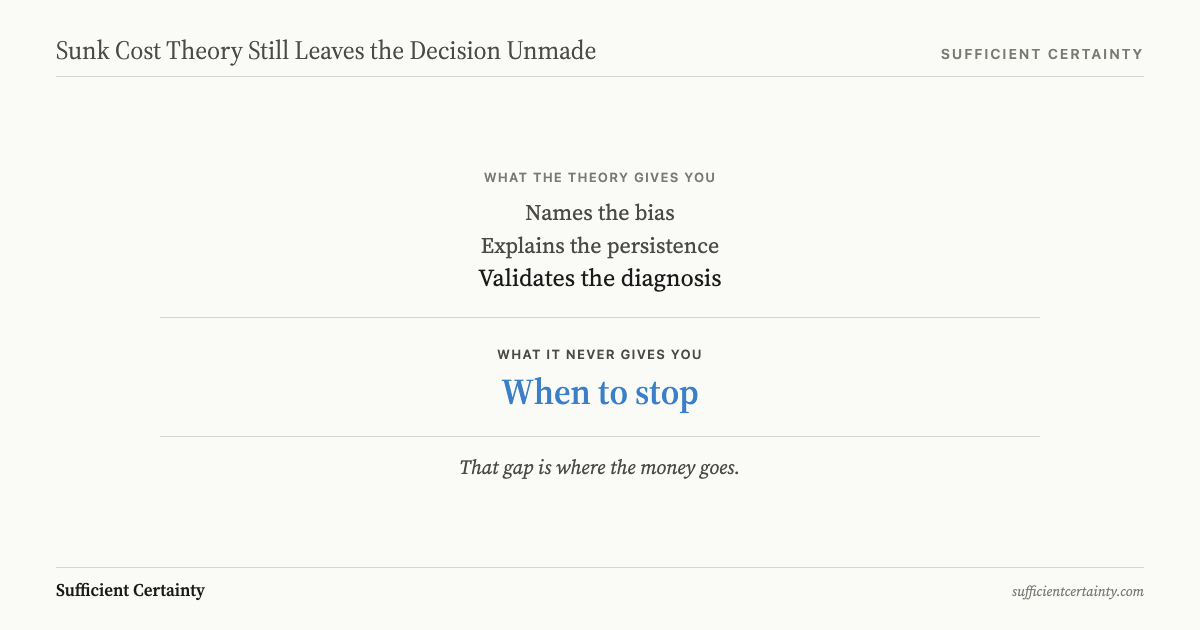
This literature describes persistence, not decisions. In Thaler's 1980 paper, sunk costs sit beside inertia and neglected opportunity costs as proof that tidy rational-choice stories do not describe how people behave. In his 2001 study, Dilip Soman showed that sunk time does not pull like sunk money unless people account for time as if it were cash. I am happy to grant both points. The room still cannot answer the live question: should we continue from here? That gap is useful to anyone hoping yesterday's approval will carry today's budget, and the sunk cost fallacy examples I have documented from Concorde to Enron show how persistently boards fall into it.
| What the theory says | What it explains | What the Decider still has to ask |
|---|---|---|
| Past spend has psychological pull | Why stopping feels like wasting the original investment | Would we fund the next tranche if none of the old spend existed? |
| Escalation protects reputation | Why sponsors defend a weak course after bad news arrives | Who benefits if continuation stays the default? |
| Loss framing changes risk appetite | Why people gamble to avoid admitting a loss | Which future cost is real, and which is only pride? |
Why sunk cost theory grew into escalation of commitment
Brockner's 1992 review moved the problem out of theatre tickets and into organisations. Self-justification matters once bad news arrives. Of course it does. I have watched sponsors defend a program long after the future case died, because admitting the first decision was weak felt worse than wasting the next tranche. The description is sound. The decision is still unmade, and that suits the managers whose jobs depend on the program continuing.
Matthias Guenzel's 2025 field study showed the same pull in corporate investment. Across 558 completed mergers, higher acquisition cost reduced the rate of later divestiture by about 8 to 9 percent, especially when the chief executive who did the deal stayed in office. I do not need a seminar to decode that. The asset is being judged inside somebody's biography, not on what it is worth now. The board inherits the vanity bill. The same pull runs through retail portfolios, where sunk cost fallacy investing locks the exit to the buy price instead of a forward case.
Put your current funding call through the five steps and see whether past spend is distorting what still counts as evidence. Start the Walk →
Why sunk cost theory still leaves the live decision unmade
The 2015 meta-analysis by Roth, Robbert, and Straus covered 98 effect sizes and found the sunk-cost effect was consistent across the literature. We know the pattern is real. We still do not know, from sunk cost theory alone, whether the next spend improves the future, what assumption must hold, or who is smuggling past expenditure into the paper as if it were evidence. That uncertainty is rather convenient for people who prefer diagnosis to decision.
In a 2021 incentivised experiment, David Ronayne, Daniel Sgroi, and David Tuckwell found that 23 percent of participants stuck with a dominated lottery after earning it through real effort, and simple ownership explained only about a third of that behaviour. Awareness does not rescue the decision. People can recognise the trap and still pay for it. That is why sunk cost bias survives training sessions and clever labels.
In my experience, the people happiest with that ambiguity are not the Deciders. They are the advisers billing to rescue the program and the managers whose jobs depend on it continuing. If the problem stays framed as a subtle quirk of human judgement, nobody has to say the blunt thing: the future case is gone. The sponsor keeps cover and the committee keeps spending.
A board paper built on theory still fails in the same dull way. It can tell me why people hate abandoning effort. It cannot tell me which option now serves the Purpose better, or what evidence would justify another quarter of spend. That blank space is where bad governance lives. The board thinks it has been informed. In truth it has merely been warned.
What sunk cost analysis looks like when the room has to decide
Useful sunk cost analysis starts by banning prior spend from the evidence column. I start with Purpose inside Frame the decision: what is the organisation trying to achieve now? One chair told me I was slowing the room down. What he meant was that I would not let yesterday's spend masquerade as evidence.
Then I make the continuation case speak plain English. If someone says we have come too far to stop, I rewrite it as an assumption: continuing from here will produce a better result than stopping now. That is the discipline I set out in sunk cost and decision making, and it sits inside the Universal Decision-Making Method because Recognise assumptions is where rhetoric loses its costume.
I do not let anyone hide inside verbs like support or maintain. I ask what continuation is expected to achieve, by when, and against which alternative. Most rescue papers go limp at that point. Their certainty is rhetorical and their evidence is historical. The beneficiaries are sitting at the table.
Sometimes leaving really does create a new future cost. I once worked on a plant system change where stopping mid-cutover would have meant buying temporary controls, retraining operators, and taking a second outage six months later. Fine, price that. If leaving now creates a new cost, price it. If the argument is only wounded pride, kill it. That is the distinction behind the sunk cost fallacy is not always a fallacy.
Roger Estall and I wrote Deciding because theory never stopped one of these meetings. I want the assumption, the trigger, and the owner. If continuation depends on a forecast, name it. If we must reopen the decision later, name what would trigger that. Without that, sponsors keep their cover and committees keep spending. That is the only part that bites.
You could explain sunk cost perfectly and still approve another weak tranche.
Work through your decisionNo sign-up. Just pick your decision and start.
Grant Purdy is the co-author, with Roger Estall, of Deciding (2020), and the architect of the Universal Decision-Making Method.