
After a 5 Whys analysis, the step before choosing corrective action is to write the evidence supporting each arrow between answers. A completed worksheet can reach the approval meeting with five answers and no supporting records beside them. Keep that worksheet open while checking what each answer actually establishes.
A 5 Whys analysis uses repeated “why” questions to trace a problem through proposed causes toward an underlying explanation.
Check the arrows before assigning corrective action
The usual next step is to turn the final answer into an action. Someone owns the change, and a deadline appears beside it. That sequence gives the discussion a practical destination. It also creates a point where the team must distinguish a plausible explanation from a supported cause.
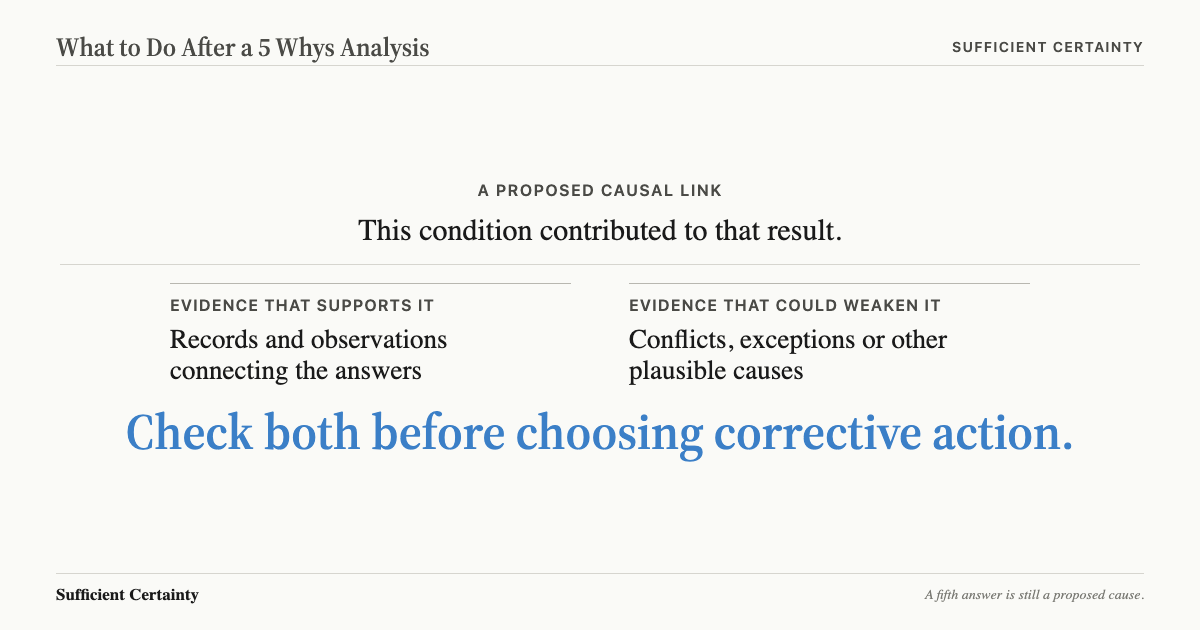
Start with the worksheet already produced. Read each pair of answers as a claim: this condition contributed to that result. Beside each arrow, identify the record or observation that supports the connection. A dated system log might establish when something happened. An interview might explain what someone understood at the time. Neither automatically proves the other.
Keep missing evidence visible. If the team has only an opinion, write “not yet checked” beside that arrow. If two accounts disagree, record the disagreement rather than choosing the account that fits the last answer. The approval meeting then has a specific question to resolve.
Where records allow, compare occasions when the proposed condition existed without the problem occurring. A difference in those occasions may reveal a missing condition. It may also show that the answer is too broad. Record that limitation beside the arrow, even if the final cause still seems likely.
The arrow needs evidence as well as an answer. This is especially important when the final answer becomes a familiar label such as “insufficient training”. Which knowledge was missing? How did that gap affect the event? Would the proposed training change the relevant behavior under the same working conditions?
OSHA’s incident investigation guidance warns against concluding that carelessness or failure to follow a procedure alone caused an incident. It asks investigators to examine underlying conditions. Treat that as a reason to inspect the explanation, rather than replace one blame label with a more acceptable one.
The immediate output is an annotated worksheet. It shows which causal connections are supported and which still need checking. This makes the next discussion narrower than a fresh investigation meeting. It also applies the distinction in evidence-based decision-making: the evidence must support the decision actually being made.
Check the causal claim before committing to its remedy.
Five answers make the explanation easier to inspect
Repeated questioning has a useful discipline. It asks the team to explain the answer above instead of stopping at the first visible problem. A written sequence lets someone outside the discussion see how the team reached its conclusion. That person can challenge a specific connection instead of rejecting the whole analysis.
ASQ’s guidance on five whys says that reaching an underlying cause can take fewer or more than five questions. The number is a prompt to continue questioning. It does not establish when evidence is sufficient. Filling the fifth line therefore cannot serve as the approval condition for a corrective action.
Consider a hypothetical office example. A report was late, and the worksheet links that delay to unavailable source data. Before buying software, check whether the data was absent or whether access arrived too late. Those are different claims. They can require different changes even when the report looks identical at the end.
A precise claim makes a useful check possible. “The process failed” leaves too much open. “The reviewer received the file after the submission deadline” identifies something records can confirm or contradict. The next question concerns why that timing occurred, including conditions the current chain may have missed.
The worksheet remains useful when a connection fails this check. It identifies where further work belongs. As with a fishbone diagram, recording a possible cause gives the investigation a lead. It does not convert that lead into a finding.
The fifth answer remains a proposed causal claim. Use the wider strategic problem-solving discussion to keep the purpose of the change visible. The objective is to reduce the relevant problem, rather than defend the worksheet.
Use The Walk to check the causal assumption behind your proposed corrective action before approving the change. Start the Walk →
What did the MGPI investigation actually establish?
On 21 October 2016, a chemical delivery at MGPI Processing in Atchison, Kansas, entered the wrong tank. Sulfuric acid mixed with sodium hypochlorite, producing a toxic cloud containing chlorine and other compounds. More than 140 people sought medical attention. The Chemical Safety Board’s January 2018 release describes the event and its investigation.
The driver connected to the wrong fill line. But the investigation examined conditions around that action. The two lines were close together and looked similar. They lacked clear markings at their connection points. The wrong line was also accessible. These findings directed attention to the equipment and working conditions as well as the connection itself.
The CSB case study provides a particularly useful distinction. A missing split ring prevented the wrong line’s cap from being secured. Investigators also examined identical padlocks, which allowed one key to open different locks. They identified that arrangement as a potential problem but explicitly found it was not causal in this incident.
That distinction matters after 5 Whys. Finding a defect near an event does not establish that the defect caused the event. The identical locks warranted attention, yet they could not simply be inserted into this event’s explanation. A possible hazard and an established cause are different findings.
The report also found that unloading procedures and actual work practices differed. Its analysis covered human factors and emergency safeguards. Appendix A presents a simplified logic tree with multiple contributing conditions. A single downward chain would have to make room for those branches rather than force them into one sequence.
There is no evidence here that MGPI or the CSB used 5 Whys. This case illustrates the evidence needed to examine causal claims. It is not a reported failure of that technique. The disputed accounts of whether the operator pointed out the correct line also show why an investigator must preserve uncertainty instead of smoothing the narrative.
A causal chain must change when the findings require it. The lesson is to distinguish supported connections from nearby concerns. General complex problem-solving can require several interacting conditions. Completing five questions does not remove that possibility.
From a plausible cause to a justified change
Return to the annotated worksheet before approving the corrective action. Focus first on the connection that most affects the proposed change. If that connection is wrong, would the action still reduce the problem? If the answer is unclear, identify the smallest useful evidence review before spending money or changing the process.
Give that review a named owner and a due date. State which record must be examined and which decision its result will inform. This keeps “collect more evidence” from becoming an open task with no clear effect on the proposed action.
For each important connection, state what finding would weaken it. In the hypothetical late-report example, evidence that the data arrived on time would weaken “unavailable data caused the delay”. It would redirect attention to access or subsequent work. Do not ask only for more examples supporting the explanation already selected.
What evidence would show that this arrow is wrong?
The review need not become an endless search for certainty. Match it to the consequence of choosing the wrong action. An easily reversed office change may justify a limited trial. A safety-critical change requires appropriate specialist review and stronger support. Hazardous events must not be recreated to test a worksheet.
Test the assumption that makes the action worth choosing. The Universal Decision-Making Method connects that check to the purpose of the decision and the certainty needed to act. The relevant assumptions in decision-making include both the cause proposed and the expected effect of the remedy.
Record why the action should affect the supported cause. Assign an owner to check its result under relevant conditions. Specify what finding would reopen the decision. No repeated incident is encouraging, but quiet weeks alone may say little if the conditions that exposed the problem have not returned.
Keep the worksheet with its evidence notes when the action is approved. Later reviewers should see what was known and what remained uncertain. The approval should rest on checked connections. That gives the team a reason for the change it can revisit when fresh evidence arrives.
A fifth why names a proposed cause; The Walk helps you decide whether its evidence is sufficient to act.
Work through your decisionNo sign-up. Just pick your decision and start.
Grant Purdy is the co-author, with Roger Estall, of Deciding (2020), and the architect of the Universal Decision-Making Method.